Erie Tribs Steelhead Report, Nov 5: Of technical fishing, lockjaw, and persistence

In the UK, they celebrate November 5th — Guy Fawkes Day — with fireworks. In western PA, the day wasn’t nearly as explosive. Low, clear water; the approaching cold front lockjaw syndrome; wind and leaves; and the need for highly technical presentations were all formidable obstacles. But I can be the kind of angler who likes a challenge, even more so when I know the fish are there.

We fished Elk Creek, and the good news/bad news was significantly more water than this time last year, but far fewer fish. Places last year where the steelhead were wedged in like sardines were this year distressingly empty. Low, clear flows on these creeks require a certain level of stealth, and technical casts and drifts. To get dour, on-high-alert steelhead to eat, you’ve got to nail a perfect cast, then make all kinds of technical mends to keep the fly on target. Weight and indicator adjustments are a constant dance you perform until the judges tell you that you’ve got it right.

The first fish in the hoop is always a relief. I’ve been known to say that all I need is one steelhead to make me happy, and on most days that’s true. I had seven eats in the first three hours, and sealed the deal on three. Not a great batting average, but I did have some bad luck in the form of a snapped tippet, and another that mysteriously wriggled off after I slammed it with a powerful hookset. Blood Dot eggs, size 14, were the menu item of choice. By late morning, we decided to take a break and seek our pleasures elsewhere.

We did a bit of walking to try to get away from other anglers, but the story on new ground was the same: low, clear flows, leaves, and precious few fish that we could see. We finally located a pod of about a dozen fish, but in addition to the previously mentioned lockjaw, these steelhead seemed more interested in canoodling than eating. Two darker alpha males set the tone in the pool, chasing fish away from their lies, with the pod constantly shifting position after their antics.

Then, the rains came. This was a boon to the bite; the fouler the weather, the more takes. When bite windows open, you’ve got to jump on them, and so we did. I had one epic eat from a fish that was part of pod hiding under a ledge. The presentation was tricky. I had to cast into the main current, then drag the flies toward the ledge in front of me, resume dead drift, and hope the team of two would pass through the strike zone unimpeded by the edge of the shale barrier. As the flies moved into position, I had to switch to a quasi tight-line presentation. Of the dozens of attempts I made throughout the afternoon, one worked. That was my favorite fish of the day.
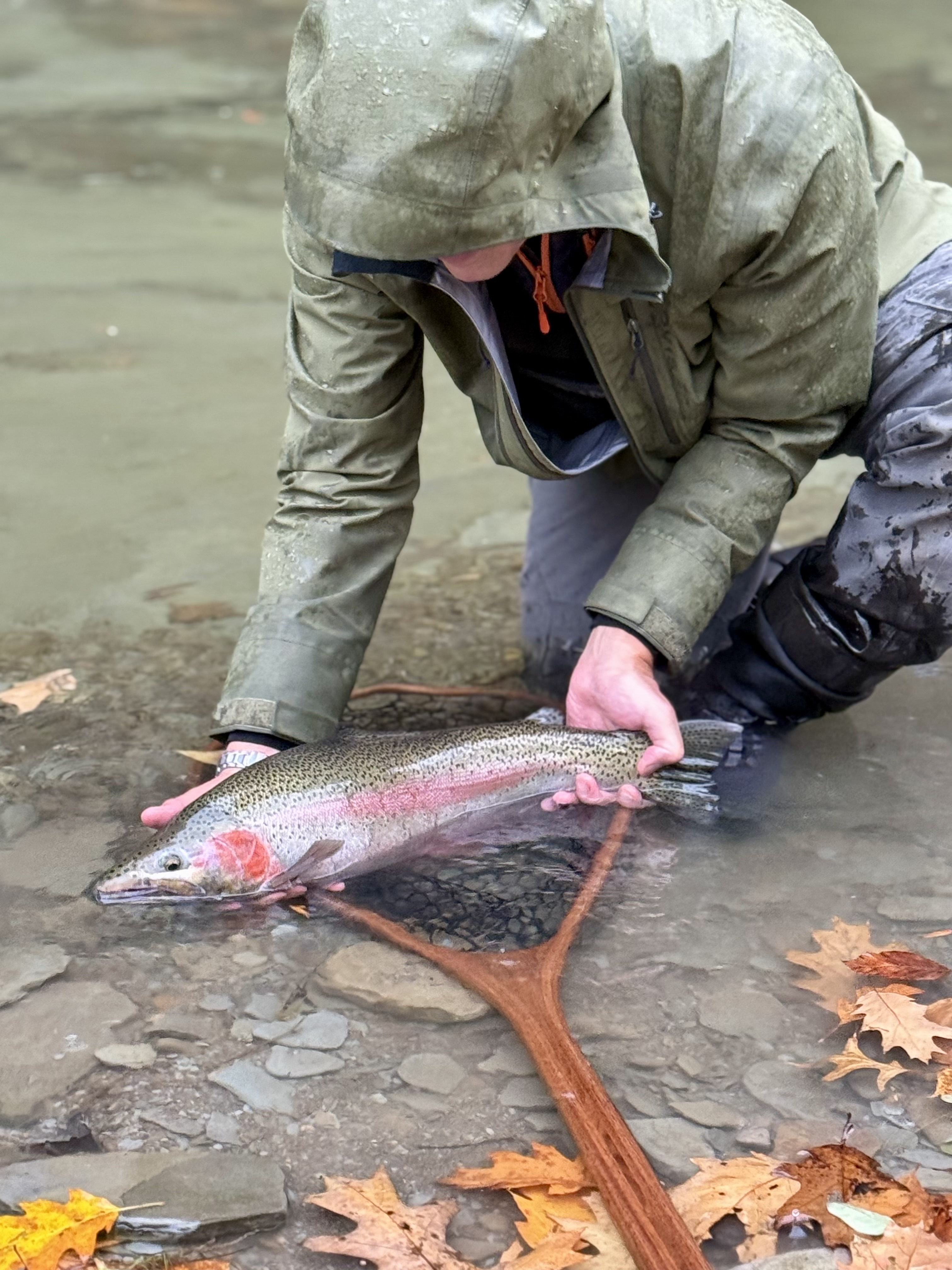
One of the alpha males that — finally! — made a mistake. Guy’s got some shoulders, and clearly, he’s been in the system for a few weeks. I lost a substantial chrome hen to a hysterical display of leaps and rolls. When I stuck the hookset, she bolted upstream like a dragster coming off the line. One, two, then three spectacular leaps worthy of a tarpon had us cackling with delight. She made a beeline for a shale ledge and rolled, then did it again, and on the second one she spit the hook. What tremendous sport! I finished the day with nine to hand, which I considered a major victory given the conditions. Yup. I love steelheading.

‘Tis the Season…for Steelhead. (And other musings on rigging for the Erie tribs)

I spent a few hours the last few days restocking my steelhead boxes, mostly egg patterns. But I did whip up a batch of White Death Zonkers as well. (What an appropriate name on Halloween!) I also tied a few new patterns, because I like to occasionally experiment with flies and steelhead and conditions. It’s a never-ending project, and while I’ve made huge strides in the last five years toward mastering that fish, steelhead remain wonderfully enigmatic and fickle and subject to the whims and caprices of nature.

First up this year will be the Erie tribs. On that fishery, I use a different leader system than I use in Ontario tribs. I learned it from steelhead guide extraordinaire Bob Packey. The butt of the leader is a 9-foot stepped down taper: 4′ of 20lb., 3′ of 17lb., then 2′ of 12lb., terminating in a power swivel. I use clear Stren nylon for the butt. From there, it’s tippet, typically 6lb. fluorocarbon, 12″-18″ to the first fly (you can fish two flies in PA and OH), then about 16″ of tippet tied from the bend of the top fly, terminating in the point fly. Steelhead fly fishing is one of the few instances where I’ll use fluorocarbon.

If you don’t have this book, you should.

Your shot goes on the butt section just above the power swivel. In normal-to-higher flows, the top fly is typically a brass bead head. In low-to-trickle flows, I may not use any weight, and both flies will be unweighted and sparse. I like wingless shot. I struggle with seeing white and certain shades of orange, so my indicator must be bright or fluorescent yellow. Missed takes are missed fish! If I can, I like to use my own yarn indicators. In base flows, conditions dictate that I use one of those foam tab indicators.

The vast majority of hookups come on the point fly, so that’s typically my high-confidence pattern of the moment. Blood Dot Eggs in egg with an apricot supreme dot are a favorite, along with White Death Zonkers if the flows are good. You can see more on “Building a more Erie tribs-Appropriate Fly Box.”

Steelhead fly fishing is one of those endeavors where you can do everything right and still have things go wrong. However, the more things you do right, the more you tend to have success. Confidence catches fish, and having a proven leader system takes rigging guesswork out of the equation. Fish on!

November Erie and Pulaski Steel Reports

I realize I’m squarely in the better-late-than- space. So rather than blather, let’s get to it.

We start with a brief PA Erie tribs sortie in mid-November. The water was painfully low, and that made fishing extremely challenging, especially in the public water sections of Elk Creek. I did one day on private water (with a dabble in public), and then a half day on public water.

Harsh conditions. They’ve gotten ridiculous rain and snow since then, so where I’m standing is probably up to my chest! The fish were on high alert — we saw raptors everywhere and several fish with bird attack wounds. If the water had a flat surface and you were in the fish’s vision cone, they generally wanted nothing to do with your offerings. Even in the bigger, deeper pools that held a hundred steelhead, virtually every drift went ignored. With little-to-no current it was difficult to even get a drift. You had to make ultra-precise casts to get them to eat.
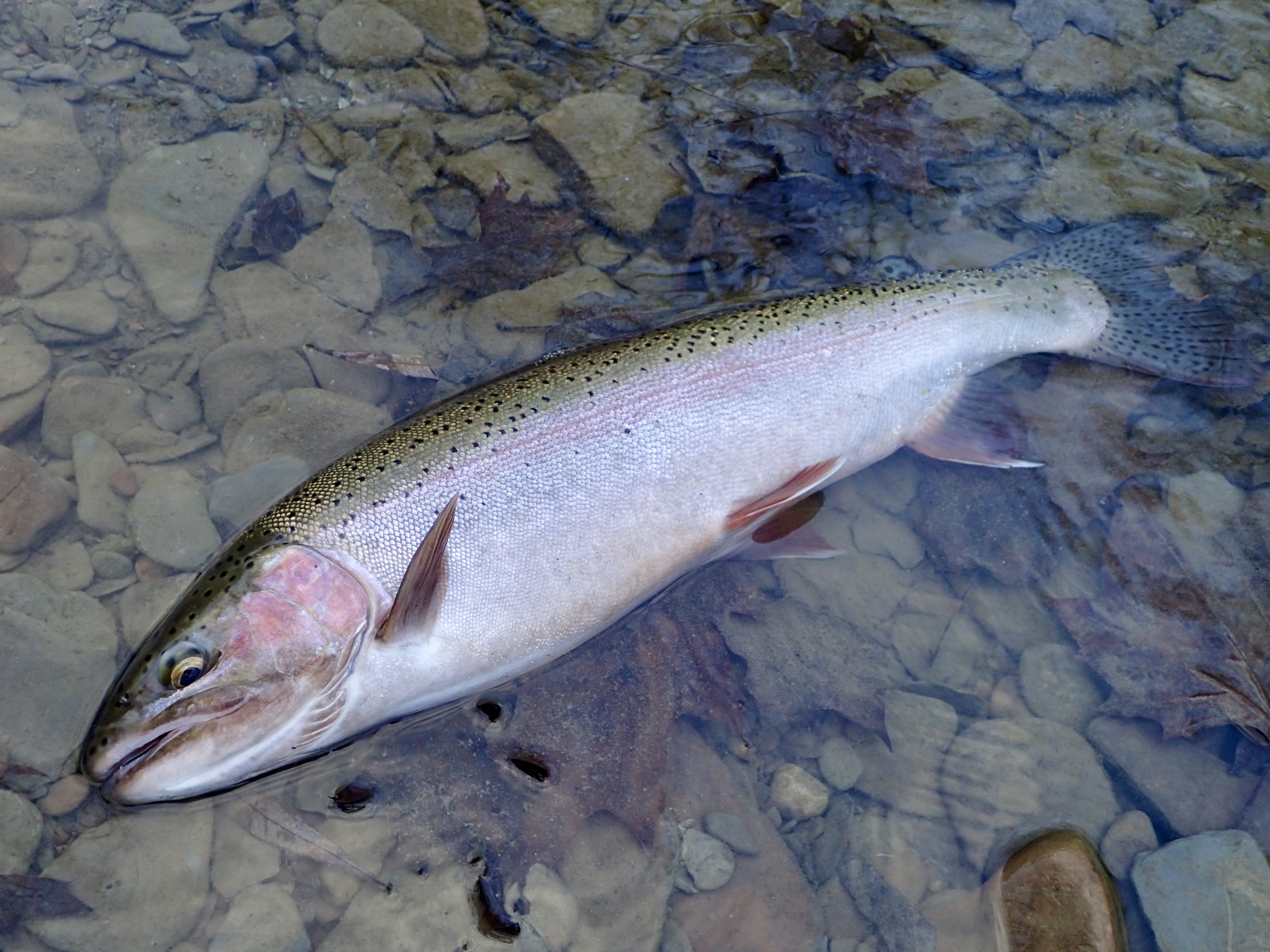
I had my greatest success targeting fish that held in the shallow broken water of dump-ins and pockets. One such spot produced two steelhead. Here’s one of them. We fished Blood Dot eggs, White Death Zonkers, and pink Squirmy Worms, and the Blood Dot was the overwhelming favorite. Since you can fish two flies in PA, all of the flies were dropped off an another Blood Dot. This was the first time I’ve ever fished for steelhead without any weight. I also tried a new tactic to get my flies into the lane: as soon as the flies hit the water, I dragged them as needed to move them into position. Success!
I finished the first day in public water. Holy hyper-spooky steelhead, Batman! It was extremely difficult to get into casting position, let alone present, without triggering the flight reflex. I managed one fish before a squall front moved in and blasted the area with gusty winds and torrential downpours. The next day, the creek was way up and running the color of tea with a dash of milk. Great color, but leaves were an issue. That influx of water moved all the steelhead out of the section I fished, and unfortunately no replacements came in overnight. I fought the good fight, but I didn’t get a single touch, and saw only one other fish hooked all morning. Time to head home and get ready for…

…Ontario tribs, and my long-awaited trip with Number One Son Bill. Bill had been steelheading before, but had never hooked and landed a fish. Under the watchful eye and excellent guidance of Row Jimmy, our mission was to change that. Like western PA, upstate NY had suffered from low rainfall. While the flows weren’t as dire, a float trip was ruled out. So crik stomping we went.

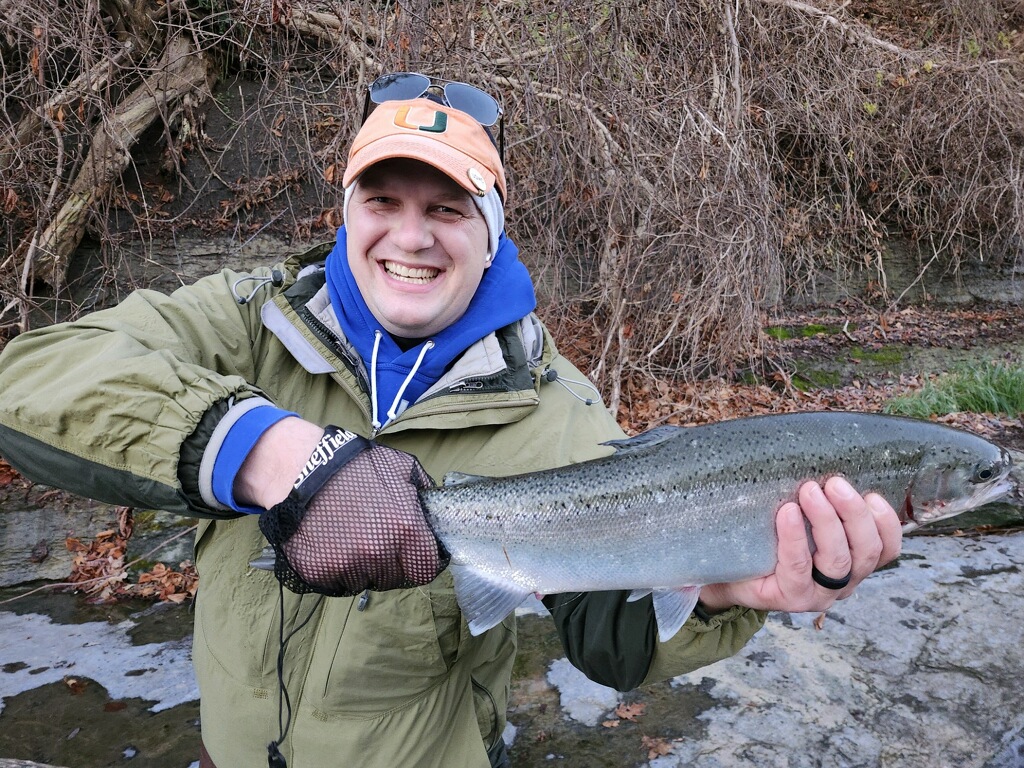
We arrived early and locked down a couple spots. I chose wrong, fruitlessly flogging the water for a three hours without so much as a courtesy touch. We had excellent conditions, and the clients of one of Jim’s guide friends had hooked 15 the day before. But something changed overnight in between dropping water levels (color was still good) and a dreaded cold front (I had ice in my guides until 9:30am. Nonetheless, Bill hooked and dropped one above me, so that gave us hope that creatures might be stirring. About 15 minutes later, yes! With pictures retaining their constant rate of worth, I’ll let Bill’s smile do the talking. Congratulations!

The rest of the day was peck away persistence fishing. I’ve never seen this creek so crowded, but people largely came and went because the action was virtually non-existent. It seemed like everyone had the same idea about the potential of the fishing, and then, once they realized they were wrong, left. We stuck it out, and I eventually landed three. With one more day to fish, we decided that rather than jockey for position and start well before dawn in the Altmar area, we would try some private water on the Salmon River.

We got a quarter inch of rain overnight, and that small amount was enough to move the fish out of our target run. Picture us standing in the rain at first light, wondering where all the fish went because no one is getting even a courtesy tap. Silver linings took the literal form of a few dime-bright steelhead fresh from the lake. Bill dropped a couple before hooking and landing a beautiful chrome hen, which he brandished with almost child-like delight. Though 1pm, all I had to show for my efforts was a silvery skipper.

I decided to attack a different section of the run, and it payed off. As my fly glided along the bottom of an uneven run, the indicator dipped as if it had somewhere else to be in a hurry. By the time I set the hook, the steelhead was running diagonally across and upstream, peeling off line at an astonishing rate. By the time he stopped, I could see the expanse of white that was my backing. I began furiously cranking the handle. As I regained precious line, the fish tuned and the line went slack. My heart sunk as I feared the worst. I even announced, “Fish off!” After I landed it, I remembered other such battles where the hook remained seated due to the tremendous drag of the line in the current. Next came the aerials, two of them, and I could see that I had a fresh fish the size of Bill’s. Bill grabbed the net and did a pro job netting the fish. Well, done, Bill! We decided to end on a high note, and victory was declared. Let’s go get a cheeseburger. I’m buying.

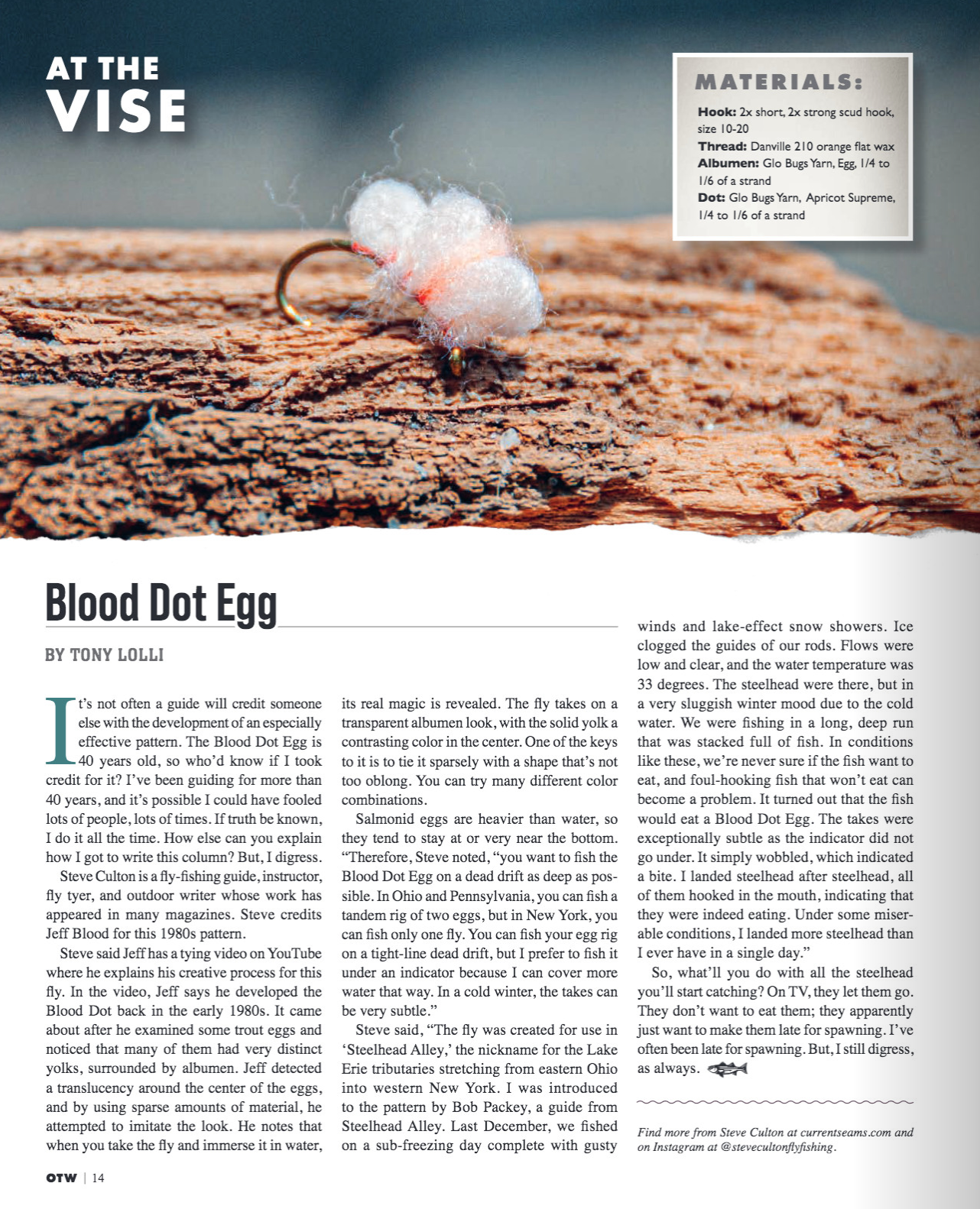
Blood Dot Egg featured in On The Water’s Guide Flies Column

Ok, so it’s not my pattern — it’s Jeff Blood’s pattern. But the Blood Dot Egg is a classic guide fly, and I was delighted to share it with the readers of On The Water magazine‘s “Guide Flies” column, written by Tony Lolli. (Thanks again, Tony, for letting me play!) This is the single best egg pattern out there, and it’s so ridiculously easy to tie that you won’t fret when you sacrifice one or three or a dozen to the bottom gods. Steelhead season is upon us. Now, if we can only get some rain.