
Thanks to everyone for all the excellent Zoom topic suggestions. This one showed up (in various iterations) multiple times — and so by popular demand, you shall have it.
Thanks to everyone for all the excellent Zoom topic suggestions. This one showed up (in various iterations) multiple times — and so by popular demand, you shall have it.
I’ve been getting a lot of wet fly questions, and I thought I’d share my answers with the group. I’m excited that so many of you are interested in this ancient and traditional art. So here we go:
Q: What size and length rod are you using on the Farmington? A: My dedicated wet fly stick is a 10-foot 5-weight Hardy Marksman II. I don’t hate it, I don’t love it. It’s got a good backbone for helping manage bigger trout in snotty currents, but I wish it were a bit softer in the flex. What’s important is that it’s a 10-footer, which I find useful for mending. Note: I still take the 7’9″ Tonka Queen out for an occasional wet fly jaunt, albeit in moderate/slow currents. That cane pole is a dream for mending.
The Queen in action. This rod gives me an ultra-fine level of line control.
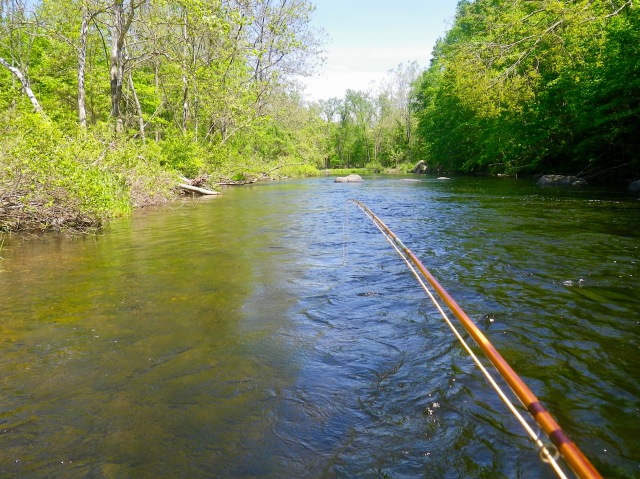
Q: Do you use an indicator? A: My joke answer is “yes” — the splash of the take, the spray of water, and the jolt of the rod tip all indicate a strike. The real answer is no, not in the traditional sense. The vast majority of time, you need no visual aid to tell you the fish has taken the fly. An exception would be when you’re fishing upstream, drawing the line toward you as the rig moves downstream. I’m watching the tip of the line like a hawk for stalls, shudders, or stoppage that would indicate a delicate strike well below the surface.
Q: Do you use a floating line? A: Yes. (I’m a line control freak.)
Q: When you’re casting and mending, is it basically a dead drift, then the flies start swinging and rising? A: Kindof. Unless you introduce slack into the presentation, you’ll never really have a true dead drift. So even when I’m doing a quartering down or straight across cast and mend, the flies are moving downstream and across, albeit in a slower manner than they would with a traditional wet fly swing.
Q: You’ve said that in spring, you focus more on pool-type water, and faster water in the summer. I’m having trouble finding the right type and depth of water. Any advice? A: Generally speaking, the colder it is, the greater the chance that trout will be in deeper pool-type water. That doesn’t mean you won’t find trout in 1-foot deep riffles in December. The bottom line is: there is no substitute for experience on the water. Get out and explore. Keep a log. Where and when did you fish? Were you catching? Were others catching? What was the weather like? What was the water height? You can see where this is going. And finally, a wee plug for myself: take a lesson. I hear this a lot from clients: “I’ve driven past this spot a hundred times and never thought to fish it.”
Q: I fished wet flies and only had one bump. What was I doing wrong? A: (This person was out on the Farmington this week.) You’ve got a lot of elements working against you. For starters, I don’t like to fish wets in the Permanent TMA in any flow over 500cfs (it’s been 750cfs and higher). 250cfs-400cfs is the wheelhouse. Hatch windows also have a lot to do with the wet fly bite. For example, right now (Hendrickson and caddis hatches) you want to be swinging anywhere from 11am to 3pm-ish. You’re trying to entice the trout that are taking the emergers. And this cold, wet weather isn’t helping, either.
When you hit the emergence just right, the results can be magical.
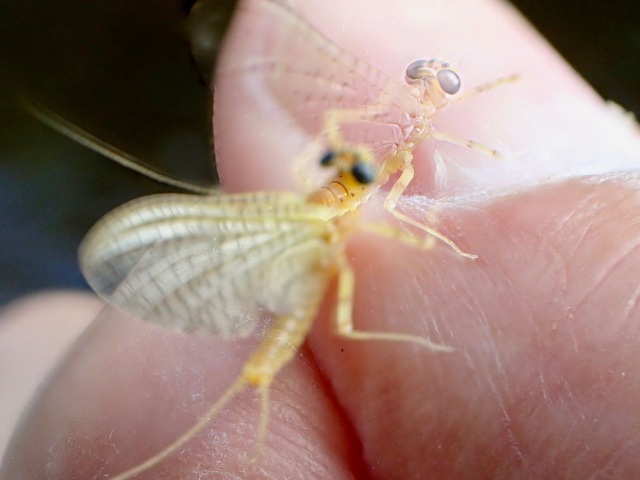
Keep on swinging.
Booming and Zooming. That’s what the test pilots called it when they broke the sound barrier while flying in a parabolic arc. We did our own version of B&Z last night: 50 attendees at the inaugural Currentseams Zoom — Wet Flies & Soft Hackles in case you missed it — and only one big boom! (thanks for your patience) that we sorted out. So: thanks to everyone who took the time to participate. I had fun. I hope you did, too. I know some of you arrived late and I didn’t see you in the entry queue. Mea culpa. And apologies. I appreciate your patience as I sort through this technology.
We’ll do another one of these, hopefully next week, date TBD. I like the 8pm EST start. I’m hearing a lot of interest in a striper talk, so that’s probably where we’re headed. Figure the same format, a presentation then Q&A.
If you have not yet gotten on the official Currentseams Zoom email list — please send me an email — not a comment here — to swculton @ yahoo so I have a valid email url. I’ll get you on it lickety-split. Thanks again, and please stay safe and well.
Did somebody say stripers on Zoom?

The Hackled March Brown is one of my favorite big fish wet flies. Long time readers may recall the first time I wrote about it — you can read that piece here. I don’t have much to add, other than this has become a supremely reliable pattern for me when the Isonychia are flying. (Next time you’re fishing sulphurs, and you hear a rise that sounds like someone threw a bowling ball into the river, betcha your lunch money it was a trout eating an Iso.) The Hackled March Brown is almost always my point fly on a three fly team. Fish it this summer and you’ll see why I recommend you tie it on a 2x strong hook.
I don’t know if W.C. Stewart had yellow sallies or sulphurs on his wee Scottish burns. But we have them here in the States, and Stewart’s Dun Spider does a bang-up job of imitating those hatches. Try fishing this on a small stream as a dropper off a bushy dry — or as a dry-wet tandem during a sulphur emergence. (You can thank me next time you see me.)
Every fly tier has a good supply of dotterel on hand…uh…hold on…dang! Turns out, not so much, even in Stewart’s time (mid-19th century). You can substitute with webby dun hen, or heed the sage advice of the man himself:

Stewart’s Dun Spider

We know that Leisenring was a big fan of Stewart’s spiders. He called them, “a deadly combination on every stream I have ever fished.” That’s one of the things that still attracts me to soft hackles — that a pattern so lethal on small Scottish rivers is just as effective here in the States. Here’s the second in a series of three, Stewart’s Red Spider.
Fresh out of landrail? No worries (or as they’d say in Stewart’s homeland, “Nae fears!”). You could use a brownish-red hen hackle or other similarly colored game bird. I like this solution best: starling wings dyed burnt orange. I bought them a few years ago from Mike Hogue at Badger Creek. Says Mr. Stewart:
 ~
~
Stewart’s Red Spider

The Sports Illustrated Book of Wet-Fly Fishing came in the mail last week. I’ve wanted to track down a copy for years, and finally got round to it. It’s written by Leisenring’s disciple Vern Hidy, and it lists tying instructions for three patterns, one of which is Leisenring’s Spider.
They (very literally) don’t make ’em like this anymore. A little dog-eared but just as relevant today as it was in 1961.

~
You don’t hear much about Leisenring’s Spider today. (I first encountered it in a Wingless Wets piece written by Mark Libertone almost 15 years ago.) It’s not listed in his book, which is strange considering it’s got fish magnet written all over it. Leisenring used his version of a dubbing loop to form the body, and I suspect buggier and nastier is better than perfect. A so-simple soft-hackle to help you clean up during the next caddis hatch. Hang on!
The Leisenring Spider

~
Happy Sunday. Hope everyone is enjoying the warmer weather. I am not, as I am STILL under the weather. I’ve got the cold that my doctor tells me is “lasting for up to month.” I’m now on week 3. Happy-happy-fun-joy, and I haven’t been fishing since early January. Bleah.
Capt. Hank Hewitt of Block Island Fishworks says, “Steve’s cold sucks THIS much!”

So, here’s a good, short read from our good friends at the American Saltwater Guides Association. This group continues to fight the good fight, and is being relentless even in the face of disappointing news. Please consider showing your support for their efforts with a donation. You can effort that on their website.
~
Many of you noticed my recent post on Stewart’s Black Spider. I’m hoping to cover his Red and Dun spiders next. Then, some more of Leisenring’s flies. Last winter I did a highly popular series of posts on Leisenring’s Favorite Dozen wet flies. Now I want to take a closer look at patterns he describes as nymphs.
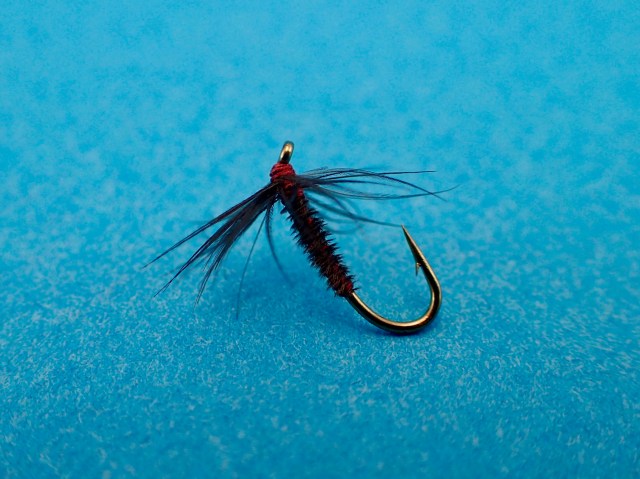
Baron von Black Gnatgenstein.
~
Speaking of wet flies, stay tuned this week for special offer/event on a wet fly tying and fishing class I’ll be leading in March! In the meantime, I hope somebody’s fishing…
Longtime currentseams follower Greg wanted to add the art of the wet fly to his arsenal. Trout should now consider this man to be armed and extremely dangerous. We fished two marks within the Permanent TMA from 3pm-7pm. To say the action was good would be an understatement — we hooked and released a double-digit number of trout during four very productive hours. A tremendous job by Greg casting, mending, and letting the trout set the hook! We got rained on a bit, and the fog was a constant, but we ended the outing bathed in sunshine.
I saw a lot of this today. After an initial slow start, the bite picked up and we never looked back. Here Greg demonstrates the result of mending the whole line (rather than a portion of it) to slow the drift and bring the flies to the trout.

~
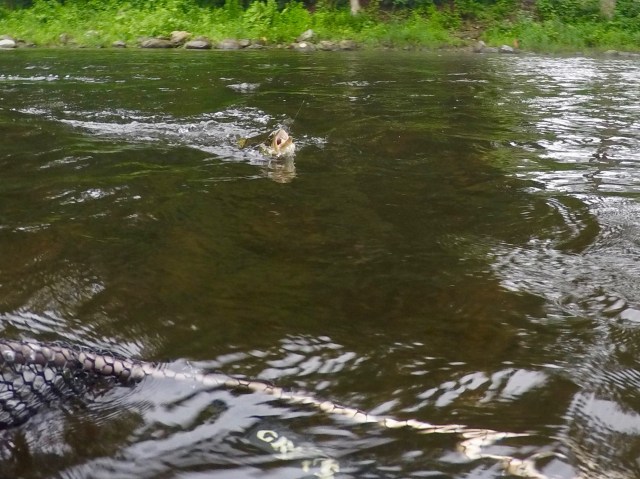
Incoming, Magic Fly in mouth. We fished a sz 12 Squirrel and Ginger on top, a sz 16 Magic Fly in the middle, and (after I saw a couple Isos) a size 12 Hackled March Brown on point. All three patterns took fish, the majority on the caddis and the sulphur.
~
Greg had the Farmy hat trick today, with a mix of rainbows, stocked and wild browns, and a hefty brookie. Here’s one of the nicer browns, a mid teens buck starting to develop a snout and kype.

~
We hit the jackpot at the second mark, finding a shaded run with a substantial number of fish that wanted those wets. You can still see the parr marks on this gorgeous creature, with some handsome dots and halos thrown in for good measure.

~
And then, I went solo in search of dry fly pleasure below the Permanent TMA. I found it, you betcha, with a massive sulphur hatch and trout boiling everywhere. I fished until I couldn’t see my fly, and then even past that. One more cast, you know?
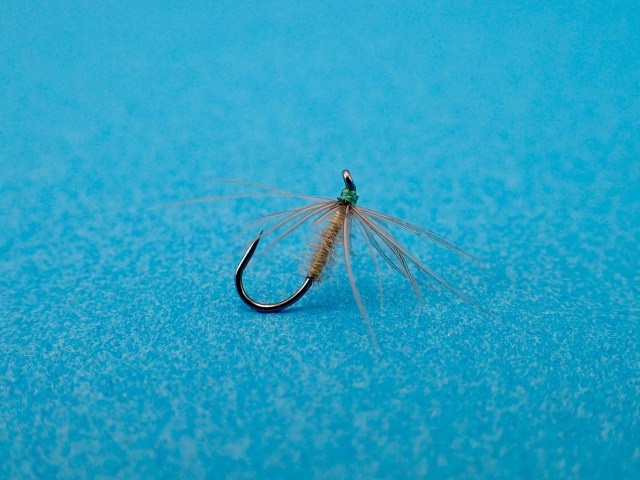
You’ll often find BWOs on the greyest of days, so ’tis fitting that this ancient-and-tradtional Olive pattern sports the same somber hues. It also makes a fine Early Grey Stone.
Waterhen Bloa
~
 currentseams.com