Housy Report 10/8/19: BWOs and Truttasaurus

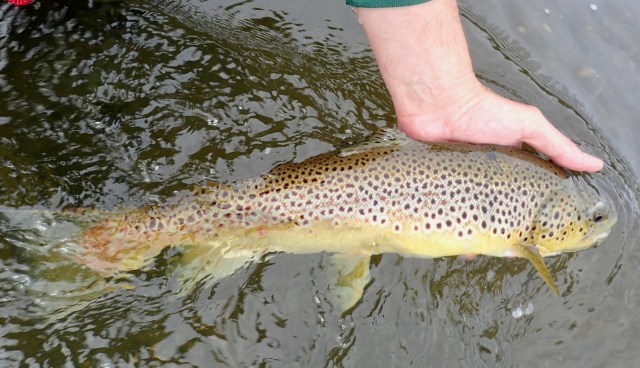
I fished the four marks within the Housatonic River TMA today, late morning to early afternoon, and while the action was spotty I was able to score my biggest brown of the season on a Squirrel and Ginger.

I began the day dedicated to the streamer cause, but after 45 minutes I’d only had one bump. Since there were tiny BWOs (size 18-22) and caddis (size 16) in the air, I switched over to a three-fly wet fly team. That produced one stocker rainbow. The third mark was a blank, so I returned to where I’d seen some fish rising earlier. Not really classic wet fly water but the trout were clearly on small stuff (as evidenced by the sipping rise rings) and emergers of some sort (the tell of splashy rises). I missed two before connecting with a 20″ holdover brown.

The take was gentle but unmistakable, as was the fish’s size once it realized it was hooked. Love the comfort factor of fishing with Maxima 4-pound — ain’t no trout in this river going to break that.

OLYMPUS DIGITAL CAMERA

~

It’s hard to take a beauty shot mid stream when you’re flying solo, so this is the best I could do. Still, you get some sense of this truttasaurus‘ length, and check out the ginormous tail. The mouth of my net is 17″ — this one did not slide in easy. We like that problem! Wet flies fished in the film, delivered to active feeders, continue to be a highly productive big fish method. 

OLYMPUS DIGITAL CAMERA

River conditions: 450cfs and rising, light stain, some leaves and pine needles, 58 degrees. And crowded for a Tuesday in October! Thanks to everyone who greeted me by name today, and as always, if you’re on the river and you see me please say hello.


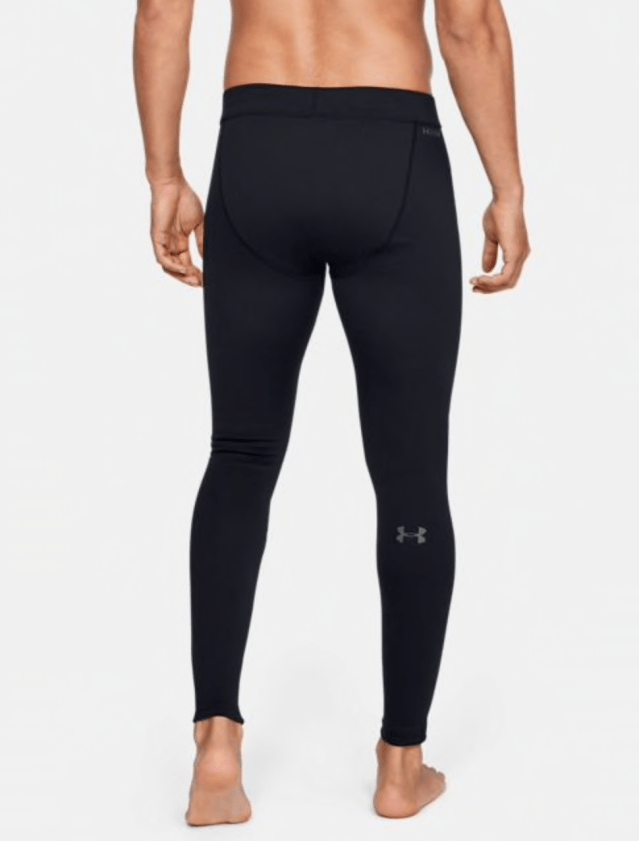
Stuff I use: Under Armour Cold Gear Base Extreme Leggings

If there’s anything worse in fishing than being cold and miserable (OK, throw in not catching, too) I’ve yet to experience it. That’s why Under Armour’s Cold Gear Base Extreme Leggings are hands down the best lower body bottom layer I’ve ever owned. I bought mine in 2018; this year’s model is called the ColdGear Base 4.0 Legging.

Ya done good, UnderArmour!

ColdGearBase

There’s a lot to love, starting with the fact that these things actually work. I’m the kind of guy who runs cold 24/7, so already I’m at a disadvantage before I step into the water. I wore these last year in all kinds of miserable conditions with a fleece pants overlay and stayed mighty comfortable in my 3mm neoprene waders.

Features you may be interested in: UA Scent Control Technology (and let’s be frank: that’s something we all could use in our nether regions); soft, brushed grid interior (very comfortable); fast-drying wicking material; working fly (yup, nature is going to call at some point). Be advised that the “Find Your True Fit Size” app on the UA site is fallible; it told me I was an XL and they hung on me like a cheap suit. I swapped ’em out for an L and we were warm and happy.

Price: $80

Rating: *****

Water’s cold, steelhead bite’s hot, legs are just right with the Under Armour ColdGear Base 4.0 Legging (hiding somewhere beneath it all). If you fish in cold water/cold weather conditions, you need these leggings.

OLYMPUS DIGITAL CAMERA


CT DEEP Trout and Salmon Forums this October

“DEEP Wants Your Opinions on Trout and Salmon Fishing in Connecticut.
Public Discussions Scheduled Statewide in October
The Connecticut Department of Energy and Environmental Protection’s (DEEP) Fisheries Division is pleased to invite all interested people to attend one of the public discussions focused on the State’s recreational trout and salmon fisheries. The purpose of the meeting is to obtain ideas and concerns specific to recreational fishing for trout and salmon via face-to-face conversation.
“Informed conversations between our passionate and loyal anglers and the Fisheries Division are essential to ensuring we are managing these fisheries in the most relevant and meaningful manner, consistent with the preferences and desires of the people we serve,” said Peter Aarrestad, Director of DEEP’s Fisheries Division.
Each meeting will begin with a brief presentation about the Fisheries Division’s management of trout and salmon to date and then expand to discussion on four key focal points related to trout and salmon fishing:
• What makes a good fishing trip?
• What is the Fisheries Division doing well?
• Where can the Fisheries Division improve?
• What actions could be taken to increase the number people fishing?
All people are encouraged to provide their perspectives. At the conclusion of all of the meetings, comments will be compiled and considered to help inform the Fisheries Division’s development of a statewide trout and salmon action plan.
To help determine the level of attendance and ensure sufficient accommodations for all, we are asking likely attendees to RSVP in advance by selecting the “tickets” button for the appropriate date and location.
RSVP can also be made by calling the Fisheries Division at 860-424-3474 or by email to mike.beauchene@ct.gov
Doors will open 30 minute prior to the start of each meeting.”
You can find the dates and locations here.

Soft-Hackled Flatwing in On The Water’s Guide Flies

My Soft-Hackled Flatwing recently appeared in the “Guide Flies” section of On The Water magazine. I’m sorry that I don’t have a publish date, but it’s out there and of course right here. The Soft Hackled Flatwing draws from fly tying giants Abrames and Bondorew and Gartside. Play around with colors, have fun, and catch fish!

The Soft-Hackled Flatwing from On The Water‘s Guide Flies. There’s a link to a pdf just below.

SoftHackledFlatwingGuideFlies

SoftHackledFlatwingGuideFlies

RI Striper Report 10/1/19: For old times’ sake

I suspect that at 9:45pm last night many of you were either watching MNF or getting ready for bed. Me? I was pulling out of my garage to go striper fishing in Rhode Island.

Used to be that fall meant many long nights spent banging around the beaches, breachways, and salt ponds of the Ocean State. Sadly, the state of the striper stocks have reduced that autumn fishery to a shell of its former self. Nonetheless, needs must go, if only to remember the glorious nights of yore when the surface of my thumb was reduced to shredded flesh.

“Steve, can you get me on the hook? For old times’ sake.” Can do, Sally.

CandoSally

I fished two marks. The first was a skinny water flat where I used a three fly team (Orange Ruthless, small PB bucktail, Morning Glory) and wet fly tactics. The flat was loaded with silversides, and although I heard a few pops, I was only able to manage a couple of touches. The lack of sharpness on the hits led me to believe that dink stripers were the culprit.

Off to Spot B, an area with an elevated perch and nearby incandescent lights. Peanut bunker and mullet in the bait mix. Now well after 1am, I was just about to call it when I heard some mischief and saw a pod of six school bass harassing bait down current. I made a cast, didn’t like it, and as I was pulling my rig out of the water one of the bass struck. The upshot was a miss, but those fish were there to eat, and on the next cast I connected with a double on the PB and the Morning Glory.

And so a happy and tired me crawled into bed just after 3am.

Not from last night, but a good likeness of my customers.

OLYMPUS DIGITAL CAMERA


One more week for Addendum VI comments, latest news from ASGA

One more week to get those comments in, people! If you have not yet commented, please do so today. For those of you who don’t striper fish, thanks for bearing through all this ASMFC stuff, and please consider adding your voice to our cause. The infographic below is telling. You can find the email/snail mail address to send comments to here. You must use the subject line Striped Bass Draft Addendum VI.

I promise we’ll get back to some trout stuff soon!

stripedbass3


Farmington River Report 9/25/19: The soft hackles have it

I guided repeat client John yesterday and we were blessed with spectacular weather. Water was low (130/160cfs, permanent TMA/Unionville) but very fishable and cool, even down south. John wanted to work on his wet fly game, so we headed up to Riverton to take advantage of the recent stocking. If the DEEP trucks made a recent visit, we saw no evidence of it: we hit three marks in two hours, and waded hundreds of yards of water without a single touch. Other anglers we encountered also reported blanking. Very curious.

Look like a good place for a SOB-ing trout to be hiding out? I certainly thought so. John covering some very sexy water with a team of three.

OLYMPUS DIGITAL CAMERA

~

Thus spanked, we headed down to the permanent TMA for a nymphing lesson. John had never done any nymphing, but he took to it quickly, and before too long was rewarded with a gorgeous Survivor Strain brown. We took one more rainbow, and both fish came on the top dropper, a tiny (sz 18 2x short) SHPT.

Parr marks, haloed spots, clipped adipose and obstreperous behavior once netted clearly IDed this fish as a Survivor Strain brown. Not a bad first Farmington River brown, nor a bad first trout ever on a nymph!

OLYMPUS DIGITAL CAMERA

~

We finished up swinging wets on the lower river and brought a few more fish to hand. Nice job John in some challenging conditions!

This seems like a good time to mention that I am a teaching guide, and if you’re like John — someone who has had some success in fly fishing but wants to expand their skill set — maybe you should consider a few hours on the water with me. I teach anglers of all levels, from beginner to experienced. You can find out more here.


What went down at last night’s ASMFC Draft Addendum VI hearing

I attended and publicly commented at last night’s ASMFC Striped Bass Addendum VI hearing in Old Lyme. (There’s another public hearing tomorrow, Wednesday September 25 in Bridgeport, CT at Port 5 Hall. Hopefully the AC will be working!)

My general impressions: People are passionate about striped bass. The meeting was well attended, with roughly 50-60 people. About half of them chose to comment. Most are in favor of conservation, and in many cases for more conservation than is being proposed. Many aren’t thrilled with the ASMFC‘s track record. Many cited enforcement as a problem, and asked for more EnCon police and harsher penalties for poaching. (That’s not on Addendum VI, but point well taken.) Unlike the Long Island session from a few weeks ago (the video that was on Facebook), there were no angry outbursts or contentious remarks, so good job on that to everyone.

This is your chance to open your mouth and speak.

OLYMPUS DIGITAL CAMERA

~

So, what did I say? I drew my comments from the following script:

Commissioners and fellow anglers,

My name is Steve Culton. I am a resident of Middletown. I am a fly fishing guide, instructor, outdoor writer, and I run a website called currentseams which has over 700 followers, many of whom are avid striper anglers. Most of all, I’m a guy who loves fly fishing for striped bass. I am also active within the American Saltwater Guides Association, which is an organization of guides and small business owners from Maine to North Carolina. Along with the ASGA, I endorse the following options:

Option 2: 18% reductions applied equally between the sectors. As Aunt Eller said in Oklahoma!, “I don’t say I’m no better than anybody else, but I’ll be danged if I ain’t just as good!”

Option 2-A1: 1@35”. There are major cons to every option listed. It’s hard for me to support an option that allows the wholesale slaughter of the large breeding female bass off of Block Island or in the Cape Cod Canal to continue. Ultimately, it’s difficult to ignore past history, and we’ve seen the positive effect of 1@36”, which helped with the successful rebuilding of the striped bass fishery last time around.

For the Chesapeake Bay, Option 2-B1: 1@18” For the record, I’m not favor of any of the options listed for the Chesapeake Bay. Killing stripers before they’ve have a chance to spawn makes no sense. But Option 2-B1 is expected to achieve the greatest harvest reduction.

Option 3.2.B: Mandatory use of circle hooks. It would be nice if this were accompanied by an effective education and awareness program. I won’t hold my breath.

Some additional comments – and some difficult questions: 

While we’ve got to start somewhere, all this is not good enough. ASMFC has got to do better.

Real power comes not from the taking of life, but rather from the sparing of it. Why are we continuing to allow the killing of the large breeder females that produce millions of eggs annually, and are critical to producing the next big year class? Why 1@35″ and not 1@40″ (or bigger)? Why is there no moratorium or catch & release only provision in this addendum? Why are we relying on a 50% chance of success?

Why is Maryland allowed to do what they damn well please? Maryland’s harvest reduction in this Draft Addendum is based on their 2017 numbers when they were severely over their total. Why would you reward a state for overharvesting by 200%? There must be consequences when states do not live up to their harvest reduction goals. ASMFC needs to change how you analyze and manage conservation equivalency proposals. Please make sure this process gets fixed.

Finally, perception is reality, and the perception is that the ASMFC has a storied history of underachievement and little to no accountability. Not good enough. I challenge the ASMFC to rise to your mission statement this time around.

I recognize the ASMFC has a number of diverse constituencies that need to be considered. However, you have an obligation to manage striped bass for the greater good. You must manage for the benefit of our children, and for their children. Ultimately, the needs of the many outweigh the needs of the few – or the one. Thank you for your consideration.

~

So that’s it. I hope you’ll award me bonus points for managing to work Star Trek and Rogers & Hammerstein into my comments.

You have until October 7 to send in email comments. You can find the public hearing schedule for individual states, and the email/snail mail address to send comments to here. You must use the subject line Striped Bass Draft Addendum VI.

 

CT Public Hearings on Striped Bass Draft Addendum VI

CT residents will have two opportunities this week to speak on the ASMFC Striped Bass Addendum VI. This first is tonight, 7pm at DEEP Marine HQ in Old Lyme. The second is Wednesday September 25, 7pm at Port 5 Hall in Bridgeport. I will be attending tonight’s hearing in Old Lyme.

If you’re passionate about stripers and ensuring a viable future for this magnificent fish, I urge you to do one of the following. First, attend a public hearing in your state. Second, send email comments to the ASMFC. You can find the public hearing schedule for individual states, and the email/snail mail address to send comments to here. You must use the subject line Striped Bass Draft Addendum VI.
What to say? You, of course, will have your own opinion. It should be noted that in this situation, there exists the awesome power of similar numbers. The more of us that push for a similar opinion — and outcome — the better. You know I am a champion of the American Saltwater Guides Association (ASGA). They have carefully considered the options, and their position on Draft Addendum VI can be found here.

If you haven’t done so already, sign up for ASGA email updates, and, even better, make a contribution. They’re truly doing good work.

Hope to see you tonight — and hope to see more of her in the future.

thumbnail


“Trout Fishing for Striped Bass” at Hammonasset TU, Thursday, Oct.10

Everyone’s invited to see me present “Trout Fishing For Striped Bass — How to catch the stripers that everyone can’t” at 7pm, Thursday, October 10, at the Hammonasset TU meeting. The venue is the QRWA building at 540 Oregon Road in Meriden, CT. For more information, please visit the Hammonasset TU website.

Anyone can catch aggressive, willing-to-chase striped bass. But what about the stripers that are holding on station — or larger bass that that are not willing to chase a stripped fly? Many of the answers can be found within traditional trout and salmon tactics. 

TFFSB_Cover