Tomorrow night, Thursday, October 19th, I’ll be presenting “The Little Things 2.0” to the Croton Watershed Chapter of TU. The meeting is open to the public, and you’re invited! Doors open at 6:30pm, and the meeting starts at 7pm. It’s all happening at the Emanuel Lutheran Church, 197 Manville Road, Pleasantville, NY. If you’re a currentseams follower, please come and say hello.
We’re all looking for an edge when it comes to catching more fish. It is my firm belief that the little things are largely responsible for the fabled 10% of the anglers who catch 90% of the fish. The Little Things 2.0 builds on the theme of seemingly insignificant things you can do make your time on the water more productive. As with all seminars in this series, the lessons apply to multiple species fly fishing in fresh or saltwater.
On Thursday I had the opportunity so spend a couple hours on small stream so I jumped on it. I hadn’t fished here since April and boy, did the heavy rains of the summer alter the streamscape. Entire pools were missing, and others were created. The fish were well spread out, and I did not see any signs of redds, nor of fish staging to spawn. Hatch activity was light with some lonely midges and a few stray small caddis. I fished downstream, subsurface, using a Squirmy Worm jig. I did tie on a bushy dry at the end just for fun.
It’s a good time to revisit some basic small stream best practices. First, learn to ID redds. It’s a good idea to stay our of the water from around now through mid-April. The lives you same may be the future of the brook you love to fish.
Please mash down your barbs or fish barbless hooks. You can also fish hook size that’s just a little too big, like a 12 or 14. This will self-eliminate smaller fish from eating the fly, and you’ll still have the sport of seeing them whack it and feeling their aggressive tugs.
Handle fish as little as possible. Keep them in the water if you can. The less exposure to air, the better. Reduce potentially damage to fish by taking the Wild Trout One Photo Challenge.
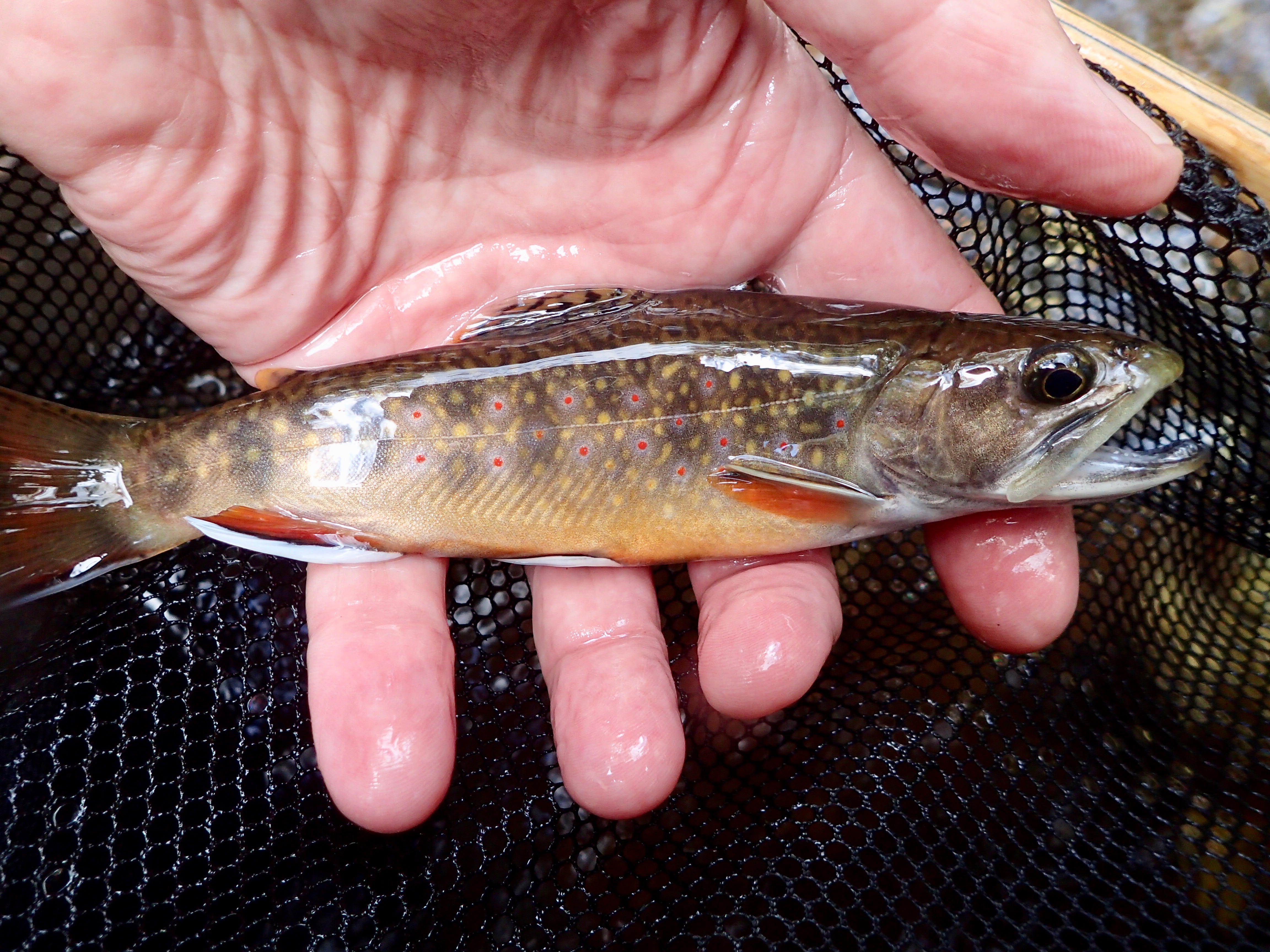
This was my first brookie to net, and it was an easy decision to make this my One Photo Challenge fish. I’m telling you, those blue haloed dots were positively glowing! I lost a few char bigger than this one, and a bunch of smaller ones, and that’s all just fine with me.
This morning I dumped all the entries into a virtual bucket and had my independent panel of one randomly select three winners: Jim D., Jack W., and Geoff K. Congratulations! The winners have already been notified by email. (Geoff K, your Charter email is bouncing back, so please send me a valid email address!) Now, to the vise…
I’d like to thank everyone who entered, and everyone who reads and follows Currentseams. Onward and upward…if you get a fishing friend to subscribe and we’ll be doing this again soon, although I may now go in increments of 250.
What a treat to spend a day fishing with #2 Son Cameron on a small woodland stream. The water was on the high side of medium, 55 degrees and crystal clear. Although the spawn has not yet begun, some of the resident char were sporting their ready-to-get-jiggy finery. The leaves are beginning to tumble down, and although they were not an issue, I would expect that they would start becoming one this week. Like my previous trip, the fish were unimpressed with the dry fly; anything subsurface was immediately bull-rushed and nipped at. If you’re heading to a small stream from now until April, please stay out of the water and be on the lookout for redds!
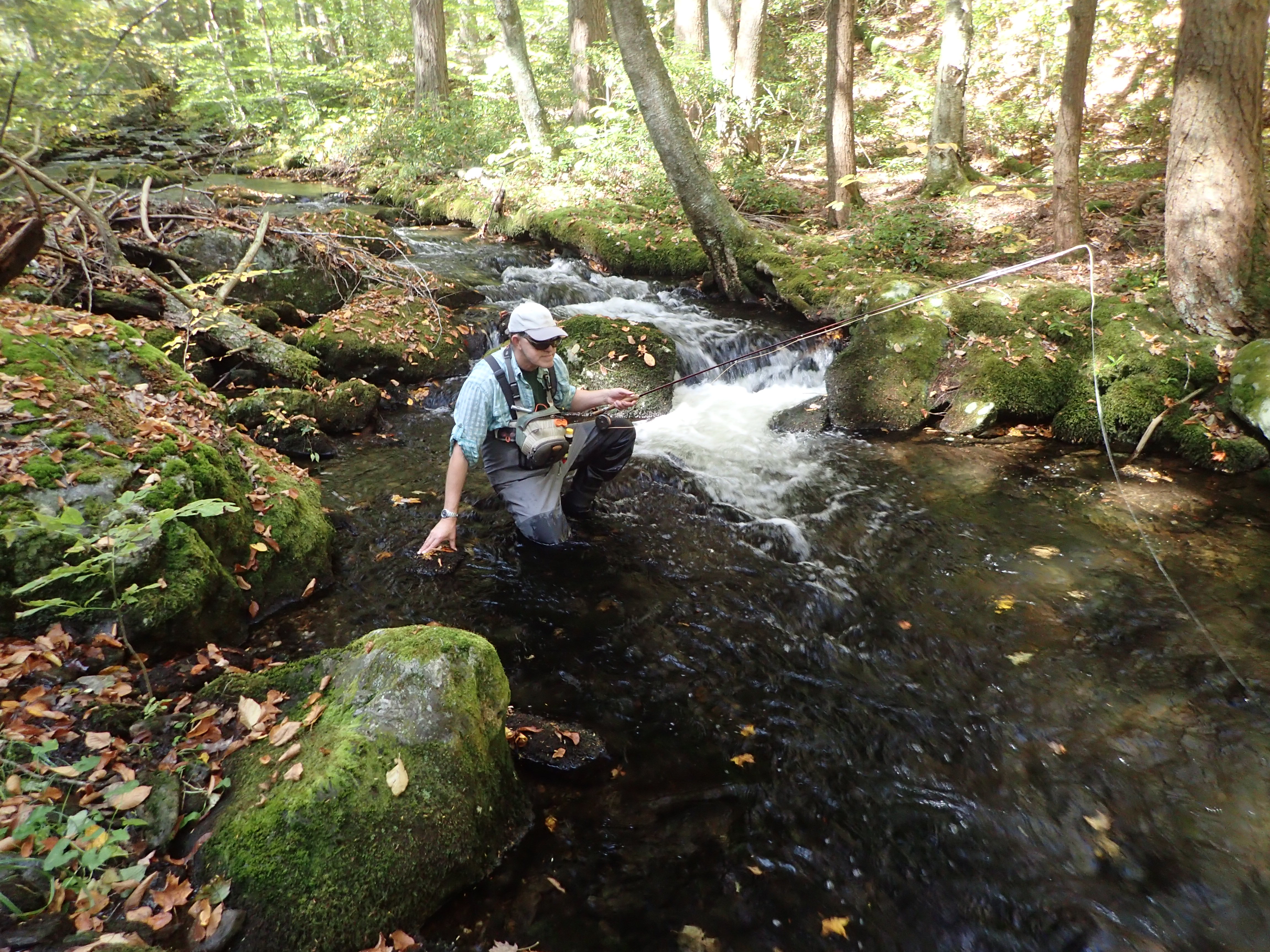
It was another work day of sorts, shooting video and still photos for presentations and social media and other stuff. This would be the “crouching low against the landscape while staying out of the sunlight,” or the “dangling the fly in the current downstream to provoke a strike” shot. Photo by Cam CultonWe all know brookies for their brilliant colors, dots, halos, fins, and vermiculations. One of the things I love about the species is the way they adjust their coloration to their surroundings. Sandy or light-colored substrate means the char will have a lighter flank. Dark horses like this often live in remote, isolated plunges that never see direct sunlight and very little light in general. The photo doesn’t do this brook trout’s dark coloration justice. I nicknamed him “The Chocolate Brookie.” Photo by Cam Culton.
Last week I spent a couple hours on Ye Olde Brookie Emporium. The water was medium-high and running clear. I hadn’t fished this stream since last spring, and there were some changes over the summer. A constant supply of too much water really moved the fish around, placing them in some holes that are normally low and devoid of char this time of year. A couple pools underwent significant structural changes that altered their size and depth, mostly due to old logjam dams being swept away and new ones being formed. The bottom line was that there were fish almost everywhere, and they were in great shape and eager to jump on.
Due to the volume of water, I started subsurface with the Squirmy Wormy Jig, which was a good call. Almost immediately, the brookies began attacking the fly. I used a size 12 to minimize hookups; later in the day I went down a size to actually land a few. Stripped, dangled, swung, hopped, it didn’t matter. This fly was under constant assault.
A woodland pond in miniature, lovingly rendered by Mother Nature.
Next, I wanted to try out a new pattern I’d read about this winter in Pat Dorsey’s book Favorite Flies for Colorado, the ARF Humpulator. This pattern from Al Ritt was designed to float better, longer. As its title suggests, it’s a riff on a Stimulator and a Humpy. (My favorite feature might be the hi-vis indicator tied onto the wing, something I’ve thought about doing on my Stimulators and Improved Sofa Pillows for years.) Although it is intended to be tied in sizes 6-10, I made my ARF Humpulators in a size 14. Like any big, bushy dry, the wild things slashed and crashed and bashed and mashed it. Again, by going with a larger size, I eliminated unnecessarily hooking smaller fish.
I was disappointed in several of the hero pools, but that may be a function of them being easy to access, and the resulting increase in fishing pressure. Leaves were not yet a factor. No redds were observed, but I did see a pod of good-sized char milling about at the bottom of one deeper gravel bed. I decided to let them be. While it was a work day of sorts (shooting photos and video), it’s hard to beat a day at the office like that.
Designed for larger western rivers, the ARF Humpulator also works on small eastern brooks. Please consider taking the Wild Trout One Photo Challenge on your next small stream outing.
I’ve been writing for years now about the new normal with flows, which is: rarely is there middle ground. Most of the time, it’s flood or trickle. We can’t catch a break with this rain (and more is on the way Saturday!) and as a result the Farmington is sky-high again. They’re currently bleeding the dam at 1.1k cfs, and the Still is pumping in an additional 250cfs. Who knows what the next week will look like? I have two lessons scheduled but we’ll have to see. The inflow to the reservoir is also high, and will need to (eventually) be bled. If you choose to go out, please exercise caution!
The 1,000 Followers Contest is officially closed! Thanks to all who entered. I’ll pick the winners soon. Keep your fingers crossed.
Finally, I owe you a small stream report. Look for it tomorrow. I also have some other fly fishing writing projects that desperately need my attention, so off I go…
As the weather turns cooler, small stream anglers begin dreaming about their favorite thin blue lines. It should be a great fall season — we had a very wet summer and the natives and other wild fish are in great shape. But along with fishing for wild trout and char comes great responsibility, to both the fish and the resource. Here are three things you can do preserve and protect wild fish.
Minimize fish photos. Anglers with cameras have needlessly killed more small stream wild trout — intentionally or not — in the last 10 years than in the previous 100. You can blame it on the convenience and portability of digital devices. You can blame it on social media. Or angler narcissism. Or all of the above. One solutions is: take no photos, or Take The Wild Trout One Photo Challenge.
Accordingly, do you really think we need a photo of every wild fish you caught on your last outing? Dr. Rick gives the same answer: no.
Be on the lookout for redds. Fall is spawning time for wild brookies and brown trout. Learn how to identify a redd, the nesting area for spawning fish. And please, stay out of the water. The eggs you don’t crush will be the trout you’re catching in a couple years.
Keep Fish Wet. Catch-and-release is useless if you’re ignoring its fundamental best practices. Learn to do it right, and you’ll have more wild fish to catch on your next outing.
The good news is: fall is finally here, along with her cooler weather, and the Farmington River water temperatures are finally getting back into trout-friendly territory! In an odd twist for September, water temps are actually cooler miles from the dam as the water that’s coming out is still (ridiculously) in the low-to-mid 60s. You should carry a thermometer with you and never fish if the water temp is above 68. I’m not sure when DEEP will do their fall stocking, but I imagine it will be in the next couple weeks. The bad news is: we’re getting creamed by rain, and the river in the PTMA as I write this is well into 4-digits cfs and the color of chocolate milk.It should drop and clear significantly by the end of the week.
Contest alert! If you have not entered my 1,000 Followers contest, you now have less than a week to do so. You can get all the details here.
This from the Ministry of Too Funny: every once in while, I feel like a total failure as a writer. That is, I write one thing, and a surprising number of people take it in a way that I could not possibly have imagined they would. After last week’s post about stripers and casting distance, I received a bunch of emails from people offering suggestions on how to increase my casting distance. I appreciate your helpful nature — I surely do. But what somehow got lost in translation was that I was already casting 100 feet. I don’t believe the fly caster who could reach the fish that Toby was hooking is alive on planet earth today. Maybe he or she is, but if so, you can probably count them on your fingers. At any rate, thankfully, the vast majority of big fish I hook come within the 75-foot range, which is attainable by anyone with the right gear and good fundamentals.
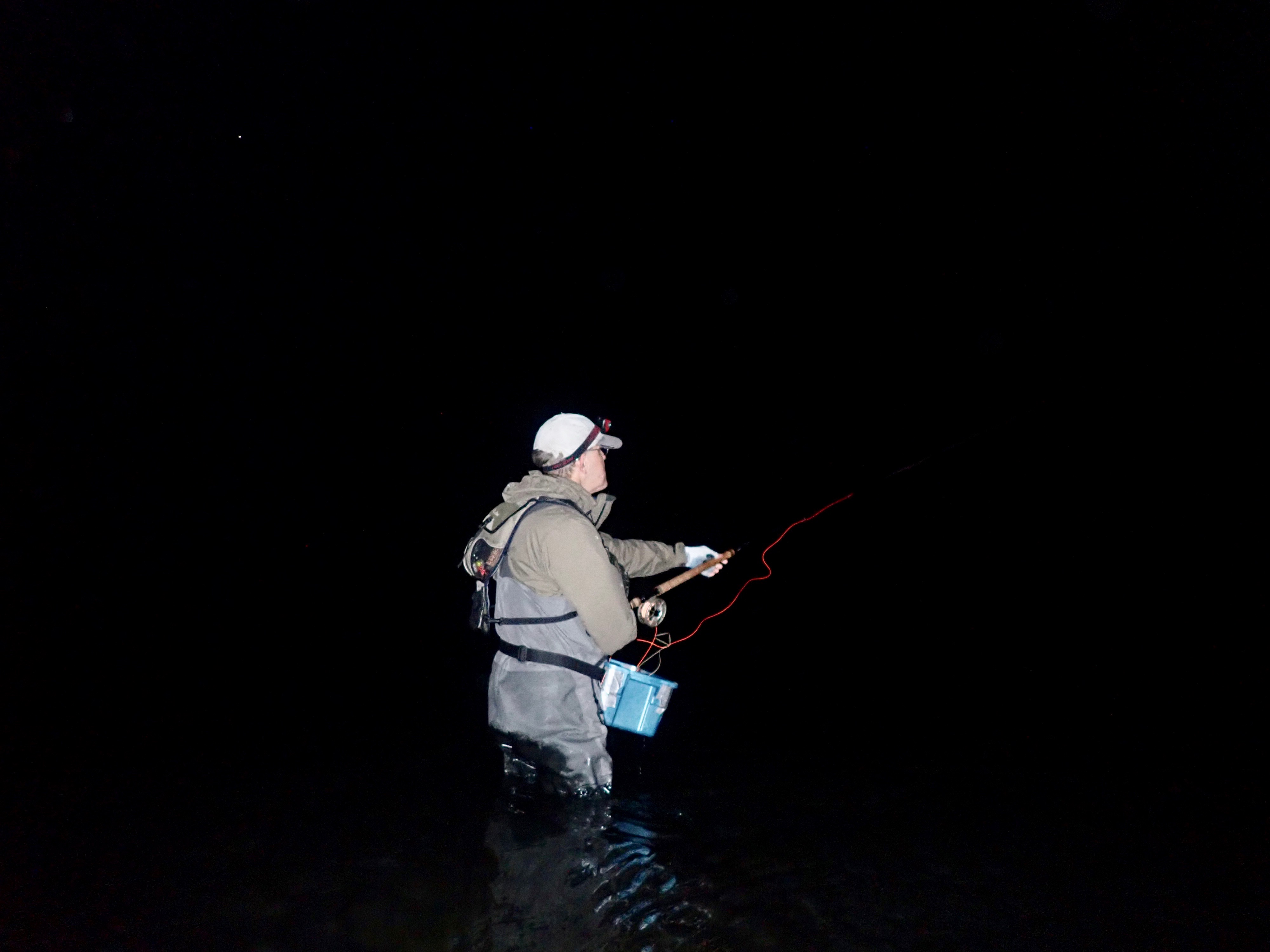
A roll cast to get the head out, a single water haul over my head, then bombs away! I love to hear the line whistling through the guides, and the dull thud of the line length bottoming out. We had great casting conditions, 0-5mph quartering over my right shoulder (I’m a lefty).Photo by Toby Lapinski
I also want to thank you all for your patience as I navigate a very busy time for me. Lots of personal projects going on (it’s all good) that are keeping me from writing here as much as I would like, and (gasp!) even from fishing as much as I would like.
Speaking of stripers and writing, I’m currently working on an article for Surfcasters’ Journal. As usual, I’ll do my best to make it fun and interesting and informative. Enjoy the rain!
If you fish for striped bass with a fly rod, you’re operating under an unimpeachable assumption: whatever you hook must be within close range. Fly casting range. Not practice casting on a lawn with just a fly line. I’m talking standing thigh-deep in the ocean with a line and leader and fly and waves and wind and if it’s the dark of the moon, limited vision. You might get 100 feet if you’re a tournament-level caster, or have a two-handed surf rod. For most folks in standard conditions, it’s probably 75 feet or less. If the wind is honking in your face, you might be talking well under 50.
Sometimes, distance just doesn’t matter. (The last striper I caught took the fly under a rod’s length away from me.) And sometimes, like Wednesday night, distance is everything.
I fished with surfcaster extraordinaire Toby Lapinski, and it was a tale of the tape. Toby got into a half-dozen-plus fish ranging from 5 to 15+ pounds, and I blanked. Oh, I had a few pulls from squid, a solo sharp rap, and then later, a momentary hookup. But the spelling of the word of the number of bass I landed begins with a Z. Toby was launching his wares way over 100 feet, and that’s where all the action was. I had my two-handed surf cannon with me, but I was well short of where the fish were holding and feeding. I saw one of Toby’s hookups, and it was a good 50 feet beyond what I was making. (And I was having a very good casting night, bottoming out on just about every cast.)
A cast, a mend, a slow gathering of the line, and….nothing. (Photo by Toby Lapinski)
You might think I was discouraged, but that wasn’t the case. I was delighted that Toby was getting into fish. Most of all, it served as proof that I wasn’t fishing poorly. I just couldn’t get the fly out far enough. Nobody could have. Thank goodness those nights are the exception.
Out thinking as we trudged back along the beach was to try a different, earlier stage of the tide, when the fish might be in closer. It’s all one huge science experiment, with your lab report being graded by the fish. So I’ll be looking to bump that C up to an A.
Mark your calendars because it’ll be here before you know it! The 32nd International Fly Tying Symposium is returning to the Double Tree by Hilton, 200 Atrium Drive, Somerset, N. J. Come for a weekend of seeing old and new friends, over 100 world class tiers demonstrating their best patterns and techniques, and plenty of product to shop. And of course, free parking!
I’m totally stoked for this as it’s a great opportunity — for me as well as you — to meet and talk to so many terrific anglers and fly tyers. Plus, I’m always walking away with some hard-to-find tying items. There are some excellent seminars that are included in the price of your ticket, and you can also sign up for a fly tying class.
I’ll also be doing a seminar and a class. Here’s my schedule:
Saturday, November 11, Noon, Seminar: Tying And Fishing Wet Flies. This is a new seminar I debuted last year. We’ll cover the basics of wet fly construction, materials, types, and how to fish them in both traditional and non-traditional ways. I have updated this presentation with some good stuff I learned about caddis this year, so don’t miss out! Seminars are included in the price of your admission.
I love this presentation, and I think you will, too!
Saturday, Nov 11, 1pm-3:30pm, Tying Class: Soft Hackles, Winged and Wingless Wets. If you’re not tying and fishing wet flies, you are not catching as many fish as you could be. These intro class to the three main styles will get you well on your way! You must pre-register for the class and you can do that here.
And of course, I’ll be tying flies on the show floor along with dozens of other folks who are far more talented than me, so make sure you stop by to say hello. Bring your questions, as I’m here to help.





 currentseams.com