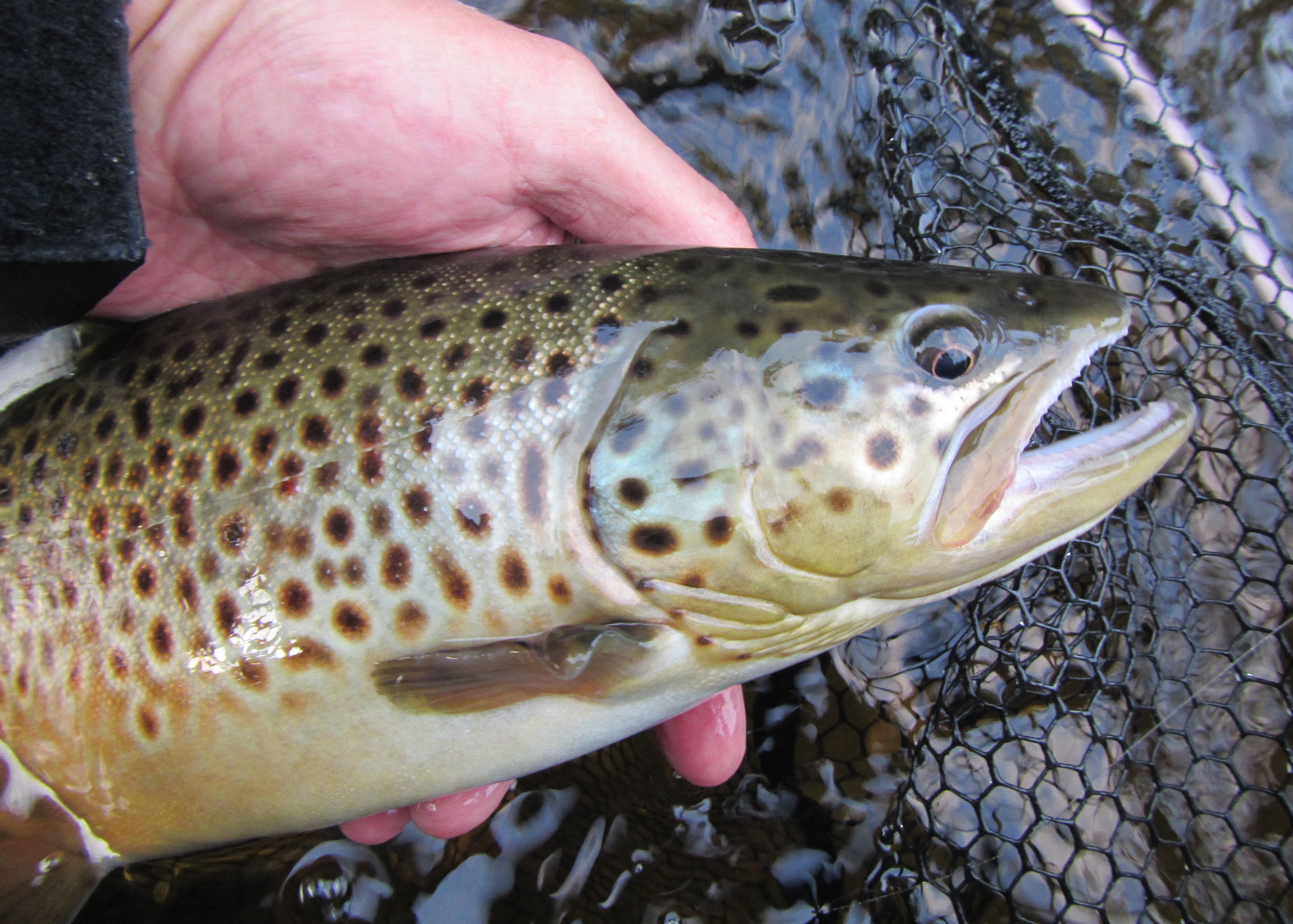
Farmington River Mini-Report 9/10/14: Getting there

The DEEP did their broodstock gathering/census on Tuesday, and this morning the flows were nearly back to normal. I fished four spots from 9am-1pm with varying degrees of success: a) one JV Atlantic Salmon, b) a nice assortment of wild browns in the 12″-14″ class, c) blank, d) a brown trout LDR. I stuck with the indicator nymphing thing, and I learned after my fifth (I was a little slow today) weight tag break off that one BB shot played nicer than two. The water was lower than it has been, albeit cool for early September, and it had a light stain. A bit of a funky pond smell in the air. All the takes today were nearly imperceptible; a subtle stall or shudder of the indicator, rather than its wholesale disappearance. Lift your rod, hook point finds insertion, and the dance begins. They liked the size 12 BH Squirrel and Ginger. Forgot my camera, so no photos. Sorry, Ansel.

I hope I enjoyed it, because tomorrow I shall be chained to a desk.

Farmington River Report 9/4/14: Delusions of Chrome

I don’t care how good an angler you are: sooner or later, you are going to make a mistake on the water. Sometimes you pay. Others, you still inherit the forune. On this morning, I got a little lucky.

It was another session dedicated to the nymphing cause. I hadn’t been doing any serious nymphing since there was ice along the river’s edge, and it felt good to be returning to my fly fishing roots. The first spot I visited was a blank. I fished it hard for 45 minutes, then decided to head upriver.

Another ten minutes without a take. Then down went the indicator. And this is where I messed up. I had been repeatedly reminding myself, “set downstream.” So what’d I do? I set upstream, as Eric M so eloquently expressed it, “instinctively doing the wrong thing.” Almost immediately, I corrected with a hard downstream set. Thus begineth the battle. I could see I had something good after his first impressive clear-the-water-by-a-few-body-lengths aerial, followed by one desperately ugly surface somersault. All worthy of fresh chrome. Eyeballing aside, I can always tell I have a good fish when I have an “I think I may be snagged on the bottom” moment. Then I feel that dampened head shake sensation as the fish yields to the pressure. This cantankerous creature did not want to come to net. After several runs and a short walk downstream, he was in.

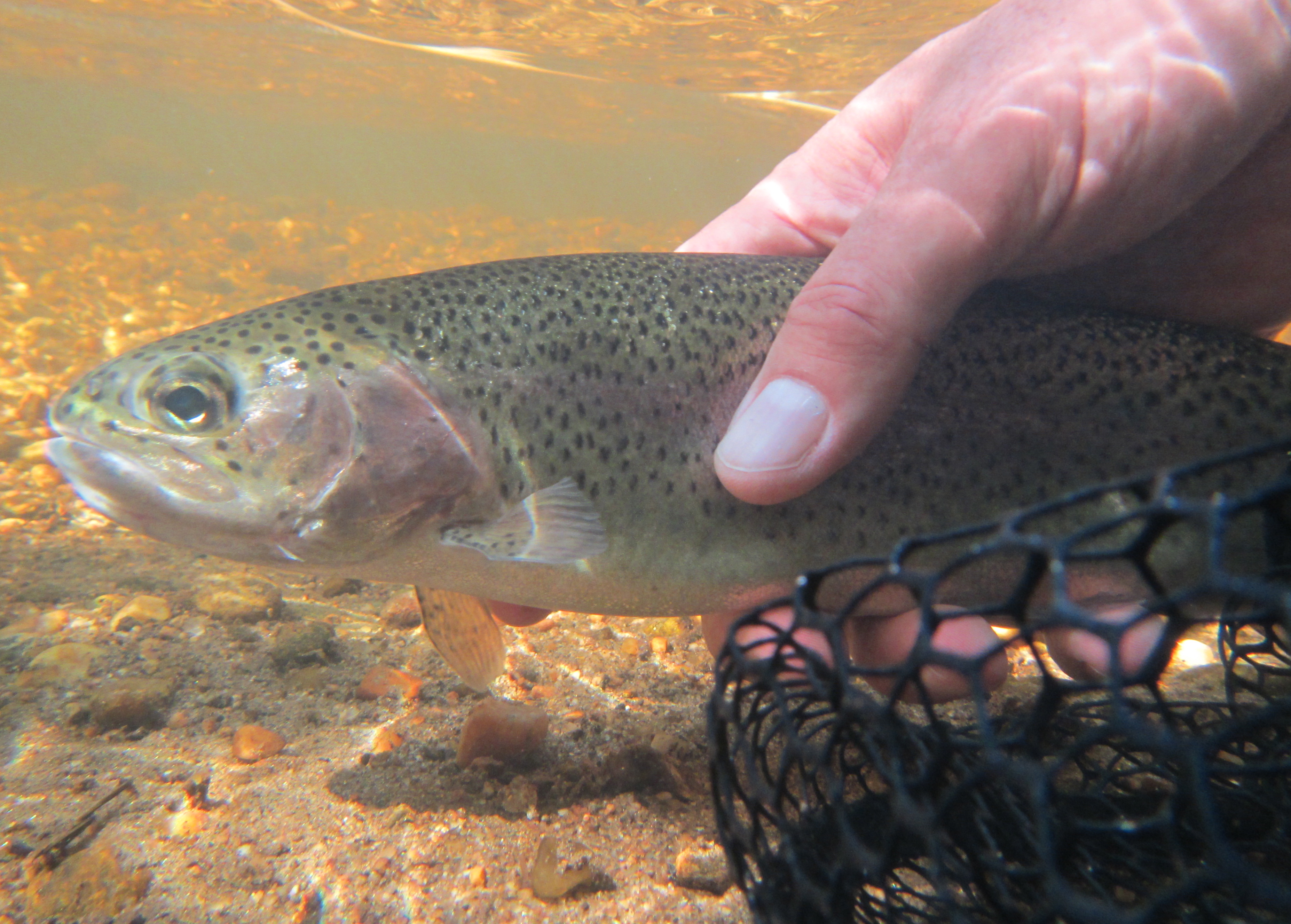
Another fish that clearly has been in the river for some time: wide pink banding, perfectly formed paddle tail, and just look at those fins. Fat, healthy, and powerful — he’s been eating well. A measurement placed it just a bit shy of the 20″ mark. No complaints here.
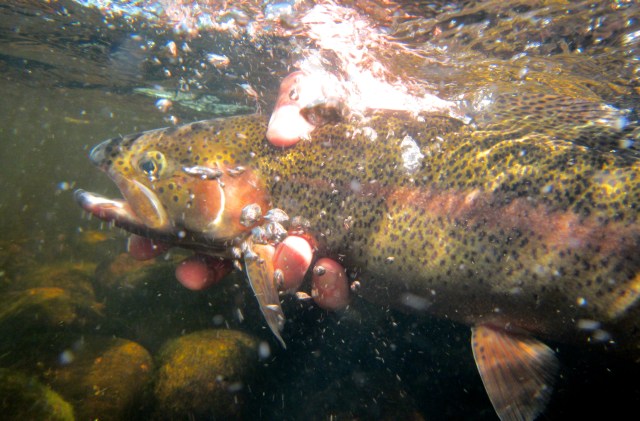
Big Rainbow 9-14

A few minutes later, I landed his younger brother. Then a wild brown. Spot C, another classic nymphing hole, delivered a few more wild browns. As the sun edged past its noon zenith, I fished Spot D, a collection of current seams (oh, that phrase), pockets, plunges and runs. Another brown, and then what I believe to be a brown/Atlantic salmon hybrid*. I am not exaggerating when I tell you this guy made head high aerials. (That is correct. Plural.) I figured rainbow, because of its color and acrobatics, but when I got it to hand it looked — well, different. Damn me, I didn’t think to get a picture. 

Here’s what was most fascinating to me today: I fished a two fly nymph rig with a size 12 bead head Squirrel and Ginger on point and a size 14 soft-hackle Pheasant Tail top dropper. The fish took both flies — but with one exception, all the wild browns took the soft-hackle. Again, some very subtle takes on the soft-hackle — almost like the indicator stalls for a microsecond. Set, and I was on.

The rainbows found the size 12 bead head Squirrel and Ginger to their liking.
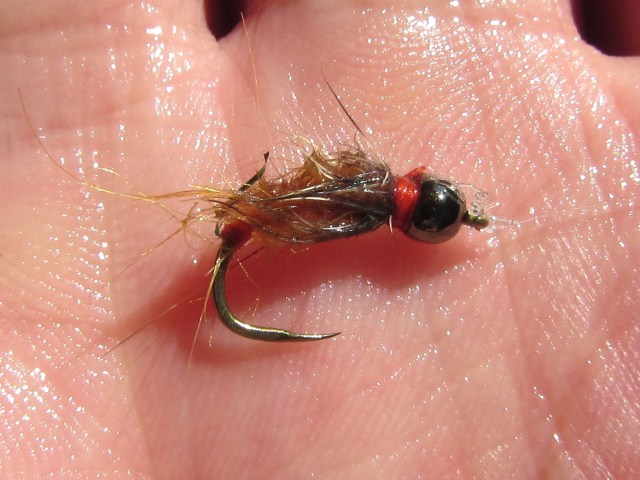
BHS&G Nymph

*In conversations with DEEP Fisheries biologists, they’ve revealed that they think some of the more precocious Atlantics canoodle with browns. I believe this is the second such offspring I’ve caught.


Farmington River Mid-Labor Day Weekend Report

On Thursday I finally got around to making my first dedicated-to-the-nymphing-cause trip of the summer. As I was walking down to my first spot, an angler upstream — presumably trying to be helpful — shouted out, “There are no fish in there. They’re all gone.” Well, one of us is going to be wrong, I thought to myself. One hour and three trout later, I was pleased that it wasn’t me.

I fished a new nymph setup that day, a drop-shot rig. My version was a leader about 8 feet long, then an emerger-like nymph dropper on a tag of 4# Maxima, then 16″ of 5# Rio nylon, another nymph, then a 6″ tag of the 5# with 2 BB shot at the bottom. The shot tag is tied off the bottom nymph hook eye. (If I get enough interest, I will draw and post a diagram.) The point of the rig is to get the weight on the bottom where it should be, then suspend the flies at different heights just off the bottom. You can fish it neat or with an indicator. I went the indicator route. Obviously, you already know it worked. I did, however, drop three fish in the course of the day, and I wondered if that bottom fly is harder for a fish to grab since it isn’t swinging freely. More research is required. Lucky me!

This rainbow has been in the river for a while. Well-defined pink lateral band, intact scale pattern, perfect fins.

Rainbow Release

Off to the second spot, where I landed a rotund wild brown (all the browns I took today were never wards of the state). Met up with friend Todd, and we each managed fish a ways downstream. By now, though, it was 11:00am and the bite had slowed. Away we went to Spot D, where we met up with Peter Jenkins of Saltwater Edge fame. Todd showed off by catching all the trout.

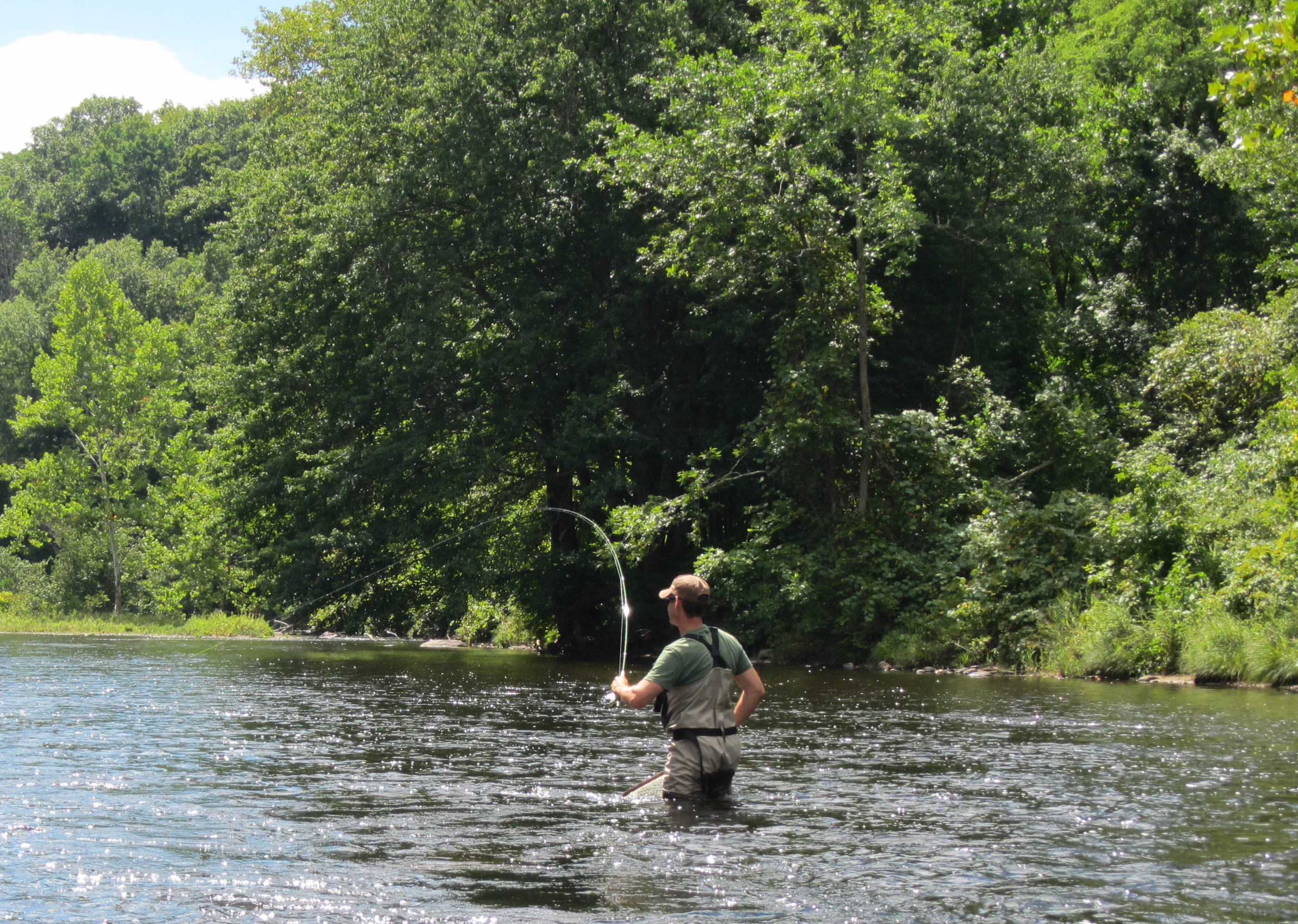
Mr. High Hook Spot D in action.

Todd Fish On

I dropped one more fish at Spot E before I had to make tracks toward responsibilities. The two flies I fished were a size 16 soft-hackled Pheasant Tail on the top dropper and a BH Squirrel and Ginger on bottom. The fish showed no preference, split right down the middle on the two.

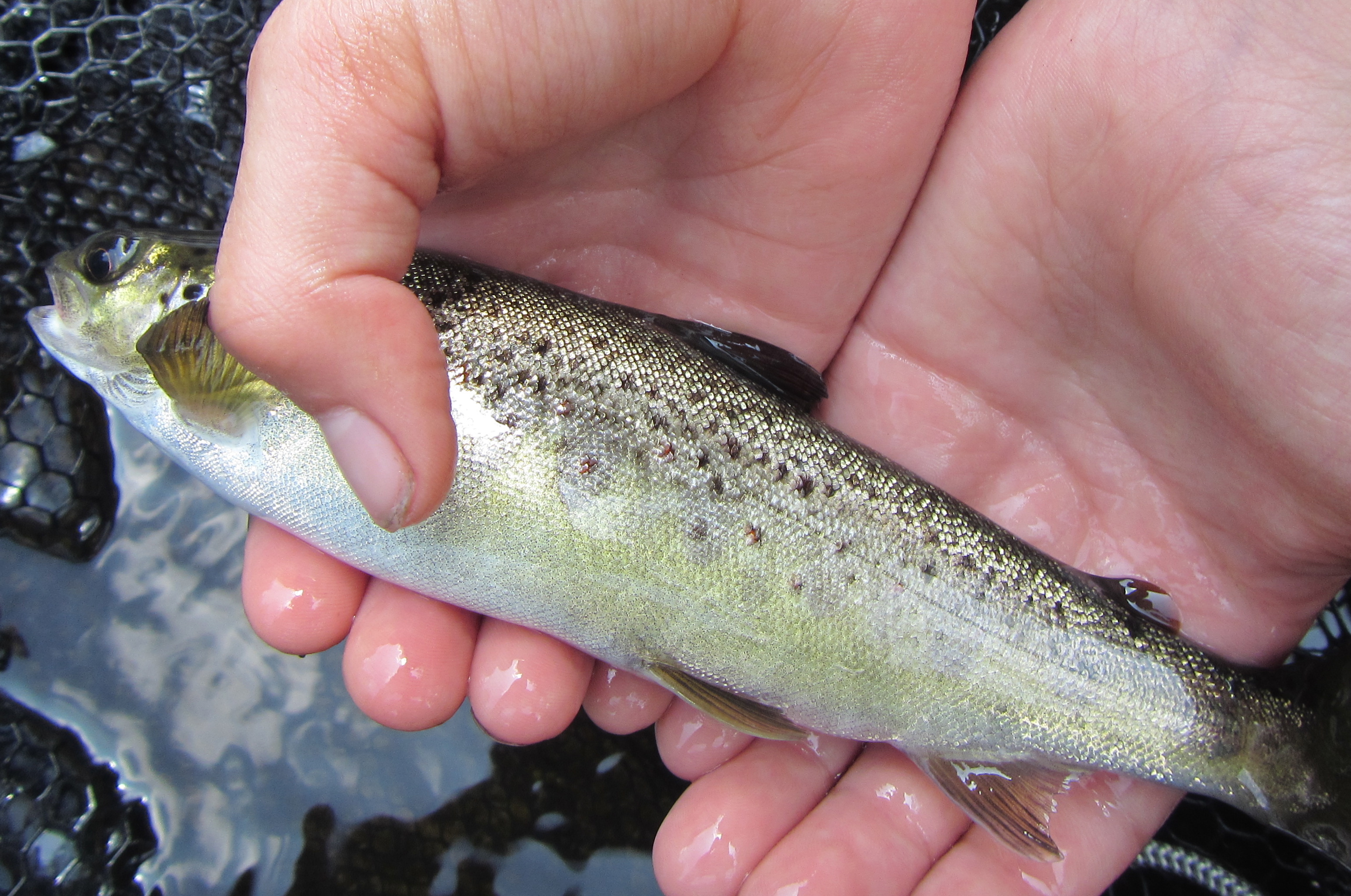
On Saturday, I was able to fish for two hours between games at my son’s soccer tournament. Wet fly was the method, and while I found plenty of fish willing to jump on, they were all juvenile Atlantic salmon. Still, a lovely interlude on the water.

I would not feel so all alone.

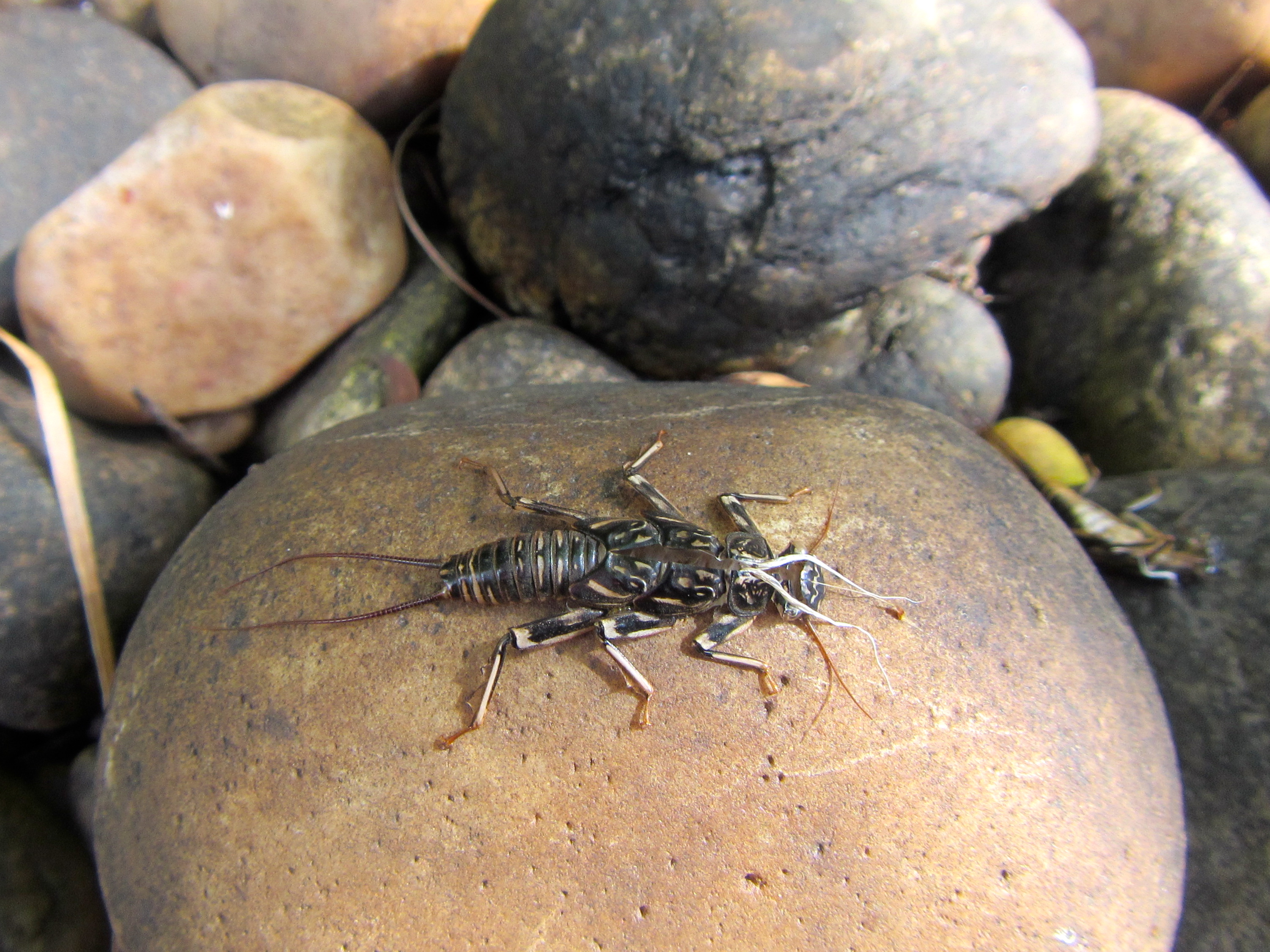
Stonefly Case

Reminder: Starting Monday, September 1, the lower TMA becomes catch-and-release.

Farmington River Mini-Report 8/22/14: Wet and wild

I had two hours to fish on Friday afternoon, so I jumped on it. I bounced around the lower river, visiting a few spots that I hadn’t fished all year. The air had a fall-like feel; it was overcast, and the river was running at 417cfs and 66 degrees. Bug activity was sparse and sporadic: a few small caddis, midges, and BWOs. 

This was a dedicated-to-the-wet-fly-cause outing. I swung a team of a sz 12 hackled March Brown on top, a sz 14 Drowned Ant in the middle, and the old reliable sz 12 soft-hackled BHPT on point. (I like a tungsten bead head fly on point when the water is running higher than normal. With a few strategic mends, it sinks the team faster, and also expedites deeper short line dead drift presentations.)

The PT was the runaway favorite fly. I hooked a nice assortment of wild browns with a few JV salmon in the mix. I had some hideous luck as well: not once, but twice I lost a good fish when he went deep and one of the flies on my team got entangled on rocks or vegetation. I lost two-thrids of my rig on the last one and called it a day.

Fat, healthy, and ready to rumble, these wild Farmington River browns are a treat to catch. Many of the takes today were subtle; more of a building of pressure on the mended swing than a clobbering hit. Good stuff.

IMG_2344

A team of three wet (fly fishermen)

And so it came to pass that the Culton men went forth on a crisp, sunny August afternoon and swung wet flies on the Farmington River. Okay. So Gordon was fishing a soft-hackled streamer, and was using a spinning rod. The point is — well, if you’ve ever taken your kids, or any kids fishing, you already know.

Watch out for those trees on the backcast. Cam didn’t catch anything, but he did a more than capable job casting and presenting his soft-hackles. Another place and time and he could have been well into some trout. A fly addict is born.

IMG_2334

Gordo’s juvenile Atlantic salmon. Dad hooked it on a hackled March Brown spider, Gordon landed it with the ten-and-a-half-foot rod. “Can I hold it?” he wanted to know. You betcha. Just get your hands wet, and watch out. They like to jump.

IMG_2329

Farmington River Report 8/12/14: Before the rains came

It’s been a slow summer for me swinging wets on the Farmington. Until today.

They dropped the flow from the dam to 340cfs, placing the upper river at a near-ideal 375cfs, and the lower river at 400cfs. Water temp on the lower river at 2pm was 66 degrees, darn good for mid-August, and no doubt cooler still at the bottom.

I visited several locations today on both ends of the river and found plenty of trout willing to jump on the wet fly. I fished my usual three-fly team; today it was a size 12 Squirrel and Ginger top dropper, a size 14 Drowned Ant in the middle, and a size 12 soft-hackle BHPT on point. I caught trout on all three flies, and even had a Farmington River Grand Slam with at least one brown, brookie, rainbow, and Atlantic salmon in the mix. One of today’s salmon was approaching the double-digit inches mark. Salar the Leaper indeed.

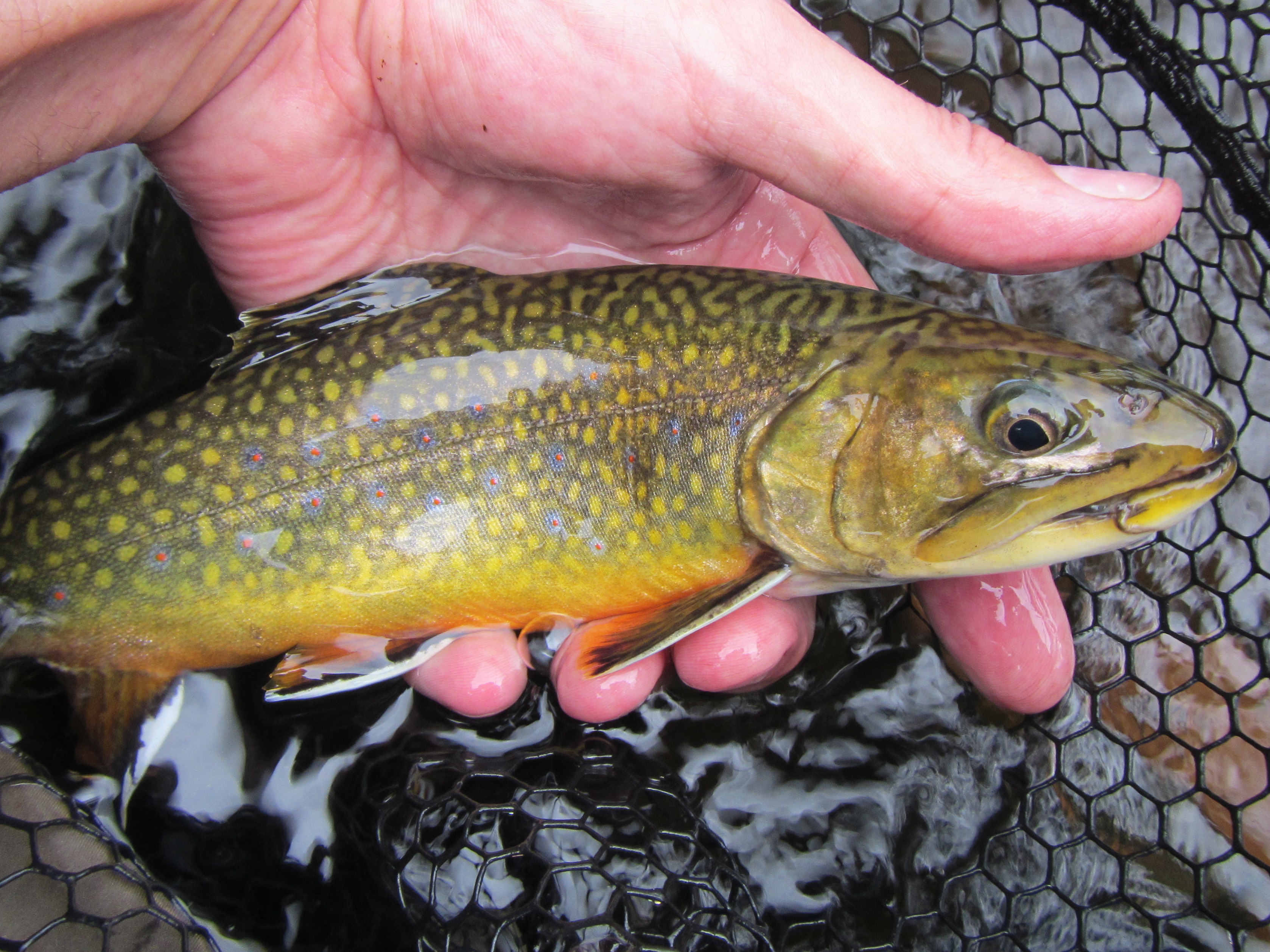
A staggeringly beautiful wild Farmington brookie who took a Drowned Ant on a mended swing. This is one of the best fish I’ve ever landed on this river, a tremendous fighter worthy of your applause. Also note the classic contrasting colors of the fontinalis fin.

IMG_2314

With the lower flows, my focus was on exploring some treacherous snotty water that had been previously out of reach. I almost went swimming a few times, and I even breached my waders when I stepped into a chest-high hole. (Please use a wading staff when you’re wading swift or difficult sections.)

Very little in the way of hatch activity today, although the Cedar Waxwings were busy.

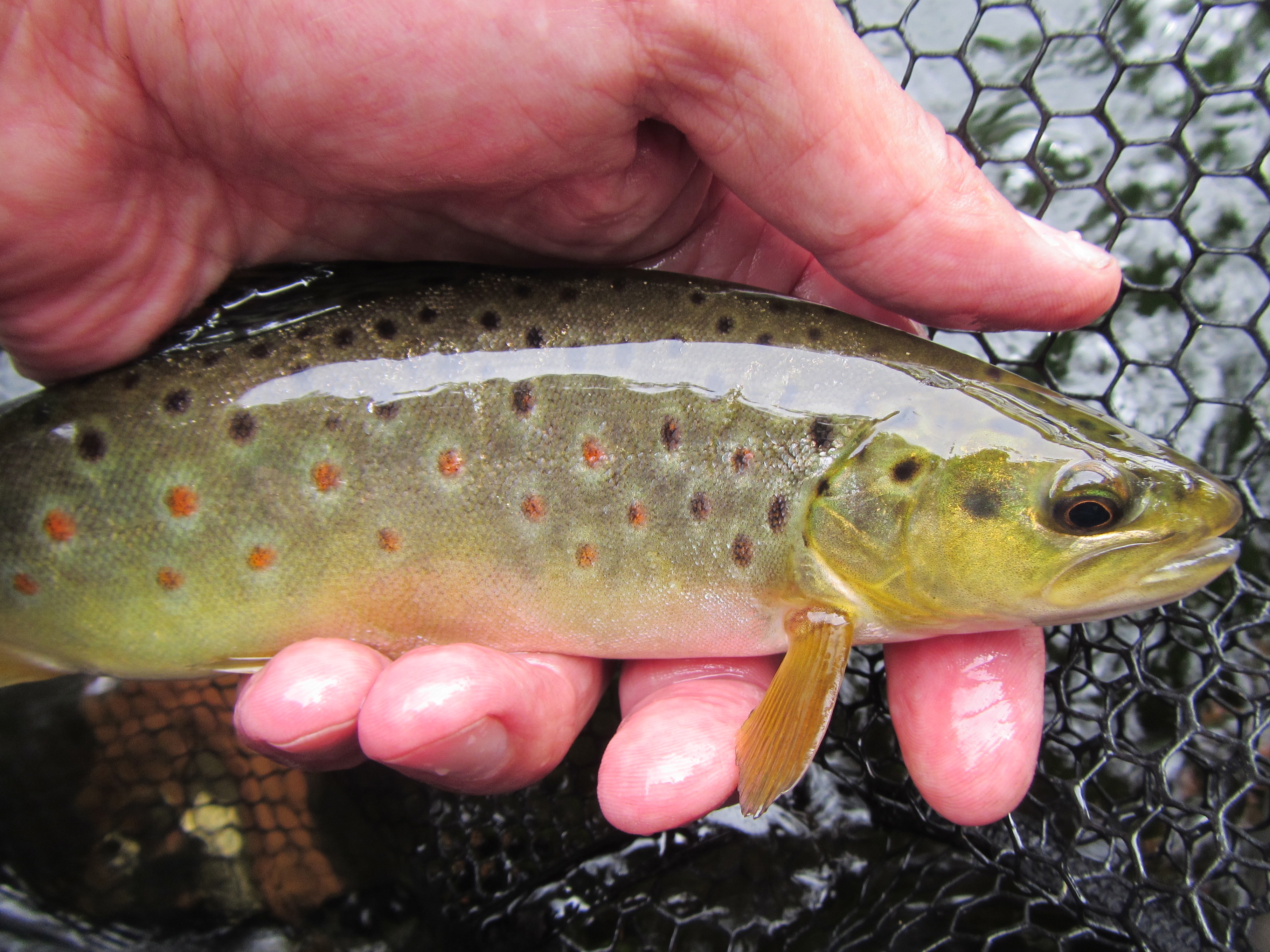
The big one — 20+ inches —  on a wet fly still eludes me this year. But with a bounty of wild browns like this one, I’m not complaining.

IMG_2303

Farmington River Report 8/6/14: Follow the Heinie Trail

It seemed stupid to spend close to two hours driving to fish for only seventy-five minutes. But I did it anyway.

I turned my attentions to a snotty section of the lower river. At 510 cfs it was a challenging wade. I didn’t bring my thermometer, but it felt about 65 degrees at index finger depth. Not bad for early afternoon on a sunny day in August.

This year, the wet fly fishing has been slower than usual for me. I think some of it has to do with the elevated flows. I probably should be doing more nymphing. At least the trout are happy. I fished size 12 Squirrel and Ginger on top dropper, a sz 12 Drowned Ant in the middle, and a size 12 soft-hackleBHPT (tungsten bead) on point. I had several raps from those pesky JV salmon; I landed one of them. What a tub of fish flesh. Almost perch-shaped. I dropped a brown who was hiding behind a rock with a dopey reaction hook set. The one brown that came to hand was wild and in the foot-long class. He was quite exuberant in his reluctance to come to net.

That one fish was just enough to cover my lack of good judgement.

Classy litterers only leave premium cans behind. This says, “I’m not just a rude, ill-bred person; I’m a rude, ill-bred person with exceptional taste.” 

IMG_2295


Someone enjoying a snack in the cool shade of the tree-lined riverbank.

IMG_2300


Farmington River Report 7/31/14: Saving the best for last

I have to confess there are times when I am completely flummoxed by this river and its residents. Like last night.

I arrived on the upper TMA at 5:45pm, committed to the dry fly cause, cane rod and 14-foot leader ready. Here’s what I was dealing with over the next couple hours: trout feeding on caddis emergers. Trout rising delicately to something very small. Trout slashing violently on the surface, breaking the film and leaving an air bubble. Trout taking sulphur and March Brown duns off the top. All of it rather haphazard, with no consistency to the rise forms or even with specific fish feeding. In one thirty second period, five fish would rise. Then nothing for the next fifteen minutes. Random would be a good word.

So I took a kitchen sink approach to fly selection. Small Magic Fly. Big Cahills. Small Cahills. Small caddis emergers. Small ants. All I had to show for it was a bunch of refusals and a JV Salmon on the Magic Fly. So I made a plan: as darkness fell, the trout would get sloppy. A size 12 Light Cahill would do the trick.

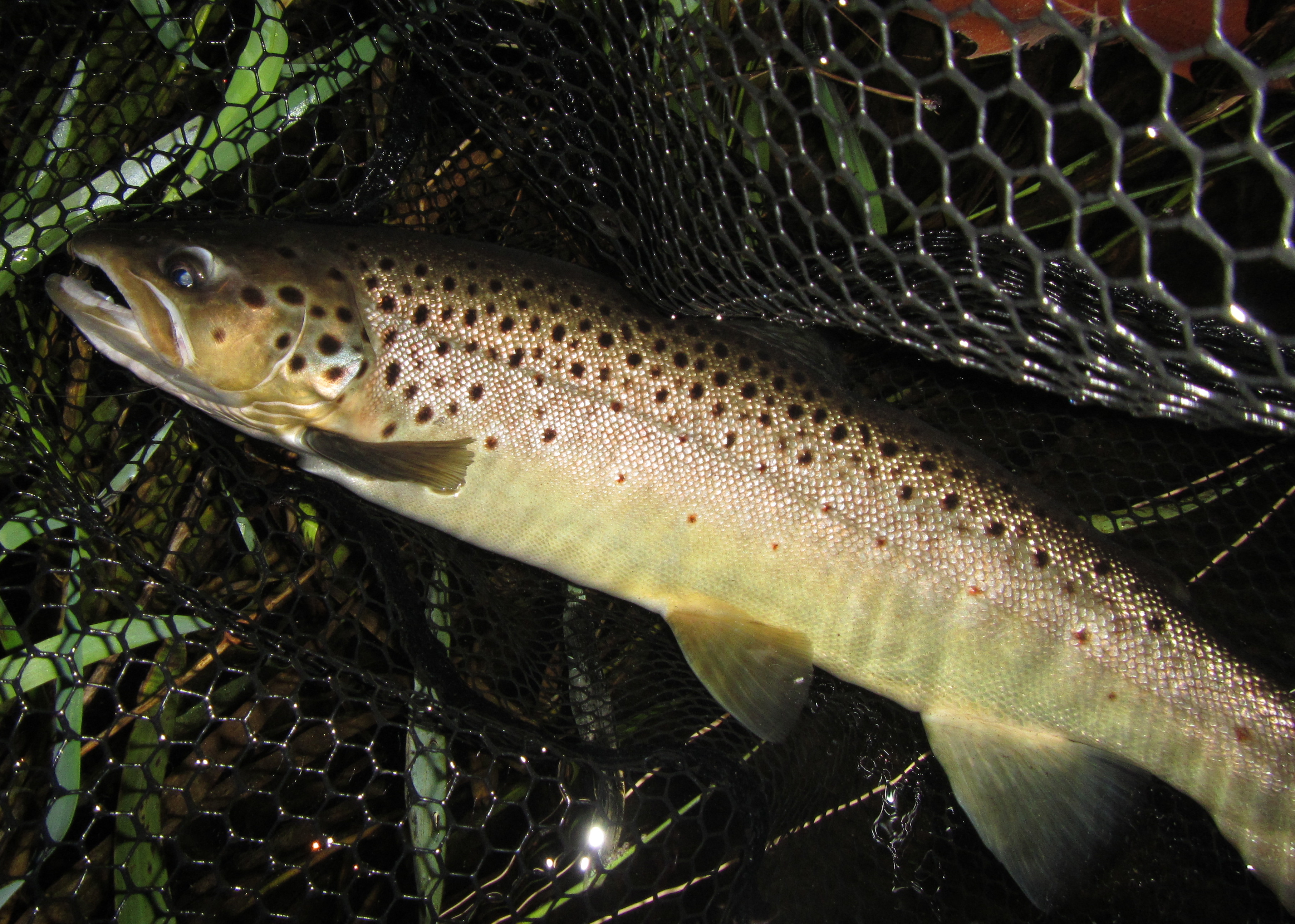
And that’s how I managed to cross paths with this handsome fellow, a wild brown in the high teens  who gave me a thrilling battle on the click-and-pawl South Bend:

Dry Brown 7:14


I stuck a few more of his friends even after it was too dark to see the fly. Then celebrated with a cheeseburger from Five Guys.

River notes: upper TMA 475 cfs. Golden stones (about a size 14) came out at nightfall. Water running cool and clear.

What about Bill?

You’ve read of the steelhead and striper adventures of Cam. Followed the woodland wanderings of Gordon.

So how come I never write anything about Bill?

Last week, Number One Son returned to his natal shores from the far away land of Miami. He had mentioned the F-word several times during his stay. And so it was that father and son found themselves on the Farmington River last Friday evening to catch the evening rise.

Catch? Here’s one: Bill had never fly fished a big river for trout. At least, Grady Allen assured me, he would have a good instructor. I replied that maybe we should get Fred Jeans.

Bill did great. In no time at all he was mending like he’d been doing it for years. I’d like to tell you that he caught a ridiculous number of fish, but it was one of those nights where hook sets were few and far between. He had the right fly (size 20 Light Cahill Catskill dry) and the right presentation — he had one low-teens brown make a good half dozen rises — but a soup-to-nuts complete transaction was not in the cards.

I, on the other hand, had lottery luck. As we were starting, I was greasing his leader, fly dangling in the current six feet below me, when I hooked a nice brown. I handed the rod to Bill, who managed to hand strip in his first trout on a dry. Well done, son. Dad managed a few more later on the Magic Fly, size 20.

We stayed till dark, then re-rigged for night patrol with streamers. No bumps in a half hour had our stomachs arguing with the fishing center of our brains. Cheeseburgers finally won.

My cigar that night was a My Father Le Bijou 1922 Belicoso Bill had given me for for Father’s Day. I was using my father’s old cane rod.

Sometimes it is fun, being a dad.

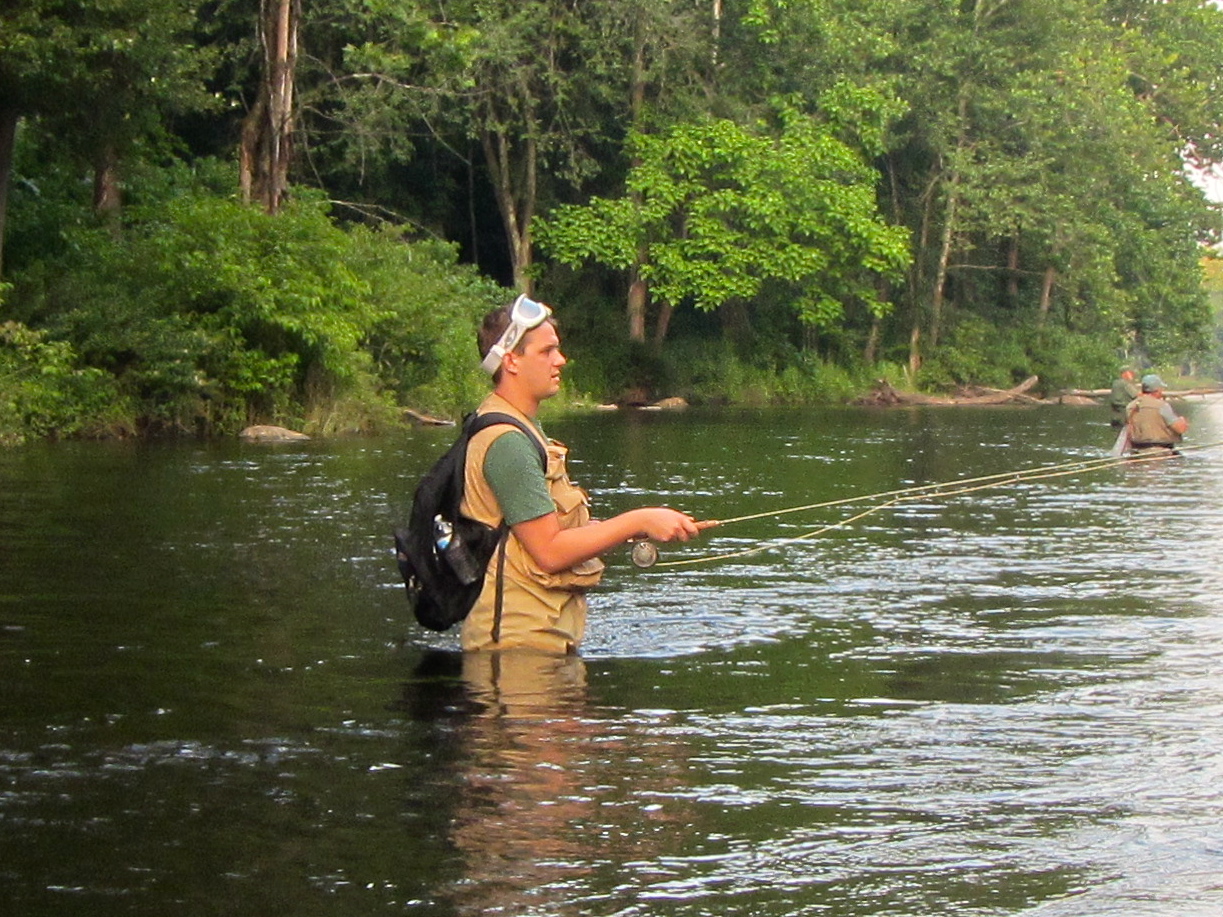
Bill at the controls, ready to stick that brown. Note the ski goggles filling in for polarized glasses. Marines adapt, overcome, improvise.

Bill Dry


Farmington River Report 7/21/14: Just the facts

Borrowed from L.A. Confidential (just finished watching it for the Xth time), whose writers borrowed it from Dragnet, so I might as well borrow it for a fishing report.

Where: Upper TMA, 476cfs, 58 degrees

When: 5:45pm-9:00pm

Hatches: Size 16 BWOs (fairly heavy). Size 14 sulphurs (a few). Size 10-12 March Browns (even fewer). Size 16 tan caddis (some). Size 18-20 summer stenos (fairly heavy).

Hello, old friend. I missed you. You’re here on July 21st right when you’re supposed to be. Summer stenos are the hatch I hate to love. I can’t think of another hatch that has caused me so much pain — and joy.

Summer Steno

Who: Ran into Steve Cook, a gentleman who took my wet fly tying course this winter. He did well, hooking trout after trout. We were also in the company of the illustrious Grady Allen, owner of UpCountry Sportfishing. Grady was there with his friend Ron. We shared the water with a half dozen other anglers, but we all had a generous amount of space to operate in, and no shortage of fish to present to.

Flies: Started with a size 16 Magic Fly, then switched to a 20. The 20 worked best. Ended the evening with the size 12 Light Cahill Catskill, until I couldn’t even see that.

Feeding: Weird. For the bulk of the evening I had no consistent risers in front of me. Most of the active fish from late afternoon to early evening were JV salmon. Most of the active fish were behind me, along a shallow bank, until dark, when the deep water switch got thrown. I took two nice browns, one a small wild fish, the other a low teens holdover, just by prospecting along the bank. All the other trout I hooked were actively feeding. The fish were mainly on emergers; I witnessed dozens of rises followed by an escaping mayfly that materialized from the disturbance. At dark it was spinner central, with dozens of backs visible as the trout porpoised.

Best fish: See below.

This is the biggest brown I’ve taken on a dry in a couple years — high teens long, thick, ham-like shoulders and a few pounds on her. She was feeding in about two feet of water ten feet off the bank. I’ve been trying to learn to play larger fish with the bamboo rod, the click-and-pawl reel, 6x tippet and small dries for years — losing plenty of bruisers in the process — and last night was the first time I felt like I wasn’t going to mess it up.

Big Brown on Magic Fly