Farmington River mini-report 9/25/17

A quick dash to the lower river to see if anyone was home. Water was low, 175cfs, about half of what it normally is this time of year, and felt like it was in the 60s. (Brief editorial: I must confess the logic behind water releases from the dam often escapes me. If periods of drought are the new norm, and September and October are traditionally low water periods, why run 300+cfs from the dam from April through July? Would we have more water now if they only ran 250 or even 200cfs all those months? What am I missing here?)

To the fishing: I swung wets in two runs for about 15 minutes each and came up with two customers, a nice 11″ wild brown and a much bigger, recently stocked rainbow. Both fish took the top dropper, a Squirrel and Ginger caddis. Lots of bug activity (caddis, midges) but nothing rising to it.


Trout fishing for stripers

Ben wanted to learn the mystical art of the floating line and traditional trout and salmon presentations for striped bass. So we braved the bluster and squalls of Jose and went exploring. We saw bunker in two of the tree locations we covered, but sadly no striped marauders. Ben did a great job with all the information I threw at him, and he’s going to be a dangerous striped bass catching machine.

Sometimes the cast is only a few feet. Ben covers a rip line where marsh grass meets flowing water.

OLYMPUS DIGITAL CAMERA

While I’ve gotten many requests for lessons like this, I have in the past resisted due to logistical (I don’t take people out at night) and practical (the day striper bite can be tough) considerations. Now that the seal has been broken, if this is something you’re excited about, we can try to make it happen. You’ll have to be agreeable to a shorter session (2 hours or so), the schedule of the tides (I can’t do anything to change them) and that the on-the-water lessons may not involve catching (see “day striper bite” above). Please don’t try to set something up though the comments section; rather, call or email me.

Bringing fly to fish. You too can learn the meditative art of the greased line swing. Here’s Ben throwing an upstream mend, keeping the fly broadside to the fish at the speed of the current.

OLYMPUS DIGITAL CAMERA

2017 Farmington River Broodstock Report

The collection for the next generation of Farmington River Survivor Strain broodstock was completed on Monday. The river is now back to a normal medium height (about 240cfs in the permanent TMA). Here are some details on the collection, conducted within the permanent TMA, from Fisheries Biologist extraordinaire Neal Hagstrom:

“We captured approximately 90 brown trout that we took to the Burlington Hatchery for broodstock. The largest was a 22+inch wild male. The state facebook page has some streaming video of the fish workups (visit the CT DEEP Facebook page and scroll down to September 11 — neat stuff!). We also took 15 other smaller or injured trout for general background health checks of diseases, something we do every year.”

Some of the broodstock are Survivor Strain from this year (left red elastomer) and last year (left yellow). About half of the older fish showed no signs of spawning and were returned to the river. The DEEP looks for genetic elasticity in their broodstock combinations, so there is a broad range of sizes, Survivor Strain and wild, and of course  both sexes in the sampling.

Neal commented that while there were plenty of fine specimens, there weren’t a lot of trophy trout. This dovetails with my experience this year: an abundance of high teens browns but not a lot of true brutes. He said the fish should be returned to the river in early December, “and no, we did not take everything. There are still plenty there.”

Thanks, Neal, and thanks to the DEEP for this amazing fishery and breeding program.

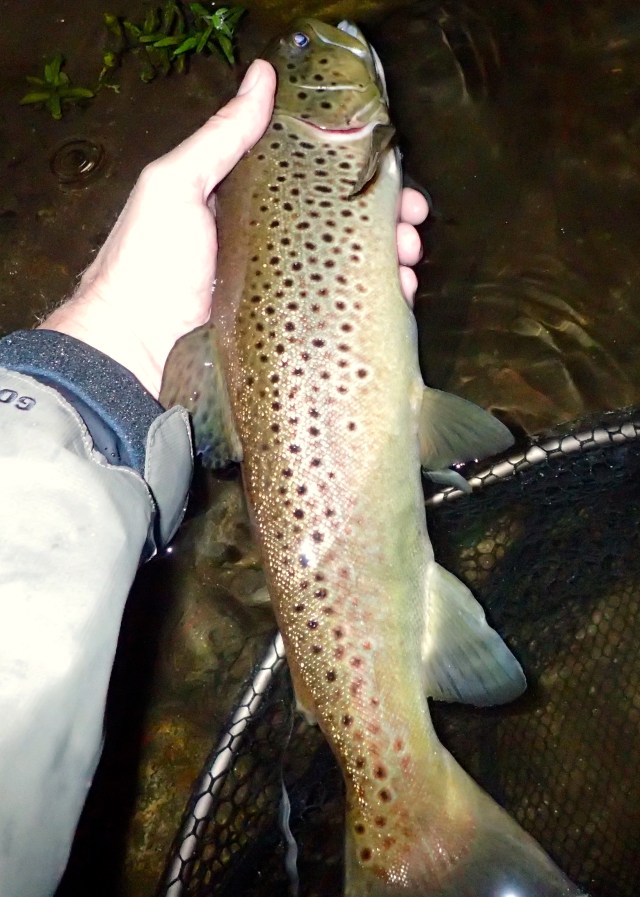
We grow ’em bigger than your net. A true 20″ Survivor Strain brown (clipped adipose) taken this summer. It’s hard to photograph a fish this big by yourself, but it’s surely a most wonderful dilemma.

OLYMPUS DIGITAL CAMERA

Farmington River broodstock collection update

Last night’s rain’s added too much water to the system (over 130cfs from the Still) so the broodstock collection has been rescheduled for Monday, September 11. I do not know if they will increase the dam outflow (currently 50cfs) this weekend, so check before you head out.

The collection takes place within the Permanent TMA. Yes, you can still fish, but anglers are asked to give the DEEP crews a wide berth. Quite frankly, I’d skip fishing until the water gets back to a more sporting level, but if you must go, why not volunteer to help out on the collection crew? It’s a great way to give back to the fishery, plus you get to see where the big boys and girls hang out…

If you’re interested in learning more about the Survivor Strain Program, here’s a short piece I wrote a few years ago for The Drake.  Survivor: Farmington

The trusty DEEP sampling crew in action.

Screen Shot 2017-09-07 at 1.30.42 PM


Shocking news from the Farmington

If you’re a regular reader, you should no longer be falling for that scandalous teaser headline. We’re talking about the DEEP’s annual electroshocking/sampling/broodstock collection that eventually produces those wonderful wild and Survivor Strain browns.

You may have noticed the Riverton USGS gauge dropping like a stone:

Screen Shot 2017-09-06 at 2.32.27 PM

Here’s the word from DEEP Fisheries Biologist Neal Hagstrom:

“The hope is to get the broodstock collected tomorrow if the river is low enough.  If not we will try again on Monday.  They are changing out a gate at Rainbow Dam and need the reservoir down to do the work. They are looking at refiling the reservoir on Wed late/Thursday.  The river should return to normal flows then.  Of course, hurricanes  can change everything…”


Farmington River Report 8/29/17: Slow and getting low

I guided Ed today, and we were faced with a river that hasn’t been this low in months. Fear not, there’s still plenty of water (190 cfs in the permanent TMA) and plenty of trout, although the latter were a bit bashful today.

We worked on Ed’s nymphing and wet fly presentations which were pretty darn good already, a testament to the slowness of the day. Spot A was below the PTMA — there were a few bugs coming off, but the only trout we played with was a camera-shy rainbow that came on a nymph.

Ed presenting his wet fly wares.

OLYMPUS DIGITAL CAMERA

Off to Spot B within the PTMA. Same story — a few bugs coming off and a few random slasher/risers, but nothing consistent. We covered that pool subsurface top (wets) and bottom (nymphing, both indicator and short-line) to no avail, until the 11th hour.

Keep on keeping on, Ed, and the rewards will be measured in pounds, not inches.

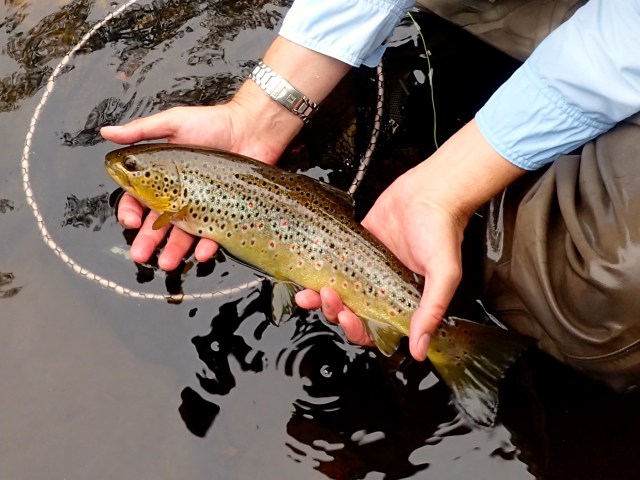
Last cast, we managed this vividly-colored 16″ wild brown with paddle fins and dramatic spotting. Taken on a 2x short size 14 Frenchie variant. A good way to end a slow day.

OLYMPUS DIGITAL CAMERA

Banging around the Cape in the dark

At dinner at the Chatham Squire Friday night, Gordo asked me, “Are you going fishing tonight, dad?” My stock reply for such questions is: “Have we met?”

I spent 90 minutes fishing a mark on Pleasant Bay toward the bottom of the tide. Not a breath of wind. The current was good and my drifts were true, but it was one of those nights where the bass were elsewhere. I cycled through some basic patterns, and the only bump came on a black deer hair head fly about 5″ long. I did see a shooting star, and that helped take my mind off the fact that I was standing in the water in the dark near white shark central. I did note silversides on the wade out.

Saturday I headed to Steve’s Secret Spot (I’ve seen one other angler there in 10 years). It’s a nondescript mid-Cape creek mouth that is either on or off. Tonight it was infested with silversides and a few striped brigands. But unfortunately, it’s an outgoing tide spot only, a fact drilled home to me while I waited almost an hour for the tide to go from slack to incoming to find that the silversides were still there but the bass had skedaddled. I had had only a half hour of outgoing, and could manage only one bump.

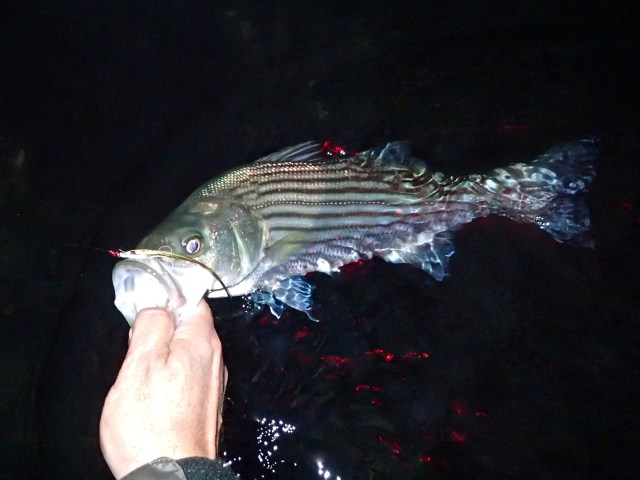
So I hightailed it back to Friday’s spot and gave myself 15 minutes to catch a bass. Midnight, second-to-last-cast, bump on the swing, then bang on the dangle. Our Blessed Lady of the Ray’s Fly Flatwing comes through again.

Four-oh. A perfect fish at a perfect time on a perfect fly. 

OLYMPUS DIGITAL CAMERA


Housy smallmouth mini-report (late)

I fished the Housy the other night from 6pm-8:30pm. Virgin waters for me, below the TMA: some pocket water that dumped into a long boulders-on-the-bottom run, shoulder deep in the middle ringed with frog water. Action: underwhelming. Hatches: underwhelming (mostly tan and black caddis). So it goes, but I did catch fish and I had the place all to myself.

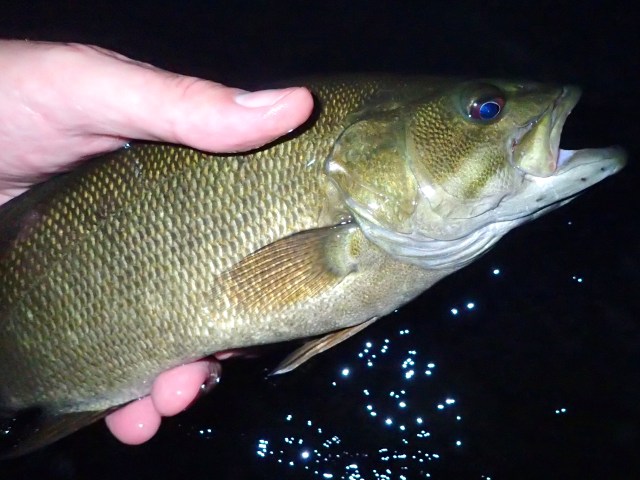
I took the usual assortment of late afternoon dinks. Pre-hatch swung wets produced very little interest (not surprising given the weak evening rise) and all the action came on the Black Magic top dropper. The smallmouth bite window was torturously brief: 8:00pm-8:15pm, then shutdown. I had switched over to a grey and chartreuse Gurgler, and my best fish of the evening came on that fly. Toward dark I did get the largest bluegill I’ve ever landed, but that’s really not why I was there.

Nearly a foot long, this dude whacked the Gurgler upon landing, then hunted it down about ten feet across a current seam. Almost put a burn in my rod hand forearm.

OLYMPUS DIGITAL CAMERA


“To play him long is to play him wrong” redux

Glass houses, stones, and all that. So this week when I hooked into a 20+” Survivor Strain brown on the Farmington, I started the clock. 93 seconds — hand-stripped, no reel — from hook set to net. (And it was only that long because I had trouble fitting him into the net first swipe.)

Unfortunately, I had camera disasters. I was using my main shooter for a different project earlier in the day and hadn’t changed the setting, so I ended up with out-of-focus mush. Then I attempted a GoPro movie of the release, only to discover that the battery was dead. So you’ll have to use your imagination: kype, clipped adipose, leopard spotting, brawny, and no match for an angler with a sharp hook and a reliable leader.

Housy Smallmouth Report 8/10/17: Questions 67 & 68

When I’m teaching or speaking, I often tell people that I don’t have all the answers. This isn’t false modesty. I really don’t. But I do have many questions. And so it goes with the 2017 smallmouth season. So, to quote the Polish Prince, I’d like to know…

Where are the bigger fish this year? Last summer’s bronze bully bonanza stands in stark contrast to this year’s onslaught of sub-6″ fish. It’s not so much that I mind the action, but I’ve managed only one bass this summer in the foot-long class. Dusk, last year’s magic time when the double-digit inchers came out to play, has been largely pipsqueak heaven.

One theory I have is that last year’s uber-low water concentrated the fish into runs and holes that provided enough current and cover; when the dinner bell rang, the alpha fish in any given spot took charge. This year, with significantly more (and cooler) water, the bass are more spread out. Still, that doesn’t explain why I wouldn’t at least have chanced into a larger fish.

Which leads to my next question: why has the dusk-to-dark surface streamer bite been so slow? Last summer, I’d have bass hammer my deer-hair head/rabbit strip tail bugs the moment they hit the water. This year, my flies remain largely unscathed. (This may speak to the preponderance of small fish, since the bug in question is 4″ long.)

Obviously, more research is needed. I’ll be curious to see how the bite plays out in this watery laboratory for the rest of August.

Notes from last night: water at 270 cfs. I fished two runs from 6pm to 9pm. The first was TeQueely territory. Lots of action, although there is a structure-laden frog water section next to current and a deep hole that continuously, mysteriously fails to produce. I’m going to have to re-visit at dusk. White flies are just about done — in fact, there were far more sulfurs on the water last night. Also small tan caddis, and the ubiquitous black caddis. The two fly team of white fly soft hackle (I’m calling it the August White) on point and Black Magic dropper continues to shine. I’m swinging wets far more than I did last summer, mostly pre-hatch, and the bass just can’t keep away. Multiple doubles last night, and the Black Magic out-caught the August White 2:1. I’m targeting active feeders, swinging through and across current seams, but I’m doing boffo box office on the dangle with a slow hand-twist retrieve. Best fish last night, 9″, came on this last presentation (Black Magic).

From one year ago to the date. I know you’re out there. Somewhere. 

OLYMPUS DIGITAL CAMERA