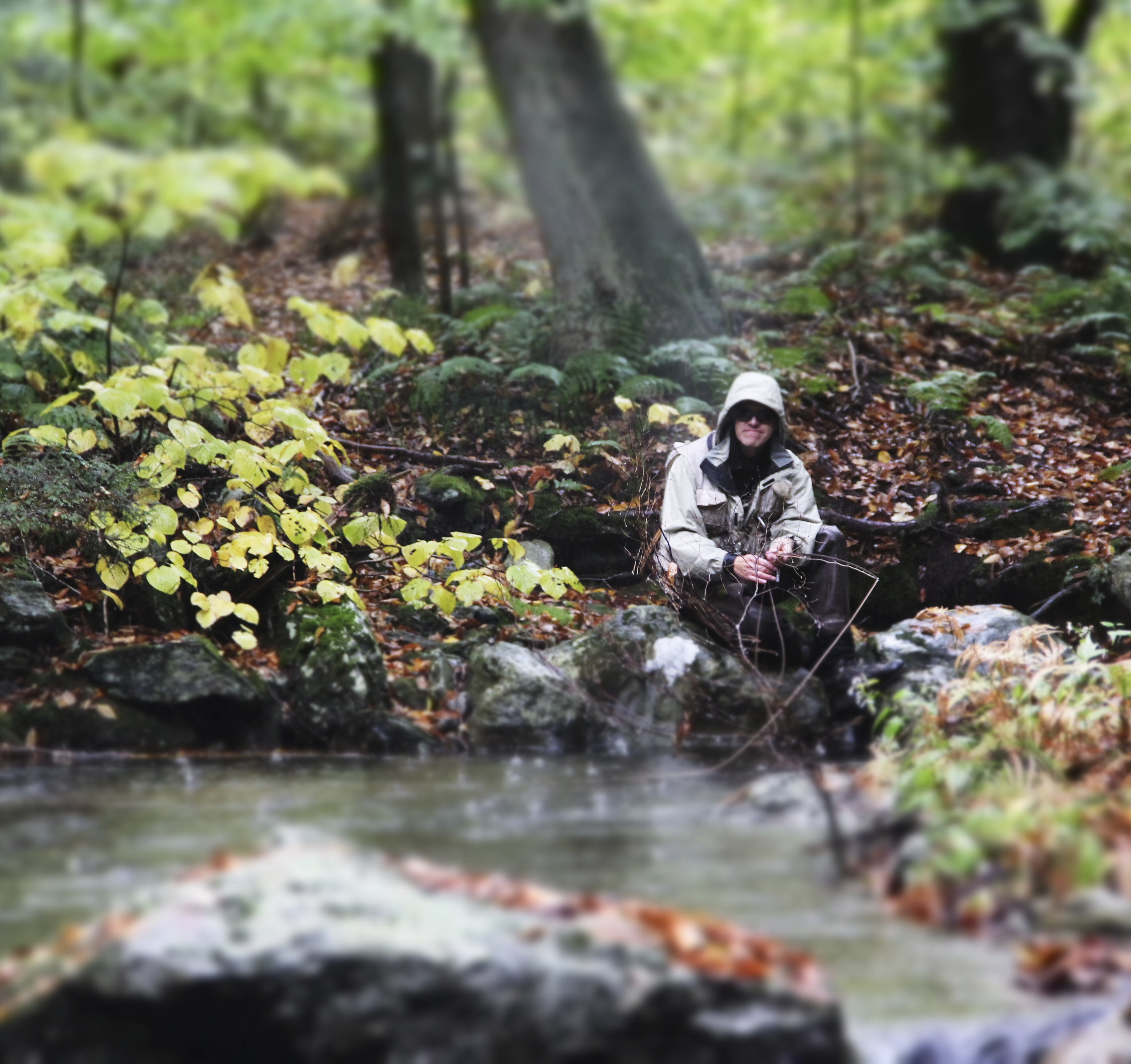
Farmington River 1, UConn 0

Those of us who love the Farmington River spoke out — and our voices were heard. UConn will be using the CT Water Company, rather than the MDC, to fulfill their future water needs.

The following is a quote from last Tuesday’s Hartford Courant:  “The selection eliminates a controversial $51 million plan by the Metropolitan District Commission to build a 20-mile pipeline from East Hartford that would have drawn water from the Barkhamsted and Nepaug reservoirs. Opponents assailed the plan, saying it would draw down the watershed of the Farmington River, a popular recreation spot.”

Yeah, baby. That’s us. Opponents. Assailants. Righteous defenders of natural resources. Thanks to everyone who spoke up, signed the petition, wrote letters, and sent emails.

Grassroots activism is so underrated.

Winner.

Image

And, winner.

Image

8/2/13 Farmington River Report: The obesity crisis among rainbow trout

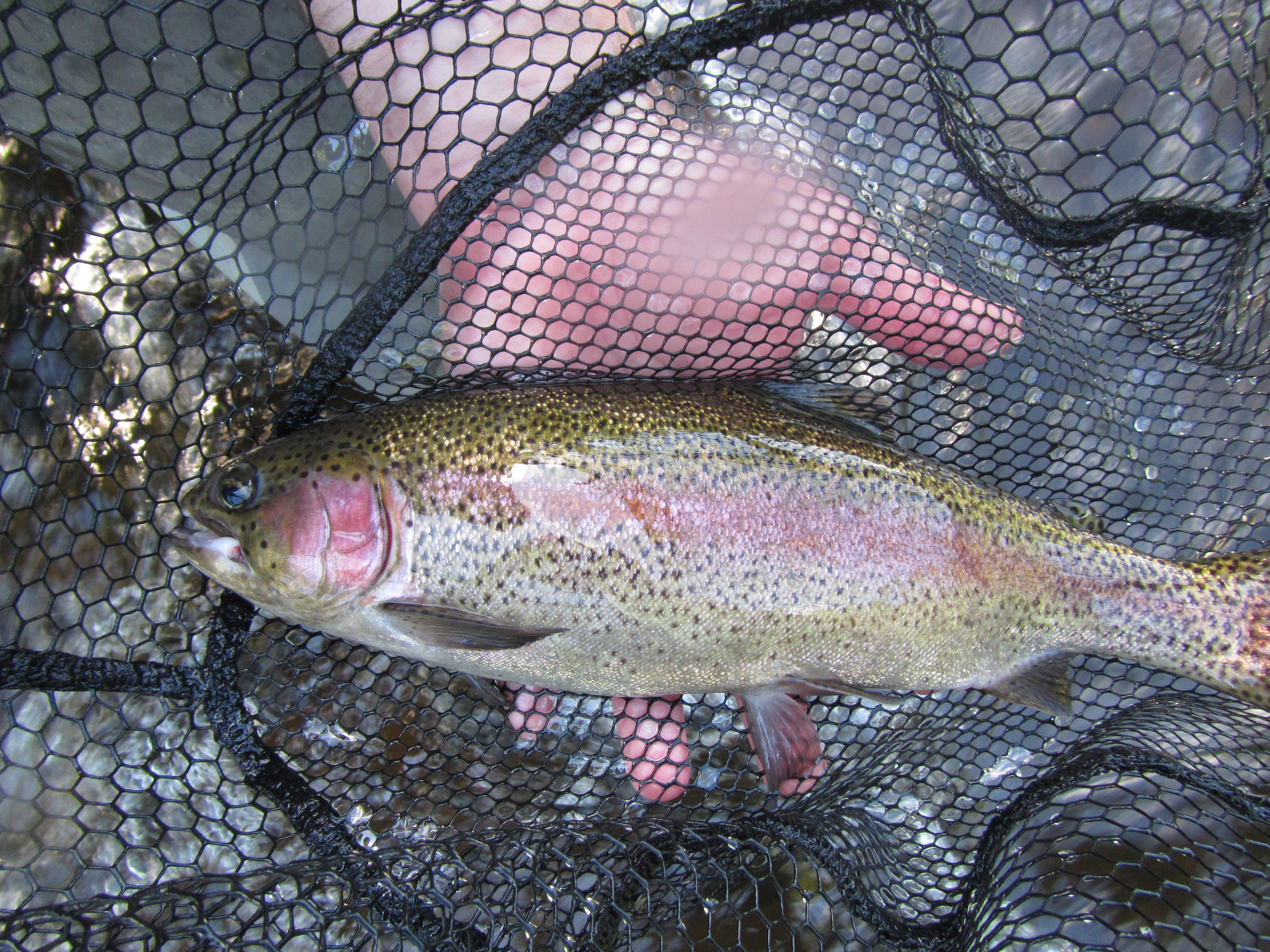
If you went fishing Friday on the Farmington, you won the weather lottery. Low humidity,  temps in the low 80s, plenty of sunshine, and not a lot of other anglers(!) on the water. I guided Matt from noon into the early evening. We had a mixed bag of success, with a fish on our first couple casts, then a long time with nuthin’. It wasn’t for lack of effort. We bounced around the river, and Matt fished his wets well from top to bottom. Very little bug activity, with water temps in the mid-60s. In the last run we fished, success! This chubby rainbow was the best of the bunch.

This is what a steady diet of cheeseburgers and fries will do to your figure.

Image

She took a Starling and Herl on the swing. What a terrific fight in the current, complete with aerials. Matt hand-stripped her in. Well done, Matt! I helped him celebrate by smoking the Punch Punch he had offered me.

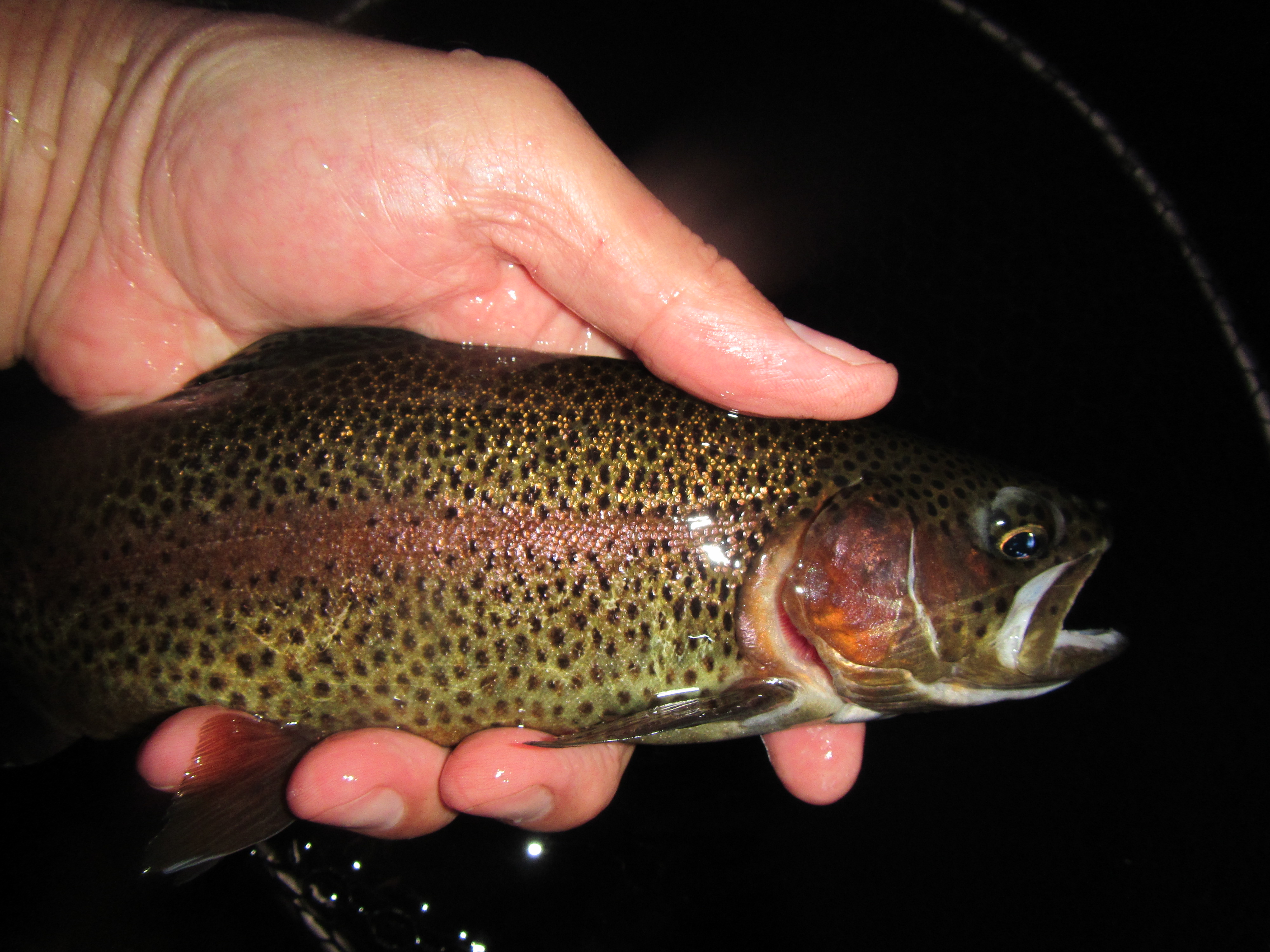
After Matt left, I fished solo for a half hour. I almost bagged it, as there were precious few bugs coming off. But a pod of fish gently sipping in the twilight talked me into it. Nothing on a size 22 Sulphur spinner. Switched over to a size 20 Pale Watery wingless wet that I fish dry and got two takers, one a brown and the other this dark matter rainbow.

I think this rainbow has been in the river a while. Besides its dramatic coloring, it did not want to come to net. Strong fish. Look at those pectoral fins. Profuse black spots, and then some.

Image

OK, so I did have a cheeseburger on the way home. But I made up for it with oatmeal for breakfast this morning, and some interval training on the bike this afternoon.

Cheeseburger after paradise

There are 365 or so days every year when you can fish the Farmington. I manage, on a good year, to do it about 40 times. But of all those days, none is more important than July 21.

I’ve made a pilgrimage to the Farmington on that day for four consecutive years now. It’s not by accident. July 21 is the day the Summer Stenos come out. Whether they appear earlier or later isn’t important; the Stenonema have their schedule, and I have mine. There’s a certain place I go to greet them, and since it’s an evening hatch, a certain time I like to be there. Admittedly, I have an unhealthy relationship with Summer Stenos. At times I hold them in starry-eyed adoration. Others, I view them with extreme disgust and intolerance. No other hatch on the Farmington so charms me that I have the date burned into my mental calendar months in advance. No other hatch baffles me with its rise-to-hookup ratio that frequently exceeds 10:1 – even though I’ve found the perfect fly for fooling the trout.

On Sunday night I got my first three trout of the year on Summer Stenos. But first, there was some swinging to be done.

I hadn’t fished with Jon in almost two months, and for our reunion outing we agreed that wet flies and riffly pocket water were in order. At 630cfs the run was quite wadeable. Jon took the first fish, a smallmouth bass, but after 45 minutes all we had to show for our efforts was a couple of juvenile Atlantic salmon. While it’s nearly impossible to get down on the bite when you’re swinging wets with an old friend on a delightful sunny day in July, I suggested we move to another spot, upstream. I guaranteed Jon he’d catch a trout there.

Such predictions are a minefield. I had second thoughts about opening my big mouth from the time we piled into our vehicles until he took his first trout a half-hour later. I was still swinging wets, working below Jon, while he had switched over to short-line nymphing. Just as my three-fly team made the transition from swing to dangle, I felt a herky-jerky tug. The fish made two quick micro-runs, peeling a small amount of line off the reel. I thought nothing of it at the time, as the take came in the heaviest section of current. No need to get this fish on the reel.

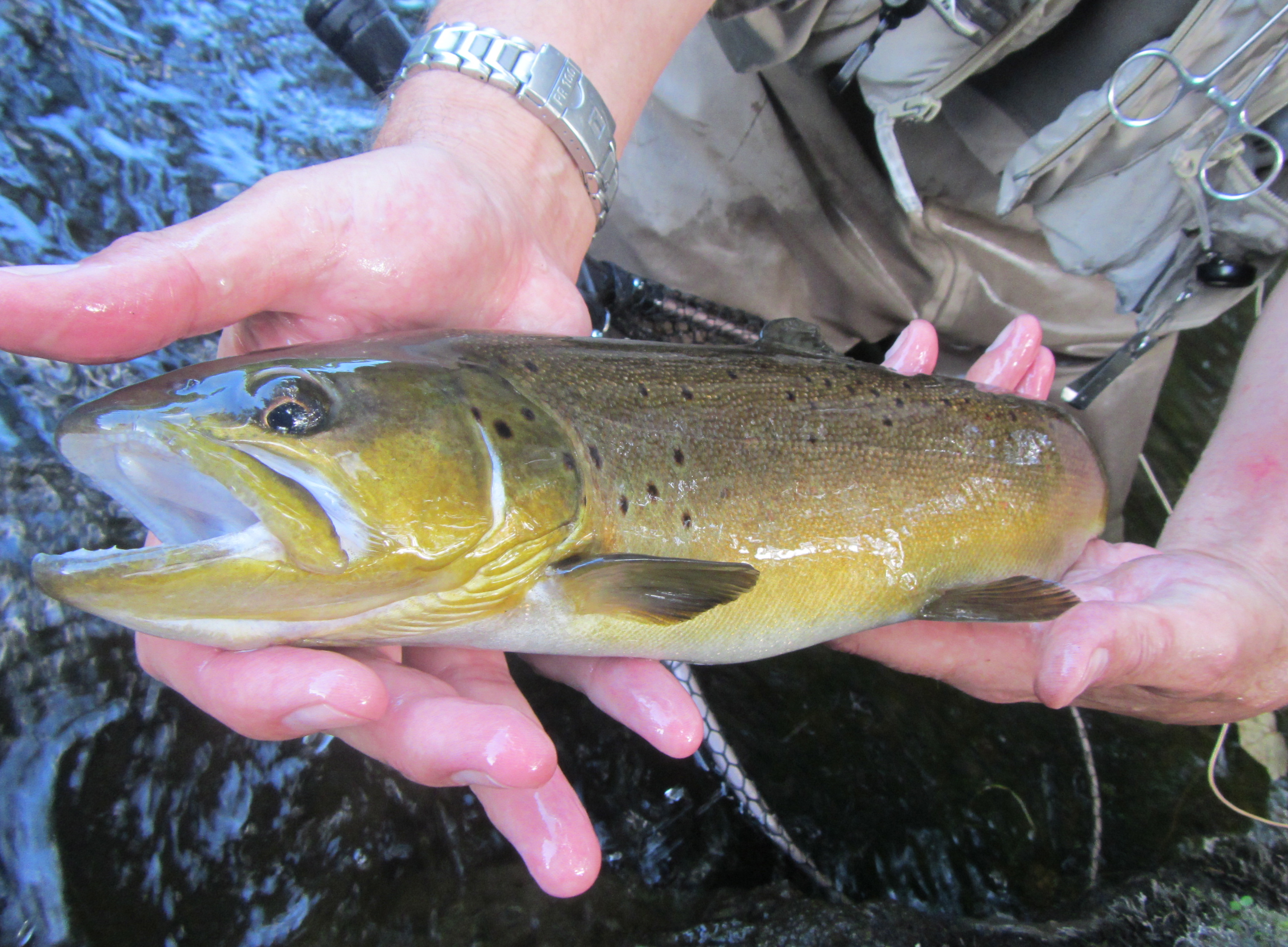
A big ol’ wild Farmington brown. These fish with a scarcity of spots are intriguing. Check out that tummy. Someone’s been eating well. He took a size 14 Drowned Ant soft-hackle.

Image

Each fight has the potential for comedy, drama, or tragedy – sometimes all three – but this one quickly declared itself a drama. The trout is usually a good one when you never see it during the encounter. Big fish have a way of hugging the bottom and using the current against you. By the time I had negotiated the trout into calmer waters, I could see that I had underestimated its size. A wild brown with an odd scarcity of spots and, despite his length, only the suggestion of the beginning of a kype.

How can you tell that you should buy a lottery ticket that day? You’re just standing in the water, savoring the moment, line dangling harmlessly beneath you, and you hook another trout. Moments later, a Cedar Waxwing lands on your rod as you hold it over the water like some conjurer’s wand. He waits there. Eyeballs you. Looks as if he’s about flee. Then stays long enough for you to call out to your friend to be your witness.

This rainbow looks like it’s been in the river a while. Jon took him short-line nymphing not too far from where he was standing.

Image

But, lest you think we have forgotten about the Summer Stenos, rest assured. We have not.

Shortly before 7pm, we were wading into a pool where friend Todd was already fishing. Jon spotted a trout rising against the far bank. Since I was already rigged for dry, he suggested I have a go at it. As I began my false casting, Jon predicted that I would stick him on the first drift. I was thinking the same thing almost as he said the words. After all, it was a day where I could do no wrong. But, after my sixth cast, we agreed I had most expertly put the trout down. There’s nothing like fly fishing to keep a man grounded.

While the hatch hadn’t gained any steam, there were a few trout feeding sporadically on the edge of a pocket. The current seam they were rising in demanded a precision cast perilously close to an obstruction. Then a rapid series of mends to keep the fly from looking like it was on the Scrambler carnival ride. I saw a few size 18 creamy mayflies come off, and switched over to my Pale Watery wingless wet variant that I fish as a dry. With a twelve-foot leader that tapers down to 6x, the line hits the water well before the fly. I was beginning to mend even as the fly was slowly settling onto the surface.

I rose trout several times, but came away with nothing but air. Then, in a glassy plate of water three feet from the shore, I saw another active feeder. This trout obliged on the first cast. A fine Farmington brown, probably not stocked. My first Summer Steno trout of the year. July 21st. The universe is in balance. A half hour later, another beauty, lower in the pool, again on the first cast.

Time races when you’re dry fly fishing. Probably because you’re so keenly attuned to the rhythm of the rises, and the limited opportunities presented by a waning hatch. Evenings, there’s also the looming specter of darkness. Can’t see your fly, can’t dry fly fish. Or at least, not easily. Dusk was just crossing the no-man’s-land into night when I hooked my last trout. I had been repeatedly casting to a small riser – or so I thought. The splashy feeding tells were slight enough to suggest a juvenile salmon. But like that big brown, I underestimated the size of this brute, a well filled out rainbow that ignored several entreaties to come to net.

A good day on the river longs for a happy ending. So I am pleased to report that if you leave the Upper TMA, waders off, rod broken down, gear stored, by 9:20, you can make it to Five Guys in Farmington before their 10pm closing. With several minutes to spare.

UConn wants to divert 5 million gallons of water a day from the Farmington River. What can you do about it? Start here.

Yes, the same UConn that drained the Fenton River Class 3 Wild Trout Management Area dry a few years back, killing hundreds of trout. They’re up to their greedy, water-sucking ways again. Only this time it’s the Farmington River they’re after. Yep, the same Farmington River that had lethally low flows last August, killing scores of fish. But, what’s another five million gallons a day in the name of progress? So what if we have to build a pipeline halfway across the state? Who cares if more fish die, or if people can’t fish or kayak or float, or if businesses that depend on the river suffer?

If you do care, please sign this petition. Pass it along to a friend.

http://petitions.moveon.org/sign/voice-your-support-for?utm_source=2013-05-30+UConn-MDC+water+petition+%2B+calls&utm_campaign=UConn+water+petition+5-30-13&utm_medium=email

The future of the Farmington remains cloudy. Help send a clear message to UConn and the MDC: Leave our river alone!

Image

Just completed a new article for the Mid Atlantic Fly Fishing Guide: “A Good Night For The Five-Weight.”

I don’t fish for stripers like most people do. Sparse flies with no eyes. Floating lines. And perhaps most of all, unconventional rods.

For five years now, I’ve been catching striped bass on my trusty five-weight. The first time I used it, I fished in fear. The second time, more excited than frightened. By the third outing, I had completely embraced the concept of using lighter tackle to fish for stripers. Every year I try to push the limits of what I can to with my nine-foot TFO TiCr. Every year, I discover that I have far more power with a lighter rod than I ever imagined. Not to mention fun.

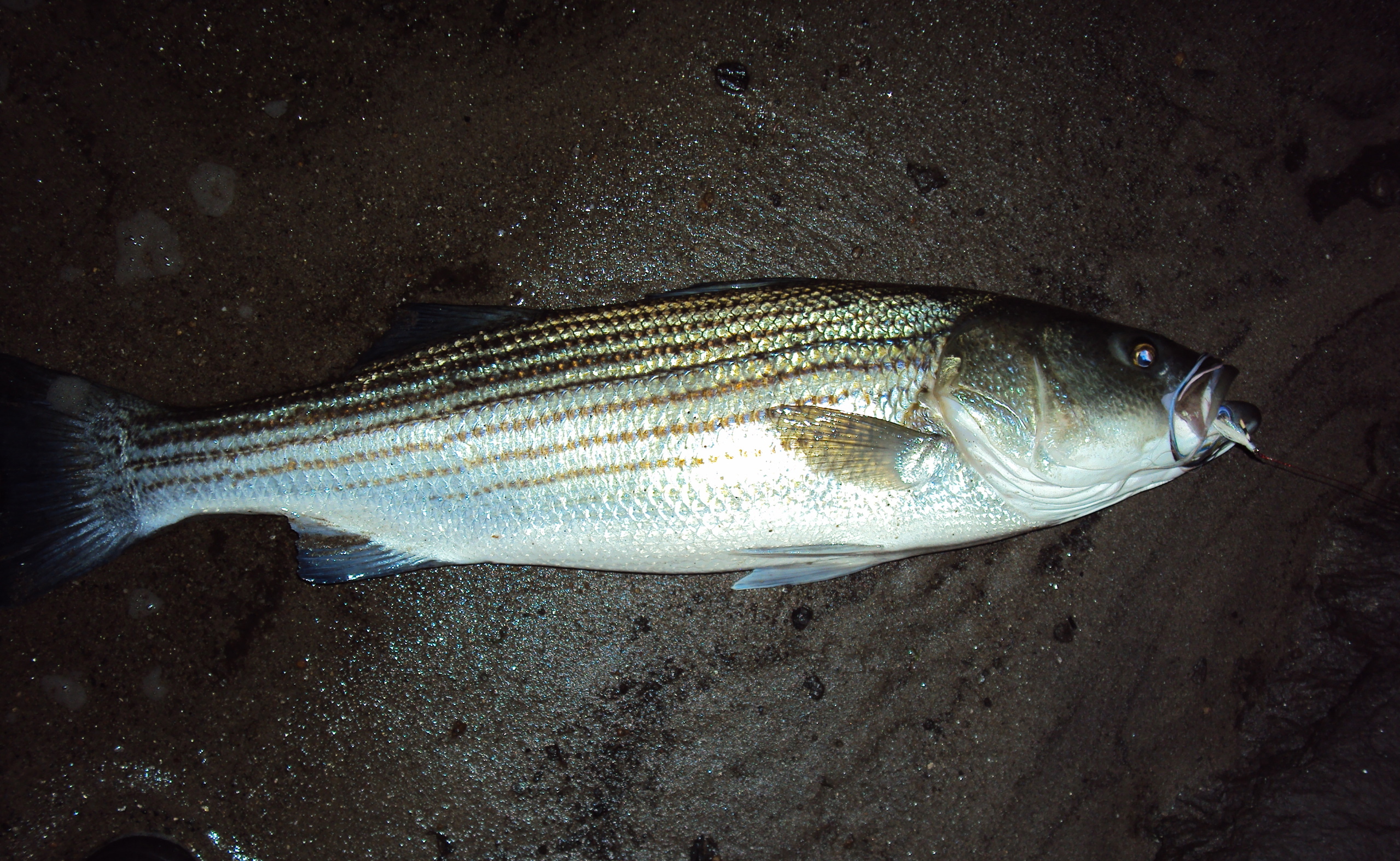
My new personal best on the five-weight, This 33″ chubette from a few weeks ago had some shoulders. She easily went 15 lbs.

Image

For those of you interested in exploring the wonders and challenges of catching bass on lighter tackle, “A Good Night For The Five-Weight” covers basics like rod selection, rigging, and how to play and quickly land larger fish.  It will be in the July 2013 issue of the Mid Atlantic Fly Fishing Guide. You can find a copy of the Guide in fly shops from southern New England to North Carolina, or though their Facebook page.

Let me know what you think.

How to take better photos of your flies

“I hate the way my pictures of my flies come out. How do I make them look more professional?” This question recently came up in one of the forums I participate in. Like the person who asked it, I was frustrated for years with the fly photos I took. I’m no pro, and I’m still learning how to make my shots wonderful. But, here’s a little of what I’ve learned: some basic steps to better fly photography.

1) Lighting is everything. To create consistent lighting, I use a light box. The front of a light box is open; that’s where the camera goes. The top and both sides are cut out and have translucent panels (in my light box it’s old t-shirt fabric) to diffuse the light I’m generating (three shop lights with natural spectrum bulbs). The back of the box holds my background, a sheet of light blue artist’s craft paper. I made my light box for about $30 or so in materials. At some point I will post my setup, but the meantime there’s plenty of online reference. Just google DIY lighting box.

2) Use the right camera and camera setting for the job. 
A good camera helps, but small, more inexpensive digital cameras have come a spectacularly long way in the last few years. I use one camera (nothing special, a Pentax W90) for smaller flies because it has a narrow field of focus. I use a spiffier SLR camera, a Canon Rebel XSi, for larger flies. In both cases, I use the macro setting, although I don’t have a macro lens for the Canon. Gotta get one, though.

A Herr Blue bucktail shot with the SLR in the light box

Image

A smaller Kate McLaren shot with the standard-issure Pentax, again in the cozy confines of the light box. The camera’s nothing special, but the detail here is pretty darn good.

Image

3) Use a tripod and the timer shutter function. Vibration/motion = bad. Again, you don’t need a high-tech aircraft-grade aluminum professional model tripod. As long as it has three legs and is stable, you’re good to go. I have a cheap plastic portable tabletop tripod that I use for the lion’s share of my photos. With the timer function, you eliminate the movement of your finger on the shutter button. Sometimes it’s the little things.

4) Edit, edit, edit your work. Take ten shots to get one great one. Be ruthless in your editing. If the shot comes out sucky (and a lot of mine do), I don’t ever use it. I will often use the zoom function in my photo editor to make sure the focus is tack-sharp, even at an extreme close-up.

5) Learn to use your photo editing app. I’m a Mac guy, so I use iPhoto. Learn how to crop, straighten, and play with other effects. Having said that, a good photo should require very little desktop manipulation.

Another Good Night For The Five-Weight

“What?”

That was my wife’s response, delivered with no small amount of incredulity – or was it sympathy – when I told her I was going fishing tonight. I really couldn’t blame her. After all, I had been traveling home from Florida all day. Now it was evening, and I was on the phone with her, calling on a New Haven-bound Amtrak from Manhattan. I wouldn’t be home for another two hours, and then it’d be another two hours before I could leave.

But, you get to used to the oddball treatment from people who don’t obsess over tide times, heights, moons, and river levels like you do. Even if you’re married to them.

I hadn’t fished in over a week, so I had it bad for some stripers. Tonight would be a perfect night for the five weight rod. Not too windy, and the prospect of a striper in the 15 pound class. I attached a fresh 30-pound test leader about eight feet long to the line, then tied on a Herr Blue flatwing about eleven inches long from nose to flash. Everything looked just right.

Not even a nighttime roadwork traffic jam could slow my spirits. I ended up getting my spot ten minutes late. So what? The fish would still be around.

The current on the outgoing tide was moving at a slow walking pace. In what little ambient light there was, I could see the intricate cake-frosting swirls of the eddies as they passed over the hidden bottom structure. I tried to guess the water temperature with my index finger. 58? 62? The thermometer said 59 degrees. Not a bad couple guesses.

I began by working a deep little run between the rocks. Herring swirled near the surface right in front of me. I tried a few dead drifts, almost like high-stick nymphing, but there were no strikes. So I began to methodically walk down-current, greased line swinging the whole way.

The fish in this section of river tend to hit on or about my second mend, but forty minutes had gone by without a tap. The drill was comforting. Cast. Immediately throw an upstream mend. Then another. Let the fly swing around. Swim, pulse, and dance it in the current. A few short strips, then let it fall back. Even fishless, the presentation was pleasant and meditative. A glance at my watch showed it was well into the wee hours, and I was out here all by myself.

Except for her.

She took the fly as they often do on the greased line, slowly, with full confidence, inhaling the Herr Blue near the head, then turning back toward the bottom. I felt it as a sudden change in pressure on the line. Subtle, nuanced, yet distinctive from the unimpeded drift. No demonstrative WHACK! No explosion on the membrane between water and air. Not yet. I came fully tight to the line with a backward thrusting motion. The hook point found its seat in the corner of her mouth. Right where it was supposed to be.

Now she becomes unhinged, tail thrashing at the surface. At first, I’m unsure how large the striper is, and I under-guesstimate her to be in the 24”class. She’s moving toward me, and I’m hand stripping her in. Once she reaches the edge of the sand bar and discovers she no longer has the comfort of depth to rely on, she lets me know that hand stripping will be ill-advised. The fish begins her first run, taking the slack line out of my shooting basket through my thumb and forefinger at a jerky, frantic pace.

The drag protests as more line is peeled off. I ratchet things down a little tighter, and that stops her. Just to be sure, I re-set the hook. Line is regained, lost, and regained. She’s tantalizingly close now, about twenty feet out, but not quite finished.

Her last defense is her undoing. To escape the shallows of the sand bar I’m standing on, she heads for the deepest nearby water, which happens to be upstream. Between the current and the pressure I put on her, she tires quickly.

As I cradle her in the water, I wonder how many herring she’d eaten that night? Our time is all too brief together, not only the fight, but the release as well. I don’t have her in the revival position for more than a few seconds before she thrusts out of my hands and melts away from the beam of my headlamp into the darkness.

I climbed into bed around 4am. The birds were singing. I was, too. All the way home.

Miss Piggy poses for posterity. “Dang,” she’s thinking, “I really thought that was a herring.” For perspective, the fly, a Herr Blue flatwing, is about 11″ long.

Image

A close-up of the Herr Blue flatwing.

Image

This piece was written in May, 2012, and originally appeared in several online fishing forums.

New article by Steve Culton in the current issue of American Angler.

For small stream/wild brookie fans, I have an article in the March/April issue of American Angler that you might be interested in. “Upstream, Downstream, Small Stream” is about different tactical approaches to high-gradient mountain streams, topwater and subsurface. The issue should be at newsstands and fly shops oh, right about now.

Image

Learn how to catch jewels like this in “Upstream, Downstream, Small Stream.”

Stalking Wild Trout on Connecticut’s Small Streams

by Steve Culton © 2006

Wow. Has it been seven years already since I wrote this? “Stalking Wild Trout” was one of my first web articles. Its initial home was flyaddict.com, and now it’s here on currentseams. I’ve tidied up a few rough patches and thrown in a few photos. And here it is:

It was a perilous approach to the bend. I crept down the steep bank, grabbing the trunk of a sapling for support, all the while trying to dodge the broken glass and poison ivy. Wading gingerly over the slime-coated rocks, I moved through the shallow riffles, past a submerged old-fashioned home radiator. When I got to the opposite bank, I tiptoed over discarded bricks, fired long ago in some nearby kiln, and loose streamside boulders that threatened to pitch me into the deep pool if I wasn’t careful. There, 30 feet away, wild brown trout were sipping insects off the delicate line of foam that curled into a gentle slack water eddy. Like Quint hooking himself to his fighting chair in “Jaws,” I removed the size 16 Tan Caddis from the hook holder and quietly stripped line off the reel. One, two false casts, then line, leader and tippet settled gracefully onto the water. The Caddis never had a chance. It had barely drifted a foot before the trout sucked it under. I set the hook. And, like Quint, I was into a ferocious fighter of a fish.

Ooh. Aah. Oh.

Ooh. Aah. Oh.

Fishing for wild trout has become a passion for me. It has taken me to many of the State’s Class 1 WTMAs (Wild Trout Management Areas) as well as nameless brooks most fishermen wouldn’t give a second look. Sure, I love the Farmington, and you’ll find me there an awful lot. But there’s nothing quite like the satisfaction one gets from bagging a wild fish, one that grew up with no knowledge of food pellets, feeding schedules, holding tanks, or stocking trucks. These are primal, wary, wanton creatures that, when hooked, fight like fish twice their size — and if you’re going to catch one, you’d better bring your “A” game.

The Water

Connecticut currently has eleven Class 1 WTMAs, defined by the DEP as “Abundant wild trout, not stocked.” Fishing here is with a single, barbless hook fly or an artificial. Catch and release only. No bait ever. Sidebar: I’m not going to list the names of the streams, or tell you how to get to them, not because I’m a secretive jerk, but because I consider them a precious resource. The last thing our Class 1 WTMAs need are hordes of fisherpeople — or worse, poachers — descending upon them. I figure that if you really want to fish them, you can do your homework and look them up in the DEP guide, find them on a map, and figure out how to get there. That’s what I did. Fishing Class 1 waters is not casual casting, it’s a commitment.

What’s more, fishing these streams will not appeal to everyone. They can be technically difficult to fish, and in many cases require special equipment and tactics. Some of them are less than pristine, and can give off a gamey odor in warmer weather. Poison Ivy and mosquitoes abound. You may have to hike hundreds of yards through steep ravines and dense, trailless woods. If you’re out of shape, you may want to hit the Stairmaster a few times before heading out. Sound like fun? Read on.

You need to take the DEP’s use of the word “abundant” with a grain of salt. Many could be the outing you get skunked, especially if you go during mid-day  or when the water is low or off-color. Rest assured, they’re in there. Getting them to come out to play is the challenge.

The waters are as varied as the state’s weather. Some of them are lilting meadow brooks, others are more a series of waterfalls than an actual stream. Some are so martini-clear and cold you’d swear you were in northern Maine, while others are in urban settings with stained flows and enough river bottom debris to start your own salvage yard. But they all hold wild trout, mostly brookies and/or browns, with an occasional surprise tiger trout for good measure. And because most of these streams haven’t been stocked in years, it’s the only way to know for sure that you’ve caught a wild fish — or in the case of brook trout, a native wild fish.

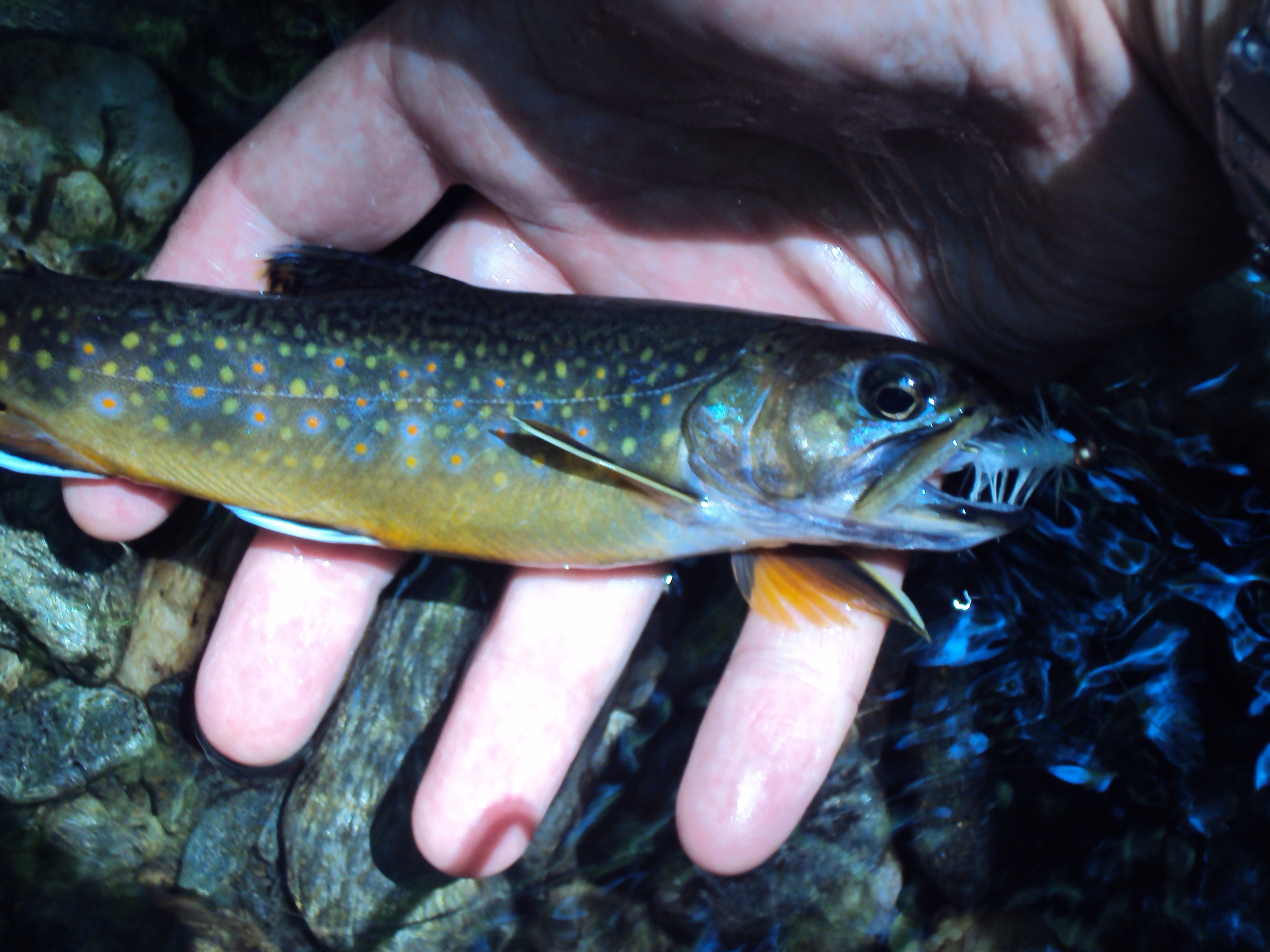
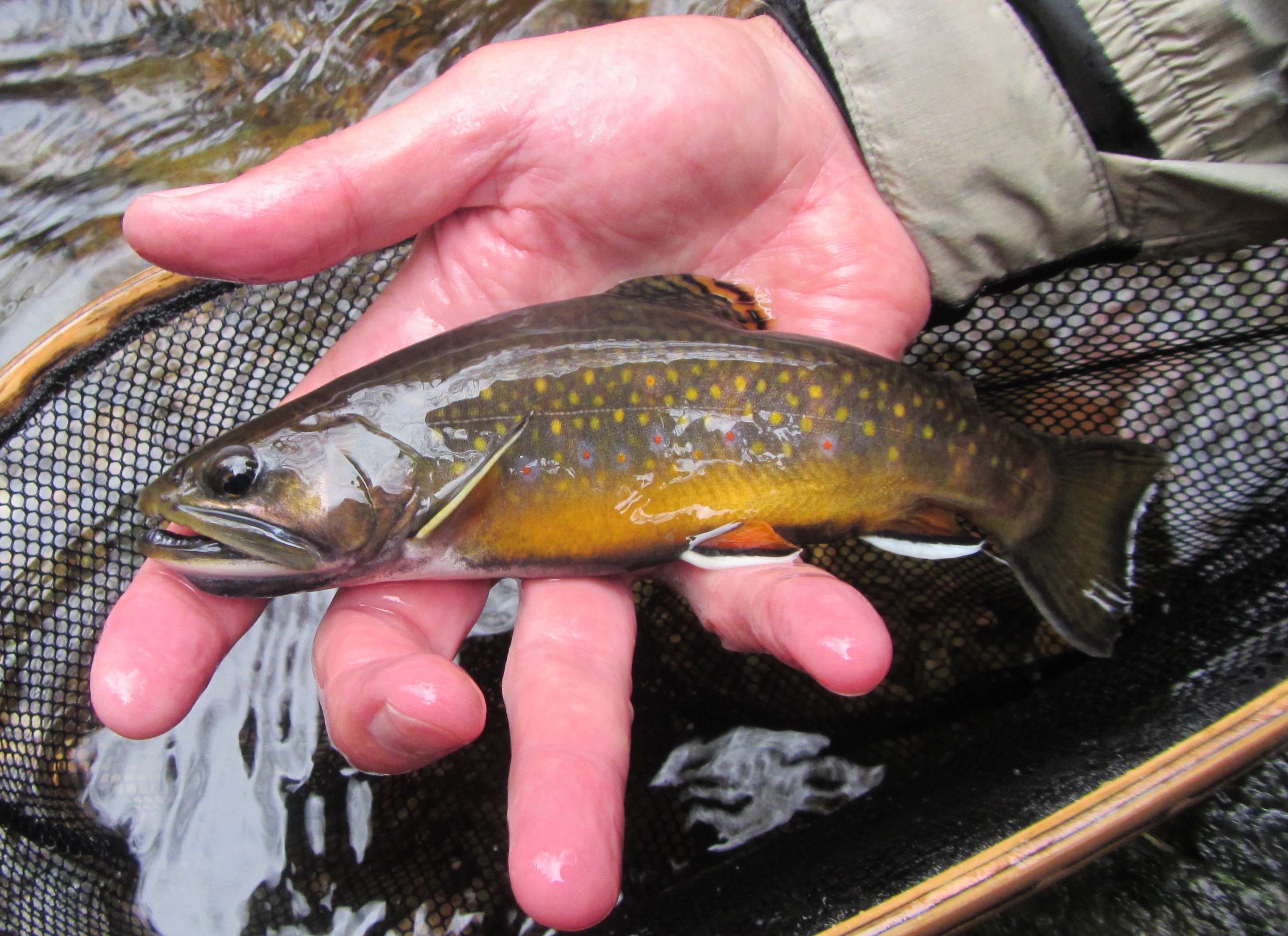
If there is a fish native to the eastern US that's prettier than the brook trout, I've yet to see it.

If there is a fish native to the eastern US that’s prettier than the brook trout, I’ve yet to see it.

Beyond the Class1s, there are hundreds of unnamed – or at least unstocked – small streams crisscrossing the state. The colder, canopy-covered ones can be wild brook trout bonanzas. Sadly, many are on private property, but the enterprising, courteous angler can always ask for permission from the landowner. My personal favorite tactic is to take my three-year-old with me. After all, who can turn down a polite tow-headed youngster who wants to fish with daddy?

Tackle and Equipment

Think light and small. Your 9-foot 5-weight rod serves you well on the Farmington, but in tight small stream quarters it’s only going to make you miserable. I have a Fenwick 6-foot 5-weight fiberglass rod that makes me weep with joy every time I use it in a densely wooded area. A 6-foot leader is all you need, and surprisingly, you don’t need micro tippet to fool the fish. I use 4x or 5x. When you hook trees and branches on every third cast, you’ll appreciate a tippet that gives you the luxury of getting medieval with a snagged branch.

Waders are a must, even on small streams. You’ll be in and out of deeper holes, climbing up riverside banks, and marching through forests of poison ivy. There are frequently no parking lots or trails, so be prepared to hike and bushwhack. Bug repellent: yes. Water if it’s a hot day, and snacks to keep you fueled. Cell phone in case you have an emergency, but don’t count on a signal. And because you could be in a remote spot, a small medical kit with some basic first aid supplies. I keep mine in an old mint tin tucked in the back of my vest.

Polarized glasses are a big help for spotting fish. I usually take my net, but keep it strapped up to my vest because I rarely use it. And though it may not be your thing, I find there’s nothing like a fine cigar (or two) to celebrate the landing of a wild trout. Plus, the smoke does a fine job of keeping the bugs away.

 Flies

You don’t need a lot of different flies in your box to fool wild fish. If it’s a brookie stream, all you really need is a size 16 Yellow Stimulator and size 16 Tan Caddis. Basically, any bushy attractor pattern will do, and if you want to go up or down a size you’ll be covered. The fish you’ll be catching are mostly going to be in the four to nine inch range, but I’ve caught them as small as two inches, and heard of 20+ inch fish being taken by DEP sampling crews. The point is, a smaller fish may need a smaller hook, so if you must catch that pesky little fink who keeps whacking your size 16, you might consider tying on a size 20. Brookies are the kamikaze of wild fish, and they will, with suicidal abandon, hit the same fly over and over. I’ve cast to a fish and gotten a dozen hits on a Stimulator before finally hooking him.

In the summer months, ants, crickets, hoppers, and beetles can be lethal. You can hedge your bets with a nymph dropper off a cricket or hopper. Nymphing works well when the fish aren’t rising. Think basic patterns like Copper Johns, Tung Head Caddis, Bead Head Pheasant Tails, Hares Ears, etc. Go small: 16-20. And don’t forget streamers. I had great success this spring stripping in Wooly Buggers and Zonkers. Streamers are particularly effective in high water conditions — if you can find the room and a pool deep enough to fish them.

And of course, if you see a hatch coming off, by all means match it.

You could fish a wild trout stream with nothing but bushy dries and expect to do well. This is a size 14 Improved Sofa Pillow.

You could fish a wild trout stream with nothing but bushy dries and expect to do well. This is a size 14 Improved Sofa Pillow.

Tactics

On Class 1 WTMAs, your approach is everything. Think s-t-e-a-l-t-h. You need to be very light-footed as you walk to the stream, particularly the ones with soft clay banks. I remember earlier this year thinking I had done a good job sneaking up on a pool, only to stumble on my last step. The trout tore through the water in a Chinese fire drill before bolting for parts unknown. Needless to say, that pool was done for a while. Now, on the waterfall-type streams surrounded with rocks, you can get away with a more cavalier style of walking and wading. Just remember, these fish don’t see a lot of people, and any streamside movement they detect will trigger their flight reflex. Whenever possible, approach pools from the rear. Keep a low profile. Yes, you may have to crawl a little — even through shallow water — to get where you need to be to catch fish.

Logjam Pool

Some wild trout streams are so small, you can easily leap across them. I like to look for structure like these logjams, and fish the seams around the whitewater in plunge pools. I pulled several brookies out of this small hole, and they were still biting when I left it.

Ever fished Greenwoods on the Farmington? You could false cast out to your backing in that pool. On many WTMAs, false casting is neither advisable nor even doable, thanks to canopy and streamside vegetation. (Please resist the temptation to break off that branch you just hooked. It provides much-need shade in the summer.) If you’re going to fish small streams, you’ll need to become adept at the bow-and-arrow cast, the roll cast, and what I call the drift cast. If you’re unfamiliar with the first two, there are plenty of on-line references and tutorials. The drift cast isn’t something I invented, but I have practiced and perfected it to the point where I can reach spots, unseen by the fish, that were previously out of my fishing range.

Use the drift cast to reach a pool you can’t sneak up on from behind. On one of the Class1s I go to, there’s a terrific little bend pool with a massive log fall over it; it’s virtually impossible to fish it from the tail of the pool. Not to worry. I sneak to a spot about 40 feet above the downed tree, strip off some line, and feed the line, leader, and fly into the current. I start stripping off line to continue drifting the fly to just under the log. The fly line, and therefore the fly, move at the speed of the current, creating a natural drift. No takes? Load the rod tip, and shoot the fly half way back upstream, and repeat.

Since many of these streams don’t allow you to fish streamers at a 90-degree angle to the current (due to stream size and the fact that you’d spook the fish) use the drift cast to drift your streamer down through a pool. You can then strip the fly in, and repeat.

Sometimes the drift cast works too well. I had discovered a gorgeous little brookie stream in March with a pool that cornered at a 120-degree angle. It looked extremely fishy. Problem one was that it was so covered with collapsed saplings and brush there was no way to present the fly other than to drift cast. Problem two was that there was a three-inch brookie that would nip at, miss, and sink the fly before it could get to the target area I believed held his big brother. The solution? The drift cast with a twist. I placed my dry fly on a concave dead leaf, and float the leaf down through the current, over the pesky little fish. Just short of the target area, I gently tugged the line and pulled the fly off the leaf (this took some practice). BANG! There was the eight-inch brookie I knew was hiding in there.

One nice thing about small brookie streams is that you can sometimes get away with wet fly swings using a dry, or even skating the dry through the current. Try dangling a Stimulator in the current and see what explosive strikes you can trigger.

Handle fish as little as possible, and then always with wet hands. Once the trout is close it will frequently shake itself off if you just grab your leader or tippet. In hot weather the fish are under stress, so don’t overplay them, and keep them in the water if you can. Exposing a fish to 90o air is a huge shock to their system. Remember, if you kill a wild fish, the DEP isn’t coming back in a month to replace it. Likewise, don’t hit the same stream every other day for a week. Give the trout a break. They’re not going anywhere, and conditions permitting, they’ll be even bigger and stronger next year.

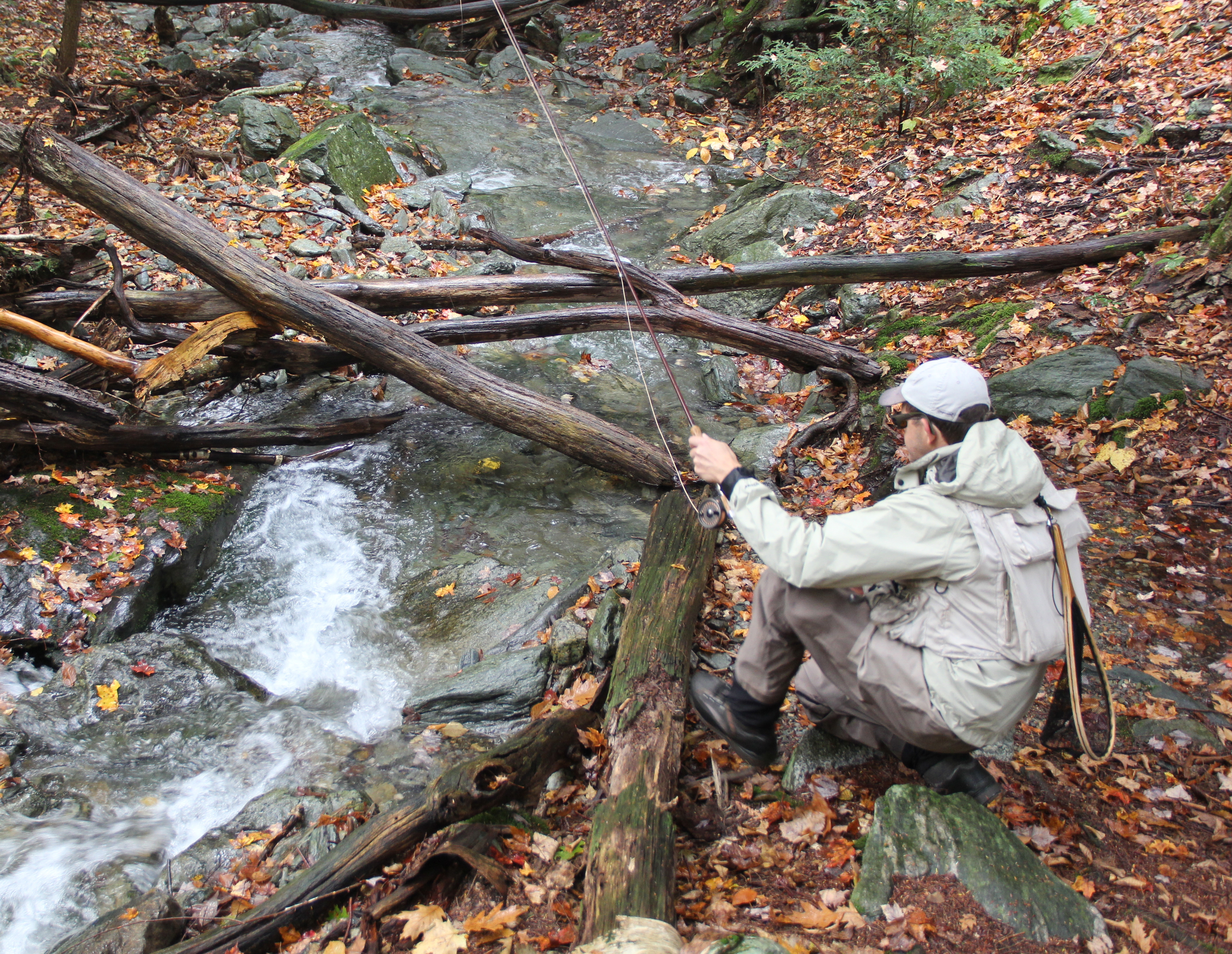
I'm usually a lot happier on a small stream than I look in this picture. Either someone's got his game face on, or is mortally depressed that the weatherman kicked the forecast.

Such a grim countenance. Either someone’s got his game face on, or is mortally depressed that the weatherman kicked the forecast. Again.

 A Fish Story

His name is Gus, and he lives in __________ Brook. Gus is a 9” brook trout, and smart — or at least careful — for a fish. He lives in a bathtub-sized pool behind a rock, just above a one-foot waterfall, and I’ve semi-hooked him a couple dozen times. I always know it’s Gus because of his size (this is a brook in every sense of the word, and he has very distinctive coloring). Gus likes to whack whatever I drift over him, but he just refuses to truly eat the fly. It’s our little game, and we love playing it. But I’m competitive, and I’m betting I can out-stubborn Gus. And when that day comes, I’m going to shake his fin. Offer him a cigar. Then happily send him back to his comfortable little home on this gorgeous woodland stream.