Tip of the Week: Fish are not smart. Stop treating them like they are.

Fish are not smart. They don’t get educated. They don’t think. They can’t reason or feel emotion. You are intellectually superior to a rainbow trout (brains shown to scale). True, this: once you stop treating fish like an intelligent adversary, you’ll start catching more of them.

The McMillan quote is one of my favorites.

Brains


How To Catch The Stripers Feeding On The Surface That No One Else Can.

I get questions like this all the time: “Last night, I heard and saw a ton of surface activity, but didn’t have a single bite. I was using the usual suspects: Clouser, Deceiver, epoxy baitfish, using every retrieve I could think of — but not a single bump. Can you help me understand what was going on?”

When I’m giving my “Trout Fishing for Stripers” presentation, this is the point where I reference highly frustrated anglers like this one. Scenarios vary, but the solution remains the same: it can be found within traditional trout and salmon tactics and presentations.

Let’s break this down. First: the last fly I’d use for this situation would be a dumbbell eye-weighted pattern. Just as you wouldn’t cast a tungsten cone head bugger to trout that are sipping tiny BWOs on the surface — please tell me you wouldn’t — nor should you plumb the depths with Clousers when the striper action is clearly on top.

So which pattern(s) to use? Well, what are the bass eating? This time of year (May, northeast waters) I’ve got a 20-spot on grass shrimp or clam worms or tiny minnows…essentially something small. Most Deceivers I’ve seen are far bigger than 1-inch long, so that pattern’s not a good choice, either. If it were me I’d fish a team of three, and those small baits I mentioned would be a good place to start.

Droppers are the fastest way to find out what the fish want.

OLYMPUS DIGITAL CAMERA

Finally — and here’s where the treasure is buried — let’s talk about presentation. We have a pretty good idea of what’s being eaten, and how the stripers are eating it (holding on station, feeding in a specific area of the water column, not willing to chase). Now we need to give them the goods the same way the naturals are behaving: on a dead drift.

Think of the current as a conveyor belt. Food is being delivered into open mouths. To make that dead drift presentation, you need to be able to mend, and to be able to mend you need a floating line. Sinking lines will drag, and drag is a death sentence for the dead drift. Forget about “which retrieve?” Your only retrieve should be when you’re at the end of a drift and you’re gathering your line to make another cast. (An exception would be fishing on the dangle, but that’s a topic for another day.)

The stripers are eating. They’re sitting there just waiting to take your fly. Answer the big four questions correctly (What’s the food? How are they eating it? What do I have in my box that looks/acts like that food? How can I present it like the naturals?) and you’ll be turning frustration into exhilaration.

Just don’t forget your floating line.

Wet Fly Questions Answered

I’ve been getting a lot of wet fly questions, and I thought I’d share my answers with the group. I’m excited that so many of you are interested in this ancient and traditional art. So here we go:

Q: What size and length rod are you using on the Farmington? A: My dedicated wet fly stick is a 10-foot 5-weight Hardy Marksman II. I don’t hate it, I don’t love it. It’s got a good backbone for helping manage bigger trout in snotty currents, but I wish it were a bit softer in the flex. What’s important is that it’s a 10-footer, which I find useful for mending. Note: I still take the 7’9″ Tonka Queen out for an occasional wet fly jaunt, albeit in moderate/slow currents. That cane pole is a dream for mending.

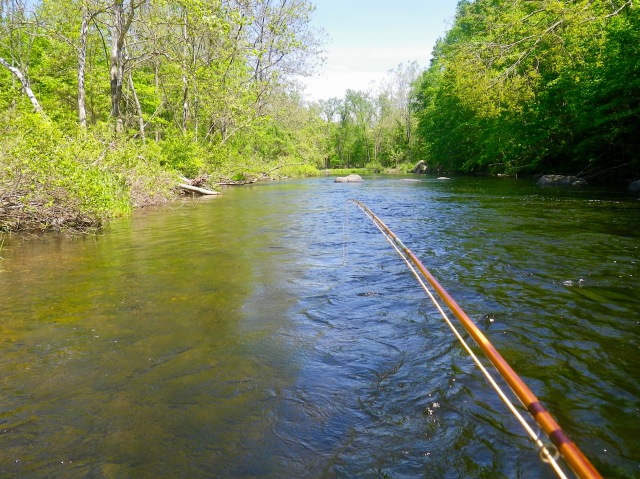
The Queen in action. This rod gives me an ultra-fine level of line control.

OptionsDangle

Q: Do you use an indicator? A: My joke answer is “yes” — the splash of the take, the spray of water, and the jolt of the rod tip all indicate a strike. The real answer is no, not in the traditional sense. The vast majority of time, you need no visual aid to tell you the fish has taken the fly. An exception would be when you’re fishing upstream, drawing the line toward you as the rig moves downstream. I’m watching the tip of the line like a hawk for stalls, shudders, or stoppage that would indicate a delicate strike well below the surface.

Q: Do you use a floating line? A: Yes. (I’m a line control freak.)

Q: When you’re casting and mending, is it basically a dead drift, then the flies start swinging and rising? A: Kindof. Unless you introduce slack into the presentation, you’ll never really have a true dead drift. So even when I’m doing a quartering down or straight across cast and mend, the flies are moving downstream and across, albeit in a slower manner than they would with a traditional wet fly swing.

Q: You’ve said that in spring, you focus more on pool-type water, and faster water in the summer. I’m having trouble finding the right type and depth of water. Any advice? A: Generally speaking, the colder it is, the greater the chance that trout will be in deeper pool-type water. That doesn’t mean you won’t find trout in 1-foot deep riffles in December. The bottom line is: there is no substitute for experience on the water. Get out and explore. Keep a log. Where and when did you fish? Were you catching? Were others catching?  What was the weather like? What was the water height? You can see where this is going. And finally, a wee plug for myself: take a lesson. I hear this a lot from clients: “I’ve driven past this spot a hundred times and never thought to fish it.”

Q: I fished wet flies and only had one bump. What was I doing wrong? A: (This person was out on the Farmington this week.) You’ve got a lot of elements working against you. For starters, I don’t like to fish wets in the Permanent TMA in any flow over 500cfs (it’s been 750cfs and higher). 250cfs-400cfs is the wheelhouse. Hatch windows also have a lot to do with the wet fly bite. For example, right now (Hendrickson and caddis hatches) you want to be swinging anywhere from 11am to 3pm-ish. You’re trying to entice the trout that are taking the emergers. And this cold, wet weather isn’t helping, either.

When you hit the emergence just right, the results can be magical.

OLYMPUS DIGITAL CAMERA

Keep on swinging.

How to free your nymph rig when it’s snagged on the bottom

No matter how you nymph, sooner or later you’re going to get snagged on the bottom. In fact, you might say snags are the price of admission for nymphing. A false positive strike isn’t necessarily a bad thing — it’s a good way to tell that you’re fishing deep enough — but then you’ve got to get the whole shebang back, often easier said than done.

Some snags are most cooperative and come free with just a little coaxing. Others, not so much. Most of the time, the worst thing you can do is start yanking and flailing the rod around like a madman — it just sets the snag deeper. Here are two tricks you can try to free your rig and get you back to fishing fast. (And you won’t go broke from having to constantly buy new flies!)


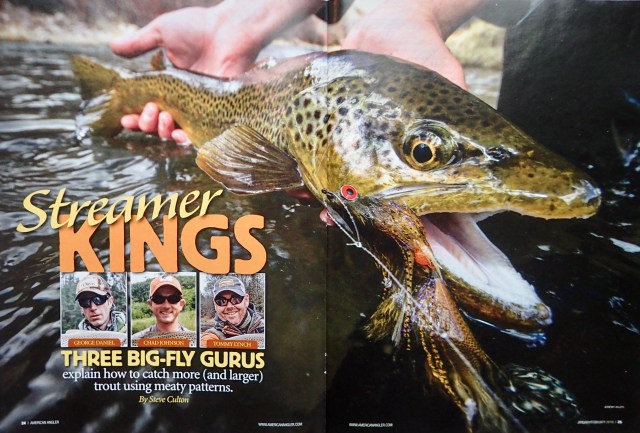
“Streamer Kings” by Steve Culton: inside tips on how to catch big trout on streamers

“Streamer Kings — Three Big-Fly Gurus Explain How To Catch More (And Larger) Trout Using Meaty Patterns” first appeared in the Jan/Feb 2018 issue of American Angler. For this piece, I interviewed George Daniel, Chad Johnson, and Tommy Lynch. The result is a masterclass on streamer fishing. Many thanks to George, Chad, and Tommy for sharing their expertise. So…what’s a good, all purpose streamer rod? How important is color? If you could fish only one streamer for trophy trout, what would it be? For these answers and more, click on the pdf link below.

StreamerKings_Culton

Somebody was ringing the dinner bell…

OLYMPUS DIGITAL CAMERA


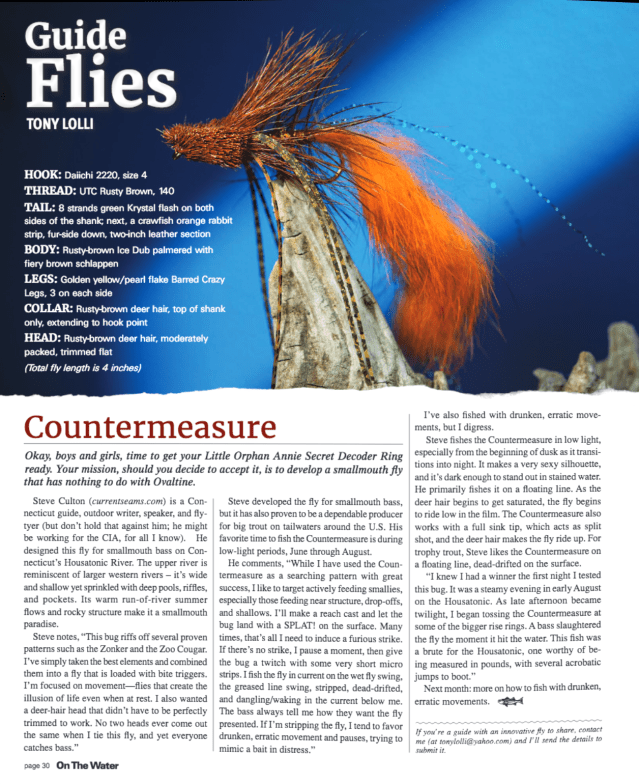
Steve Culton’s Countermeasure featured in On The Water’s “Guide Flies”

The Countermeasure, my favorite smallmouth bass bug, is the featured pattern in Tony Lolli’s “Guide Flies” column. It’s in the current (April 2020) issue of On The Water. Here’s a link to my original post on the Countermeasure. For bonus material, you’ve got a photo of the column and a pdf. Please support fishing magazines and writers by reading and subscribing. Without readers like you, we are nothing.

CountermeasureOTW

CountermeasureOTW

More Stupid Striper Fishing Tricks from Maryland

The incompetence of the Maryland Department of Natural Resource DNR continues to expand endlessly like the universe. As proof, I offer Maryland, COVID-19, and Fishing: An Arbitrary Double Standard that Endangers Public Health, written by Tony Friedrich and William Goldsmith of the ASGA. You really can’t make this stuff up.

I know what he’s thinking: Against stupidity the very gods themselves contend in vain.

OLYMPUS DIGITAL CAMERA


An in-depth, must-read synopsis of Tuesday’s ASMFC striped bass meeting from one of the commissioners

Captain John McMurray (NY), to whom I gave high marks as I listened to the chaos of the webinar, has put together a wonderful synopsis of Tuesday’s meeting. John had the advantage (or as some wags might suggest, disadvantage) of being there, witnessing, and participating in the entire process. This is a must-read, folks. You can find it here.

In the meantime, if you fish for stripers in Rhode Island, please send an email to RI commissioner Jason McNamee asking to reconsider voting in favor of the 28″-35″ slot limit. Ask for your comment to be entered into the public record. They’re meeting on it this Monday! I’d like to see a roll call of everyone who sends an email in the comments section.

Three takeaways from yesterday’s Winter 2020 ASMFC Meeting

It wasn’t as bad as I’d feared. It wasn’t as good as I’d hoped. Welcome to the wonderful world of the Atlantic States Marine Fisheries Commission winter meetings. Yesterday’s focus was on discussing and formalizing each state’s Conservation Equivalency proposals. Almost 24 hours later, here are three big takeaways.

Settle in for a cup of tea. This might take a while.

The ASMFC is structurally and procedurally bloated. An efficient organization this is not. The webinar was audio only, so it made a helter-skelter meeting like this one even more challenging to follow. At times it was like watching a Bergman film — you try your best to keep up but you’re never really sure what’s going on. And I’m not the only one who saw it that way — the chairman of the meeting described it, and I’ll quote, as “chaotic.” Maybe it’s just as well that the meeting wasn’t video broadcast — surely you could lump the ASMFC Winter 2020 CE decisions along with laws and sausages as things you should never see being made.

~

My reaction to some states’ CE proposals can best be summed up by Otto, who so eloquently stated: “Disappointed!!!” (That includes you, Rhode Island.)

Beware of rogue states within the ASMFC. North Korea, Iran, Syria, Sudan, and…New Jersey? Let’s not forget Maryland, who along with New Jersey have some rather — ahem — creative ideas on how to best conserve and restore our rapidly dwindling stocks of striped bass. Remember in “A Fish Called Wanda,” when Wanda reminds Otto that the central message of Buddhism is not “Every man for himself?” Someone should point out to Maryland and New Jersey that the ASMFC mission is not, “Kill as many striped bass as you can under the cloak of conservation.” Nope, those emperors don’t have new clothes. They’re wearing the same crappy, poorly camouflaged outfits they’ve been sporting for years. Kudos to those who saw through their charades, like…

~

Some ASMFC Commissioners get it. If a state’s CE proposal fails to achieve target results, that state should be held accountable, right? High fives to those commissioners who called out certain CE proposals, effectively telling those states to behave and eat its broccoli. Apologies in advance to those I missed, but here are a few of the people who fought the good fight yesterday: Justin Davis (CT). Capt. John McMurray (NY). Ritchie White (NH). Pat Keliher (ME). Again, these are only a few of the people I could positively identify. A very sincere thank you to all of you who are trying to save our stripers. If you’re reading this, why not take a few minutes to send them an email of thanks and support. You can find that list here.

Is anybody there? Does anybody care? Some commissioners clearly do. Especially those who understand that killing this fish now doesn’t bode well for the future.

Wet fly fishing questions answered

I had some excellent Q&A sessions about wet fly fishing at the Marlborough and Edison Fly Fishing shows (great job, people!) and I wanted to share some of what we discussed with you.

Q: What knot do you use when you build your wet fly team leader? A: I’ve been using a triple surgeon’s knot for years. It’s easy for me to tie, and it’s reliable — I don’t think I’ve ever had one fail. People also asked about the blood knot, and the answer is: use the knot you feel most confident about/is easiest for you to tie.

Q: Do you use tippet rings when you build your wet fly team leader? A: I don’t, mostly because I don’t see a need. The perceived need is that it would be easier to replace a dropper tag (rather than build a new leader) with a tippet ring and it’s hard to argue with that. This is a “what works best for you?” situation. I don’t use tippet rings because I rarely change flies on my leader system, and even when I do I’ve learned how to reattach a fly using a minimum of tag material. Speaking of attaching flies, here’s a nifty tutorial from my buddy Tim Flagler on the Davy Knot, which uses very little material.

Q: You say to pause before you set the hook. Aren’t you afraid the fish will spit the fly? A: No. I quote from The Book of Syl: “With the soft-hackled fly, the trout throws caution to the wind, because he’s not afraid to move under the water, and speeds to the fly with urgency.” The fish has made the decision to eat. He’s said “yes” to the fly. With an immediate hookset, you’re saying “no” to the fish. By pausing — asking, “Are you still there?” before you set the hook — you’re ensuring that the fish will turn away with the fly in his mouth, having neatly hooked himself.

This massive hen blasted the fly, an old English pattern called a Hackled March Brown. She hit so hard she ripped the line out of my hands. There was no need for me to set the hook.

Q: Is fishing wet flies a secondary tactic, or do you ever go to the river intending to fish wet flies? A: I frequently go to the river with the sole intent of fishing wet flies. In fact, I’d say wet flies account for the vast majority of my trout fishing — and catching — between late April and mid-summer.

Ask currentseamser Greg about how good the pre-hatch fishing can be with wet flies!

Q: You talked about using wet flies to catch trout feeding on emergers. Is there a point during the hatch, such as when you see duns on the surface, that you’ll switch to dry flies? A: What a great question! The answer is yes. If I am pounding up fish on wet flies and suddenly my hookups stop — but the river is still boiling with feeding fish — that’s my cue that they’ve either stopped eating what I’m throwing or may now be feeding on the surface. If I see the duns getting taken, and my wets aren’t catching, that is compelling evidence to switch to a dry fly. This scenario frequently plays out during the Hendrickson hatch. It’s wet fly gangbusters up until about 3pm, then suddenly the hookups slow to a crawl. Changing over to a dry usually solves the problem.

I hope that helps, and if you have questions, please don’t hesitate to ask.