A little bit of this and that, and Farmington River book tidbits

We’re preparing to host a big family reunion, so no fishing for me today. I hope you’ve been able to get out — I have, and the cooler weather this week has been a welcome respite from the relentless cycle of heat and humidity.

To the salt: A shout out to The Saltwater Edge for their Local Singles Program. Even if you’re not a spin angler, you can take a lesson from its energy — reducing striped bass C&R mortality — by mashing down the barbs on your flies. It really makes a difference. Earlier this month on Block Island, I deep hooked two bass on Big Eelie patterns. in both cases, the hook came out with ridiculous ease, with no blood nor visible damage, because I was fishing barbless. Come to think of it, it’s getting close to time to tie up some…nah, we’ll wait…

The Fly Fishing Guide to the Farmington River book project process continues. I’ll be out on the river a lot this week, both guiding, fishing, and shooting photos. If you see me, please come say hello.

Writing-wise, I’m working on the hatches section, and choosing flies to match. It just occurred to me that most of what gets the attention this time of year is either large or yellowish. Then I remembered, how many times have I seen tiny BWOs (20-26) in the air? How many times has a fishless outing turned because I started fishing a Tiny BWO parachute? The answer is: many. Tiny BWOs may not be the sexiest hatch in midsummer, but they are important. Now, let’s also not forget the attenuata…or the egg-laying caddis…

Catch ’em up.
Block Island Report: Still slow, still picking away

I recently fished 6 nights on Block Island, and this once vibrant shore fishery continues to struggle. I checked my records and found one night in 2018 when I landed 12 stripers; this year I managed 10 stripers in 6 nights with 2 skunkings, which ain’t exactly lighting it up. Once again, the key to success was finding a pattern and hammering away. I spent the first two nights trying to find a pattern, which meant bouncing around the Island, fishing different marks at different tide stages. I had a good moon in terms of darkness, but the tide heights were crappy, which didn’t help. Once I found bass, I returned to that mark at a similar tide stage the next night, although I still had to put in my time to get a couple fish. We left early this year because the fishing was lousy and we had a rain day we could fill with packing. Here’s to better days and a return to glory for this sacred fishing ground.

On the first day, I met — wow, I am so bad at remembering names, so please forgive me if I get it wrong — currentseams reader Caleb(?) sight fishing on Crescent Beach. He told me that the week before, he’d had a fantastic day surfcasting at a popular old school mark. He went back the next day, same tide, same conditions, and it was disaster bad. So goes it on Block. Fish here, fish there, then no fish anywhere. The new inshore paradigm seems to be no schools cruising through, but rather a rogue, random bass. (Insert heavy sigh here.) The sight fishing in the day was generally crappy; I had several days where I saw no bass at all, which is dreadful for early July.
That’ll save me a walk, although I did do the stairs one afternoon for exercise. The weather was generally crappy, with dense fog, high humidity, and a blustery S-SSW wind in the 10-20 mph range, which all but eliminated the south and southwest sides of the Island for the fly rod. Even with my 2H surf cannon, I wasn’t into it, especially for ultra slow fishing. I did fish multiple parts of the Island, but I could only find one specific mark that consistently held the possibility of fish on a certain tide. Even then, that tide was historically the worse of the two, so it was a surprise to me that that was this year’s pattern. Some old favorite, reliable marks failed to produce fish, which was discouraging. I want my old BI back!
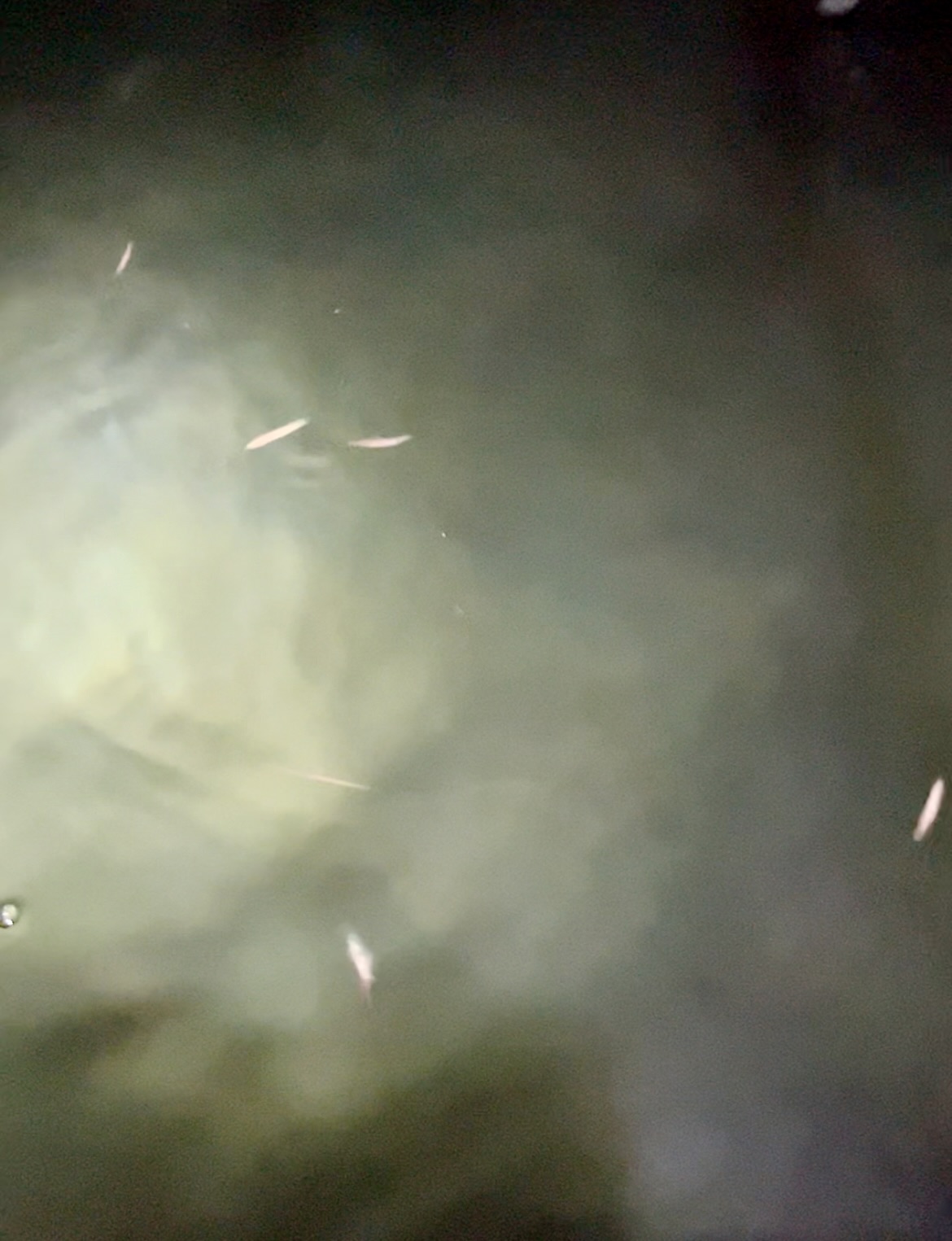
One night, at the witching hour of midnight, I ventured out onto a top-secret flat within the Great Salt Pond. Wind was an issue, but I had a moving tide in my favor. I followed my dark-of-the-moon protocol of fan casting and moving a few steps to systematically cover water, but after a while I recognized the futility of it all and headed in. I will typically turn on the light to see what creatures are stirring, and I was treated to a swarm of baby squid, about 1/2 to an inch long, hundreds of them, buzzing around and through my headlamp light cone. Sadly, no diners had assembled. This is a still from a video I shot.
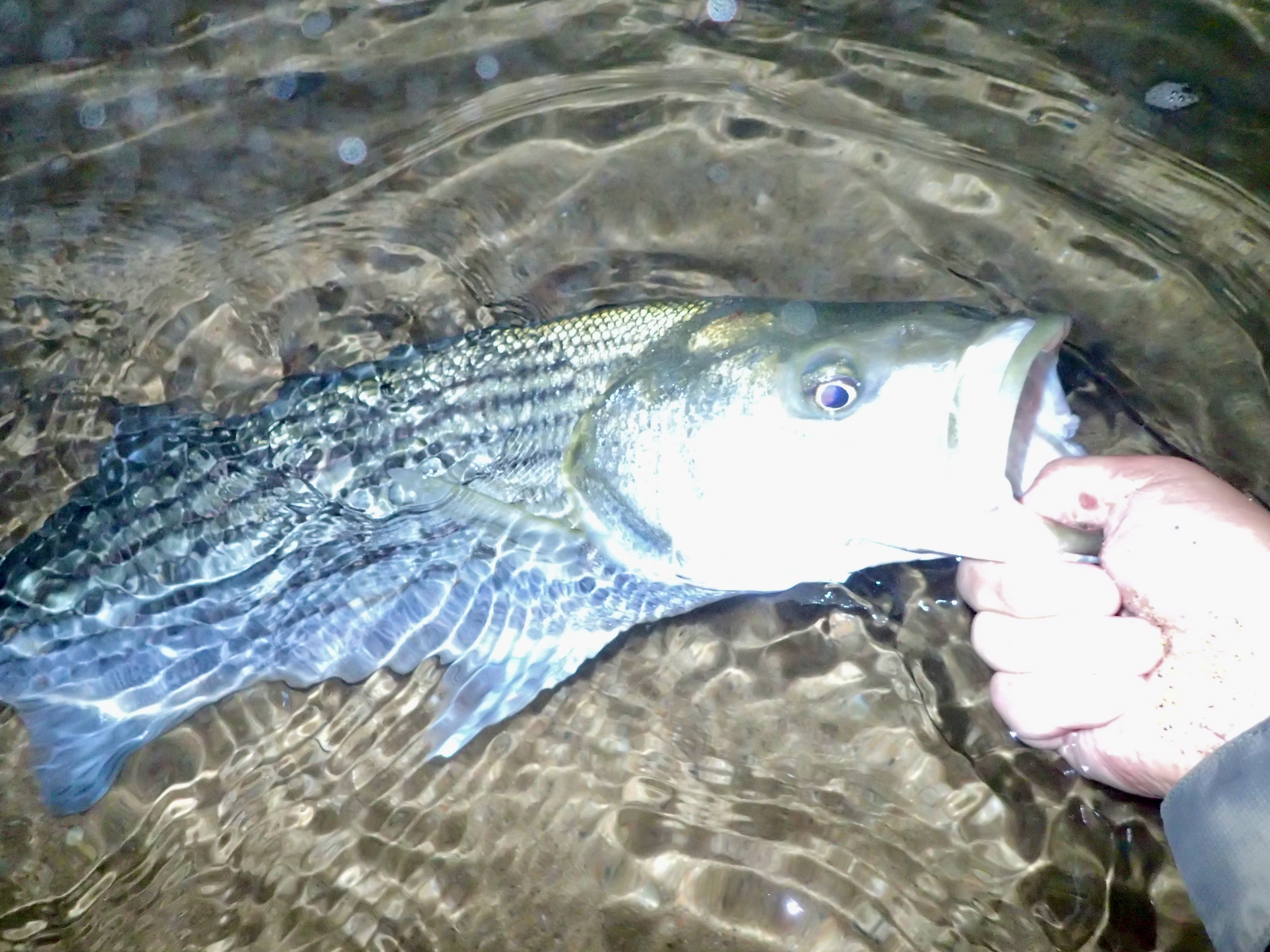
One of my ten bass in six nights. The good news was two slot fish in the mix. The bad news was nothing smaller than 24″, so there were precious few stripers in the 3-5 year-old classes represented. That would fall into line with the miserable recruitment stats from 2020 and on. While the action was less than I’d like, I did get reacquainted with the truculent nature of Block Island stripers. Aside from snook and tarpon, I don’t know another fish that hits a fly harder than a Block Island striped bass. Powerful, crushing eats, and then, once they realize they’re hooked, a bullish, line-taking run. I had several fish work circles around me and/or run along the trough by the shoreline. Simply tremendous sport.

You have questions about Block Island. I have answers.

I get a lot of questions about Block Island this time of year. As always, I’m happy to answer them (unless you want to know my secret spots, which I won’t even tell my mother). For general information, here’s a piece I wrote several years ago. It still stands up today. It’s called “Block Island Stripers From The Shore.”

Not Block, but it could be….

Farmington River Report 7/3/24: Wet fly surprises, not my finest dry fly hour

We had a fishing trip/photo shoot on Wednesday from 3:30-9pm. Delaware River guide extraordinaire Bob Lindquist came down to take pics for the book and an article he’s writing. We (filmmaker Matthew Vinick of “Summer on the Farmington” fame) started off at the bottom end of the PTMA and the action was slow. Little to no hatch activity, and precious few risers. Matthew and I had to work our butts off (he was nymphing then dry flying, I was swinging wets) to put a few in the hoop over 90 minutes. Both of my trout took a large Iso soft hackle.

Matthew had to skedaddle, so Bob and I moved up to a dry fly pool above the PTMA. As I was wading in, an old crusty angler (meant as a compliment) was leaving, commenting that the sulphur hatch was not good. He was right. It never really got started, even later in the evening as sunset transitioned into dark. Id like to blame it all on the hatch, but I don’t think I fished particularly well, mostly because I was being stubborn. Let me explain.

I saw that the sulphurs that were on the water were an 18-20. But I wanted to see if I could get them to take the 16. They generally wouldn’t, and when I put a 20 on I had double the action. I was also committed to fishing the water in front of me, which, due to varying currents seams and speeds, was difficult to maintain a quality drift. Sometimes I like a challenge, you know? But my fish worthy-drifts were few, and even when I did fool fish, I came away with nothing. I rose six trout and stuck none of them. Ugh! Finally, I moved down a few feet to more drift-friendly water, but by then it was too late. (Stubborn Steve pays the price.)

I should mention that I had some surprising success on wet flies in some very slow-moving water pre-7pm. Two trout, two crushing hits, both on LaFontaine’s Diving Caddis size 14. Later, the pattern that the trout seemed to like best was a size 20 sulphur comparadun. As it got darker, I switched over to a size 12 Usual. Unfortunately, the typical dusk feeding orgy never manifested, and both Bob and I commented about the lack of spinners on the water at dark. So it goes.

The Diving Caddis wet. I’ve been tying these without the rib, and using tan caddis Prism dub for the body. The trout are all in favor.