Three Small Stream/Wild Trout Best Practices for Fall 2023

As the weather turns cooler, small stream anglers begin dreaming about their favorite thin blue lines. It should be a great fall season — we had a very wet summer and the natives and other wild fish are in great shape. But along with fishing for wild trout and char comes great responsibility, to both the fish and the resource. Here are three things you can do preserve and protect wild fish.

Minimize fish photos. Anglers with cameras have needlessly killed more small stream wild trout — intentionally or not — in the last 10 years than in the previous 100. You can blame it on the convenience and portability of digital devices. You can blame it on social media. Or angler narcissism. Or all of the above. One solutions is: take no photos, or Take The Wild Trout One Photo Challenge.

Accordingly, do you really think we need a photo of every wild fish you caught on your last outing? Dr. Rick gives the same answer: no.

Be on the lookout for redds. Fall is spawning time for wild brookies and brown trout. Learn how to identify a redd, the nesting area for spawning fish. And please, stay out of the water. The eggs you don’t crush will be the trout you’re catching in a couple years.

Keep Fish Wet. Catch-and-release is useless if you’re ignoring its fundamental best practices. Learn to do it right, and you’ll have more wild fish to catch on your next outing.

Thank you and tightest of lines.
Farmington River coming back, contest, casting distance and other rainy Monday musings

The good news is: fall is finally here, along with her cooler weather, and the Farmington River water temperatures are finally getting back into trout-friendly territory! In an odd twist for September, water temps are actually cooler miles from the dam as the water that’s coming out is still (ridiculously) in the low-to-mid 60s. You should carry a thermometer with you and never fish if the water temp is above 68. I’m not sure when DEEP will do their fall stocking, but I imagine it will be in the next couple weeks. The bad news is: we’re getting creamed by rain, and the river in the PTMA as I write this is well into 4-digits cfs and the color of chocolate milk.It should drop and clear significantly by the end of the week.

Contest alert! If you have not entered my 1,000 Followers contest, you now have less than a week to do so. You can get all the details here.

This from the Ministry of Too Funny: every once in while, I feel like a total failure as a writer. That is, I write one thing, and a surprising number of people take it in a way that I could not possibly have imagined they would. After last week’s post about stripers and casting distance, I received a bunch of emails from people offering suggestions on how to increase my casting distance. I appreciate your helpful nature — I surely do. But what somehow got lost in translation was that I was already casting 100 feet. I don’t believe the fly caster who could reach the fish that Toby was hooking is alive on planet earth today. Maybe he or she is, but if so, you can probably count them on your fingers. At any rate, thankfully, the vast majority of big fish I hook come within the 75-foot range, which is attainable by anyone with the right gear and good fundamentals.

A roll cast to get the head out, a single water haul over my head, then bombs away! I love to hear the line whistling through the guides, and the dull thud of the line length bottoming out. We had great casting conditions, 0-5mph quartering over my right shoulder (I’m a lefty). Photo by Toby Lapinski

I also want to thank you all for your patience as I navigate a very busy time for me. Lots of personal projects going on (it’s all good) that are keeping me from writing here as much as I would like, and (gasp!) even from fishing as much as I would like.

Speaking of stripers and writing, I’m currently working on an article for Surfcasters’ Journal. As usual, I’ll do my best to make it fun and interesting and informative. Enjoy the rain!

Striper Report 9/20/23, or: The One Where Casting Distance Made All The Difference

If you fish for striped bass with a fly rod, you’re operating under an unimpeachable assumption: whatever you hook must be within close range. Fly casting range. Not practice casting on a lawn with just a fly line. I’m talking standing thigh-deep in the ocean with a line and leader and fly and waves and wind and if it’s the dark of the moon, limited vision. You might get 100 feet if you’re a tournament-level caster, or have a two-handed surf rod. For most folks in standard conditions, it’s probably 75 feet or less. If the wind is honking in your face, you might be talking well under 50.

Sometimes, distance just doesn’t matter. (The last striper I caught took the fly under a rod’s length away from me.) And sometimes, like Wednesday night, distance is everything.

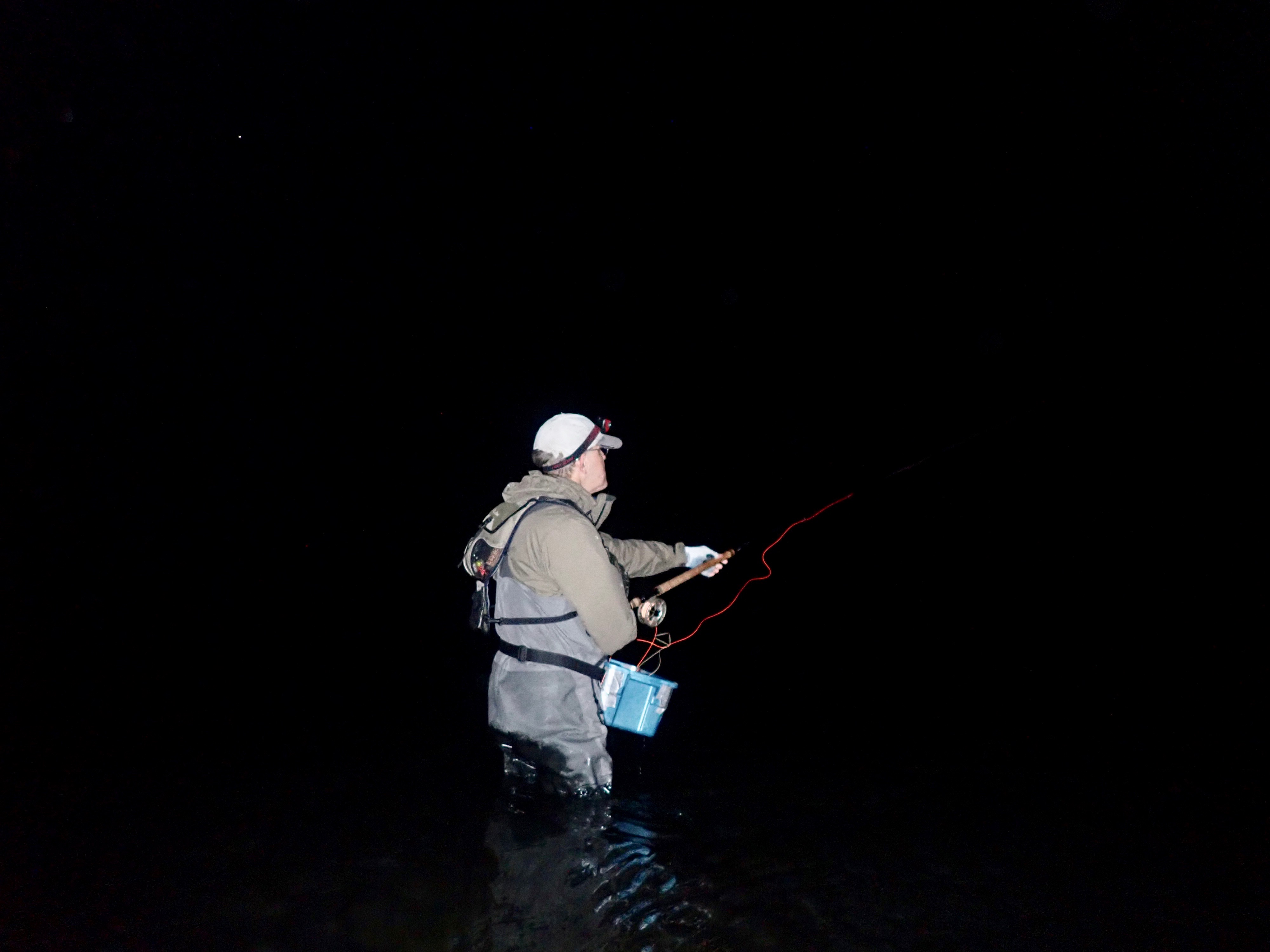
I fished with surfcaster extraordinaire Toby Lapinski, and it was a tale of the tape. Toby got into a half-dozen-plus fish ranging from 5 to 15+ pounds, and I blanked. Oh, I had a few pulls from squid, a solo sharp rap, and then later, a momentary hookup. But the spelling of the word of the number of bass I landed begins with a Z. Toby was launching his wares way over 100 feet, and that’s where all the action was. I had my two-handed surf cannon with me, but I was well short of where the fish were holding and feeding. I saw one of Toby’s hookups, and it was a good 50 feet beyond what I was making. (And I was having a very good casting night, bottoming out on just about every cast.)

A cast, a mend, a slow gathering of the line, and….nothing. (Photo by Toby Lapinski)

You might think I was discouraged, but that wasn’t the case. I was delighted that Toby was getting into fish. Most of all, it served as proof that I wasn’t fishing poorly. I just couldn’t get the fly out far enough. Nobody could have. Thank goodness those nights are the exception.

Out thinking as we trudged back along the beach was to try a different, earlier stage of the tide, when the fish might be in closer. It’s all one huge science experiment, with your lab report being graded by the fish. So I’ll be looking to bump that C up to an A.

Steve Culton Classes & Seminars at the International Fly Tying Symposium Nov. 11 & 12

Mark your calendars because it’ll be here before you know it! The 32nd International Fly Tying Symposium is returning to the Double Tree by Hilton, 200 Atrium Drive, Somerset, N. J. Come for a weekend of seeing old and new friends, over 100 world class tiers demonstrating their best patterns and techniques, and plenty of product to shop. And of course, free parking!

I’m totally stoked for this as it’s a great opportunity — for me as well as you — to meet and talk to so many terrific anglers and fly tyers. Plus, I’m always walking away with some hard-to-find tying items. There are some excellent seminars that are included in the price of your ticket, and you can also sign up for a fly tying class.

I’ll also be doing a seminar and a class. Here’s my schedule:

Saturday, November 11, Noon, Seminar: Tying And Fishing Wet Flies. This is a new seminar I debuted last year. We’ll cover the basics of wet fly construction, materials, types, and how to fish them in both traditional and non-traditional ways. I have updated this presentation with some good stuff I learned about caddis this year, so don’t miss out! Seminars are included in the price of your admission.

I love this presentation, and I think you will, too!

Saturday, Nov 11, 1pm-3:30pm, Tying Class: Soft Hackles, Winged and Wingless Wets. If you’re not tying and fishing wet flies, you are not catching as many fish as you could be. These intro class to the three main styles will get you well on your way! You must pre-register for the class and you can do that here.

And of course, I’ll be tying flies on the show floor along with dozens of other folks who are far more talented than me, so make sure you stop by to say hello. Bring your questions, as I’m here to help.

Everything you need to know is here.

Why crickets are such a great trout fly, Or: The nematomorph worm made me do it.

This is the time of year when I notice that black crickets are particularly active. I hear them singing in my garage when I empty the recycling, and when I’m coming home from a late striper jaunt. It’s usually the time of year where I say to myself, “I gotta fish more cricket flies.” The savvy small stream angler will do boffo box office with crickets this time of year, not to mention on standard-issue trout streams.

Turns out that crickets in the water isn’t always an accident. I read this fascinating piece about parasites in the July 2022 National Geographic. Because of nature’s perfect design, some parasites find their next host by influencing their current host. The nematomorph worm is a prime example. From the article: (nematomorph worms) “mature inside crickets but then need to get to water to mate. So they influence the crickets’ brains, driving the insects to jump into streams, where they become an important food source for trout.”

So the next time you tie up a cricket pattern, think about that unseen little parasite component that helps the bug find the water.

The Hopper Hammerdown rendered in all black, tied size 10-14, makes a nifty wet/damp black cricket pattern. You can find the recipe here.

It’s a Fun One (Thousand Followers Celebration)!

Happy Monday, fellow Currentseamsers. We hit it some time ago, and now it’s time to celebrate currentseams.com reaching the rarefied 1,000 followers mark! Suffice to say I couldn’t have done it without you, so thank you for being part of the Fun One Thousand. As usual, we’re doing a flies-tied-by-Steve giveaway. Here are the rules:

1) No purchase necessary.

2) You must be a follower of currentseams to enter. (If you’re not one already, you become a follower by clicking on the Sign Me Up button below the “Follow Blog via Email” header, at the top right if you’re on a laptop, and at the bottom of the scroll on a mobile device.

This is a photo, not a link.

3) To enter, leave a comment on this thread that responds to at least one of these questions: What’s your favorite fly pattern(s) for the Farmington River? What’s your favorite section of the Farmington, and how do you like to fish it? If you don’t fish the Farmington, where do you like to fish and what’s your favorite fly pattern(s)? One entry per person. Deadline for entering is 11:59pm September 30, 2023. Three winners will be chosen at random. The winners will be notified in the comments section of this thread or by email, and will be responsible for sending me their address so I can ship the flies out. Sorry, I can only ship to U.S. addresses.

4) All decisions by me are final.

Thanks again for reading and following currentseams.

Stuff like this could be in your hot little hands if you enter.

When you’re expecting small, be prepared for big

If you’ve taken a lesson with me or attended one of my presentations, you’ve heard me say that we all put our waders one leg at a time. So, even though I may be considered an authority of sorts, I’m still human — and I still make mistakes on the water.

Twice now, on my last two trips to the Cape, the catch has been trending small. Twice, I’ve subsequently hooked into something very large, and lost the fish.

Now, you could make a case that I was a little unlucky. There’s probably some truth to that. But the single biggest reason I lost those potential cows is because I wasn’t ready for them. I didn’t make a powerful initial hookset. And by the time I realized what was happening, I’d already lost the fish.

Gordo hooking up. At least someone on this crew knows what they’re doing.

My most recent tale of woe came earlier this week on the Brewster Flats. I was fishing a small weighted crab pattern, probably on a size 4 hook, letting it bounce along the bottom, then swing up at the end of the drift. It had been a slow morning — Gordo, who was spin fishing with a jig head small soft plastic, had connected with two smaller bass. So that’s what I was expecting. I hadn’t had a touch all morning, and had been cycling through patterns in a desperate attempt to find something the fish might eat. The crab fly was on the dangle below me just over a deep hole, and I was daydreaming.

WHACK! The bass hit the fly like a bullet train. Immediately, line began screaming off the reel. The fish made a textbook striper series of runs: one good, long one, then a pause (where I attempted to reset the hook and gain some line). Then a second powerful, albeit shorter run. I reset again, but it felt wrong. I was furiously cranking the reel when the line went slack. Heartbreak.

So. I hoping that I’ve learned my lesson. It’s OK to expect small, but be prepared for big. I certainly will be.

Next time.

Farmington River Report and other items of variable interest you should definitely read

I’m in a goofy mood, hence the goofy title. Welcome back! I hope a splendid holiday weekend was had by all.

There is no joy in Mudville — and not just because I’m a Mets fan. There’s certainly no joy in Riverton. As I write this at 12:20pm, even if you were fishing above Riverton, you’d be fishing in water that is at a dangerous temperature for trout. It’s already north of 70 degrees(!). The MDC has decided to help (he said sarcastically) by cutting the flow a bit. With this week’s heat wave, the hits just keep on coming. Fear not: the hardiest specimens will find a way to survive, and the stocking truck shall return, as will New England fall nights in the 40s.

Things are heating up in the Culton kitchen, too. These are Trinidad Scorpions. Their heat is measured in the millions of Scoville Units (a jalapeño is 5k-8k).

Note: once safe fishing does resume, the entire river from the base of the dam to the steel bridge in Unionville is catch & release only until 6am second Saturday in April. If you have not done so, please program in the DEEP TIP line into your phone so you can report poachers: 800-424-4357.

I’m kicking off my speaking season tonight in Long Island with my good friends the Long Island Fly Rodders. I’ve been presenting to them for years, and I’m looking forward to seeing everyone. If you’re in charge of speakers for your club, now’s the time to book as my calendar is filling up.

Finally, I was on the Cape this weekend and managed to get out on the Brewster flats for one morning. I’ll tell you about that later this week. If you salt, that might be your best diversion while you wait for the Farmington to drop.