December Dinks

The most difficult part of striper fishing in December isn’t the cold. It’s finding the fish. Once you do, you can pretty much get out the tally sheets.

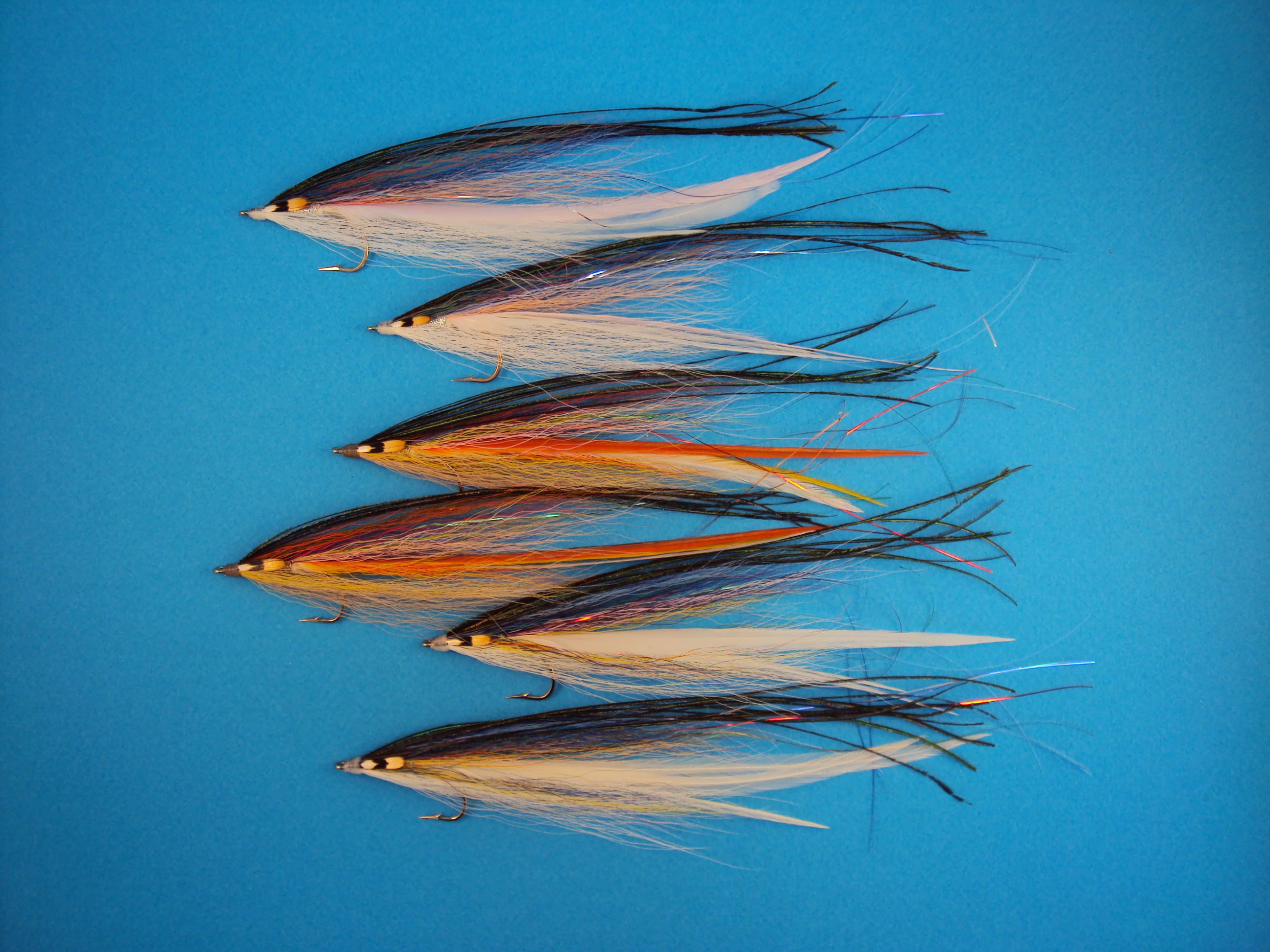
So I headed south to see who might be out and about. Save for a multitude of sea birds and one other fly angler, I had the beach all to myself. This being a powerful moon tide, there was no shortage of sexy rips and seams to cast into. I was two-handing it with a floating line, a six-foot section of T-11, and a three-foot leader of 20-pound mono. A four-inch long September Night seemed like a fine choice of a fly, although I spent considerable time debating the merits of throwing a sparse bucktail like the Magog Smelt.

I fell into the meditative rhythm of cast, mend, mend, swing, slow retrieve. I was ready for the pull of a hungry fish.

The answer was no.  All I was catching was sea lettuce and marsh grass. The other angler across the way was likewise blanking. Then he got into a small striper. And another. I kept waiting for the hits that never came. Since I had a limited time slot — I was slagging off work — I reeled in and headed for another spot. The distance and brisk pace I kept made me sorry I had put on that extra layer of fleece.

New venue, same results. There comes a point in every skunking where you make peace with the fact that you’re not going to catch anything. So I reminded myself that while most of the world was working, I was fishing. The sun was out. I had the pleasure of a peppery, earthy Churchill. But, I asked, could I please get just one fish? I raised the question out loud, because I find that when you’re alone, that works a lot better than just thinking it. How else to explain the strident bap! at the end of the next swing?

These stripers didn’t know there weren’t any mullet around. Not to worry, for the September Night worked quite nicely on this December afternoon.

Image

And that was the start of the Bass-o-Matic. All small fish, but each of them fresh from the ocean,  flawless and gleaming bright.

With great discipline, I peeled myself away from the frenzy five minutes before my hard stop. So much to do. So little time.

At least now I could cross “catch December stripers” off my list.

Hudson River Striped Bass 101

Smile, oh big-mouthed Hudson River tribe member. 

Images

Bob Creeden recently made a detailed post about the Hudson River striper stock on the Stripers Online Fly Fishing forum. I found it so informative that I asked Bob for permission to share it with my readers. He graciously agreed (thanks, RJ). And here it is:

The Hudson River filling in was done mostly in the 19th Century. The Railroad did 80% of it. Especially on the eastern shore between Manhattan and Albany. It was polluted in the 19th and early 20th Century. And when the bass crashed in the mid 1980s it included the Hudson River strain.

There have been many changes in the past 45 years in the Hudson River and the 25,000 square Mile watershed that feeds it.

Today, the Hudson is clean. Clean enough to be recognized as a Class “A” swimming water from Albany to the NY City Line. The Hudson River striped bass stock was the quickest to recover from the over fishing of the 60s, 70s and early 80s. It is the best environment for healthy striped bass production. The 100 miles of freshwater tidal from Cornwall, NY (below Newburgh) to the first barrier dam North of Troy, NY, is consistently productive with no lack of water and no high water temperatures like the Chesapeake Bay Estuary has been experiencing for the past 20 years.

I was born on the banks of the Hudson. (Manhattan – Washington Heights) Grew up and maintained a boat on the Hudson from the age of 12 (docked a 1/4 mile up the Croton River at Crotonville) and lived most of my adult life on or near the Hudson in the Catskill Creek to Kinderhook Creek portion above the Rip Van Winkle Bridge. When I got out of the Marines in the 1960s, the upper Hudson from Catskill to Troy, NY was a dead sewer of a river. Since the mid 1960s, thanks to Nelson Rockefeller’s Clean Waters Act that had water filtration plants built in every village, town and city down the NY City line, the river is vibrant and alive. A birthing place and nursery for hundreds of fresh and saltwater species. I was appointed to the Hudson River Estuary Management Advisory Committee (HREMAC) during Cuomo’s administration and sat on it through two other Governor’s terms. George Pataki’s Environmental Bond Issue, voted by the majority of New York residents, built on the foundation supplied by the Clean Waters Act. It has gotten better and better from those great environmental steps.

We still have landings of 50 to 70 pound striped bass and a solid female contingent of 8+-year-old female striped bass producing a decent level of Young of the Year striped bass. Healthy 30 to 40 pound Hudson River DNA striped bass are counted, tagged and released every spring while they hang out in the freshwater tidal portion of the river. The spawning creates each year class, that are counted in September in that same clean freshwater tidal area of 100 miles as they come out of the bays and creeks along with YOY American Shad and YOY Blueback and Alewife Herring. The daily bag length should be reduced to a single fish and the length set at 35 inches. This would at least allow the females to have two full years of egg production with out being culled from the biomass before they can contribute to the stability of their species.

Another Hudson Riverling. Hard to imagine she was once smaller than a silverside.

Image

The Hudson River DNA Tribe is the second largest producer of migratory striped bass on the East Coast. The Chesapeake Bay DNA Tribe produces 60% to 70% of all YOY counted annually in September. The Delaware River DNA Tribe is the smallest producer, due to the shortness of its spawning range and its reliance on a strong spring run off of snow pack and spring rains to keep the salinity of Delaware Bay from Chester, PA to the C&D Canal just below New Castle. 2011-12, “The winter that wasn’t” failed to produce enough freshwater to allow for a minimal spawning effort. I’m not sure the runoff this past spring was much better.

The problems caused by human population explosions along the shores of the Chesapeake Bay’s western shoreline and the Chicken Broiler production of a billion chickens annually for meat consumption down the length of the Eastern Shore in DE, MD & VA has loaded the bay with a choking amount of nitrate’s and potassium that create algae blooms that have cut off the cool deep water refuges needed by juvenile striped bass. They are genetically programmed to spend almost three years in the Bay and its tributaries before migrating out into the clean and cold Atlantic. It is estimate that 70% of the YOY counted in the Chesapeake Bay the September after they are hatched will die before they are old enough to reproduce. That is were a huge loss is occurring. Millions of immature Chesapeake Bay striped bass are dying because they cannot seek the cool depths and are forced into the stress of living in 90 to 95 degree water in the summer months. These conditions are destroying the productivity of the Chesapeake Bay Striped Bass Tribe.

A fully mature female striped bass is 8 years old. She is between 31 and 32 inches and weighs 15 to 16.7 pounds when full of eggs. The Hudson River 8+ Female count is strong and steady. No great fluxuations over the past 15 to 17 years. I’d really like to see what the Female age 8+ is doing in DE, MD and VA. In 2011 VA or MD declared the greatest number of YOY striped bass in 50 years had been produced. in 2012 it declared it had the worst YOY count ever for striped bass.

We folks in NJ, CT, RI, MA, NH & ME benefit from the migration of striped bass from the Chesapeake Bay every spring, summer and fall. I believe the anglers in the areas north of Cape Cod in MA, NH and ME have seen a steady decline in the number of mature striped bass they are seeing in their waters. Most of the striped bass south of the Cape Cod beaches are Hudson River fish with a little bit of Delaware River SB mixed in. The Hudson River Tribe’s migration after spawning goes south to Cape May and North to the southern beaches of Cape Cod. We all should pay a little more attention to what is happening to the Chesapeake Bay Striped Bass tribe.

Striped bass, like shad and river herring, need freshwater to spawn in. The river herring tribes and the shad come out of the summer nurseries they grow in between May and September and they come down the fresh water rivers and make their way to the ocean.

The Hudson River YOY move down the river and travel to the rivers and bays that are salty. They move into the Hackensack, Passaic, Raritan, Shrewsbury, Navesink and Shark rivers of NJ. They make their way up the East River and out into Flushing Bay and the western end of LI Sound. From there they invest in all of the salty ends of the south flowing CT, RI and MA River. Plus the north and south flowing rivers and bays of Long Island, NY. They will spend the next two seasons growing and sharpening their predatory skills in those waters. When they reach their 3rd Spring (in March or April) they begin to migrate to the Atlantic Ocean and spend the next 5 or 6 years maturing. Then they return to the Hudson River starting in March of their 7th or 8th year. Some 7 year old females will produce eggs and spawn that spring. Others will produce eggs and fail to spawn at age 7. Those green eggs will be absorbed back into the flesh of the 7-year-old female as protein. A baby striped bass will hatch and the outer shell of its egg will remain attached to the tiny, perfect striped bass baby. That tiny fish will absorb the shell protein into its body and when that process is completed it will begin to prey on food too small for us to see. As it grows and needs more protein, it will begin targeting larger and large prey. The biologists believe that immature female striped bass use the egg absorption process they used as tiny YOY.

Stripers-by-numbers

2: Number of cigars I smoked, a Gispert Churchill on the drive down to Rhode Island, and an H. Upmann 2000 Reserve corona gorda on the way back to Connecticut.

5 and 9: The weight rod and line I used. Perfect for the tight confines of the first spot we fished. I could load the rod with a minimum of line, and shoot the rest with a flick of the wrist.

7 and 9. The weight rod and line Jon used.

1: Number of stripers we caught in the first spot (Jon was the successful angler).

4,957: Number of weeds I hooked in the first spot. At least it seemed like that many. I was fishing a greased line swing, then a dangle, and I could feel the tick the moment the weed hit the fly.

1: Number of stripers we saw in the second spot. Jon noticed a wrinkle on the surface in the moonlight. As we worked our way along the bank, I felt a quick little bap! And then he was gone. Other than seeing a few silversides and a juvenile fluke, the place was as dead as Julius Caesar.

86: My heart rate when we got to our last stop and saw a couple fish feeding out in the current.

10: As we were already well past our cutoff of 11pm, our agreed-upon time limit, in minutes, to catch a striper.

1: Number of bass we caught. (My turn.)

2: Happy anglers who made the drive home to Connecticut.

Block Island Diary 2013: Hey! I Remember You. (Kindof.)

If you’ve followed my previous Block Island Diaries, you know that the last two years of fly fishing from the shore have been – ahem – underwhelming. Used to be, a good night on the Block was a dozen stripers. An off night, two or three, with an odd visit from the skunk tossed in to keep you honest. But in 2011, I took only six bass in seven nights. Last year, a measly four bass. Buoyed by a strong 2012 fall run in Rhode Island and an equally impressive 2013 spring migration here in Connecticut, I ventured once again to the magical land of the Manisses.

Saturday: Red Right Return

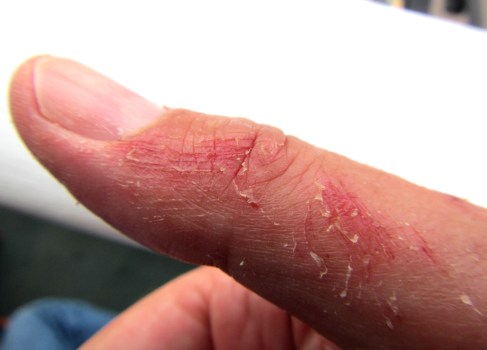
There’s a reason Luke Skywalker doesn’t blow up the Death Star at the beginning of Star Wars. Unfortunately, you don’t have the luxury of manufactured drama in non-fiction. You get what the fates throw at you. And what I got tonight was a good old-fashioned summer blockbuster climax. It was so humid it felt like you could grab handfuls of air. Low clouds and fog banks whipped past, accentuating an already mysterious setting. Five casts in, and I had my first bass of the trip, a porcine twenty-one-incher that went immediately on the reel. Twenty minutes later, I’d already caught more stripers here than I did all last year. Halleluiah! These bass were gathered for one purpose: to eat with extreme prejudice. Sand eels were the entree, and I could hear them plink-ploinking through the water as I waded. There were stripers everywhere, and they attacked my fly, a Big Eelie in a Crazy Menhaden color scheme, with undisciplined fury. Missed strikes were frequently followed by punishing returns. Without a sealed drag, the moisture in the air and an occasional dip in the water reduced my reel to a shadow of its locked-down-tight self. Once hooked, the bass were off to the races, and I did my best to palm the reel. My knuckles took a beating as the handle repeatedly whacked them, but it was a good hurt, and I laughed at my clumsiness. The commotion I created sent several spin and fly anglers scurrying over to join the fray. By some perverse twist they all caught few or no fish. Some muttered as they left, and others departed with a palpably grim silence. Twice I told myself I would give the spot a rest and seek my pleasures elsewhere. Twice a fifteen-pound fish talked me out of it. The action slowed only when Mr. Boating Dipstick 2013 set a course for the wrong side of the channel marker – despite his blazing, brilliant spotlight – and momentarily hit the sandbar. But that was the only wrinkle in an otherwise flawless night. When it was over, my thumb looked like a pound of ground chuck under cellophane. My fly had been surgically reduced to a couple hackles and some forlorn strands of bucktail. Even when I tried to stop fishing, I couldn’t. I caught a legal fish just reeling in my line. One of the stalwart souls still on the beach called out to me. “Are you leaving?” Yep, I’ve had enough. “How many did you get?” I don’t really know. I stopped counting after fifteen. “You had some big fish there.” At least a half dozen in the 15-pound range. “Can I see what fly you were using?” Absolutely. “Wow. That’s it? It doesn’t even have eyes” Nope. Here, take this fly, and this one too. Color doesn’t matter. Good luck to you! Then I began the long walk back to the truck. As I trudged through the sand, I switched on my headlamp, and basked in the warm red glow of an absolutely righteous return.

Any night filled with ten to fifteen pound stripers doesn’t suck. I know, I know, it’s not the most fish-friendly photo. If it makes anyone feel better, I lipped the rest.

Image

That’s gonna leave a mark. The price of admission for a dozens-of-bass outing. 
Image

Sunday: The five most feared words in fly fishing

My friend Bill arrived on the Island today, and I’ve been regaling him with tales of gluttonous bass, buckets of bait and thumb-wrecking action. Word travels fast about a good bite, and the parking lot is mobbed. The weather and the wind are a carbon copy of last night. All we have to do is wait for dark and a little more of that flood tide. Unfortunately, there are more anglers than bait. Or stripers. Plenty of skates, though, in thick and beaching themselves, wings flailing away, frantically slapping against the sand. The wind picks up in intensity, and brings with it brief tropical downpours. I can see a light grey band in the skies over Block Island sound, then a foreboding line of India inkiness over the mainland. In the end, the bite never materialized. I managed a single bass by moving around and fan casting with a black, blue, and purple Big Eelie I call the Bruiser. I couldn’t blame Bill when he bailed after the second squall came through. As he walked off I called out to him, “You shoulda been here yesterday!”

Until someone brews up Silver Stoat Stout, Todd’s Norway Ale, or Flyrodder Lager, I’m still the only dude in my crew with his own label. (“The Fisherman” is my internet forum nom de voyage.)

Image

Monday: Gettin’ jiggy wid it

The wind is banshee bitch, even more so than the previous two outings. The fishing’s about the same as last night, possibly a degree less of suckiness: three fluke in about 90 minutes of fan casting over an expansive flat. Einstein’s definition of insanity being what it is, I decided to go for a wade along some shallows that border rocky structure. I spooked a fluke, then saw some suspicious upheaval on the surface about 50 feet away. I climbed up onto a rock to investigate. Three casts and two bass later, I had my answer. The fish were standard-issue Block Island mid-twenties schoolies, which is to say that they were rotund, powerful swimmers that went on the reel. Not much else going on, and I was in bed by 2am. While I was sleeping, Ravi, who works at the Block Island Fishworks, was jigging for squid in New Harbor. At 3:30am, he hooked a squid, which moments later was swallowed by a 31-pound cow. He said her stomach was full of calamari, from 2” to over a foot long. Now, which box do I keep those Banana Squid flies in?

When the fishing’s slow, you look for ways to amuse yourself. Here’s my attempt at an abstract: a long exposure of boat masts swaying in the wind, accentuated by a rogue fireworks shell burst.

Image

Tuesday: A very deep trough

Nothing. I fished the snot out this Island tonight, and nothing. Nothing at the Saturday night heroics spot. Nothing at my favorite jetty. Nothing at Charlestown Beach. (Not that five minutes of beleaguered casting in hellacious 20mph crosswinds counts for much.) Bill came back out tonight, and I talked him into trying a spot on the west side I’d never fished before. We were sheltered from the wind by a kindly bluff, but it’s generally a bad idea to wade out into unknown waters at night, even if you scouted them from the shore in the daylight hours. Bill gave it 15 minutes, but he just wasn’t feeling it, and after he left I got the standing-in-the-ocean-at-night-by-myself-catching-nothing blues. The visibility was so poor that I couldn’t even make out the horizon. All it took was one good gut-high wave to knock me off the rock I was standing on. Off to more clement waters, where, of course, I caught nothing. There was the mystery of the glow-in-the dark shooting basket to keep me entertained, though. I noticed that at odd intervals, the inside of my basket would glow a dull red. It was a puzzlement until I realized it coincided exactly with each draw I took on my cigar.

Yup. That about sums it up.

Image

Follow the fish. If only finding stripers was this easy.

Image

Wednesday: The natural

Tonight I’m taking my 10 year-old out with me. Last year was Cam’s first time night fishing for stripers, and although we didn’t catch any bass, he aced the outing. Whether it’s because I’m with my new fishing buddy or I’m attuned to some angling sixth-sense, I feel like we’re going to see some saxitillus tonight. Cam is fishing a 4” jig-head Sluggo, and lands a fluke in short order. We move to a different spot where Dad hooks a bass. It’s a standard-issue schoolie, but Cam is more than happy to land it on the fly rod in the misty twilight. Our last stop is the jetty. We experience our first double, although it is curiously strange that we have both hooked skates, Cam’s from the bottom and mine on the surface. We go out in a blaze of glory when I tie into a keeper bass about 70 feet away. I set the hook, and hand the rod over to Cam, who’s never fought a striper that large before, let alone on a fly rod. I take a quick picture, then clamor down the weed-covered rocks, telling Cam to let the fish run when it wants, reel it in when he doesn’t, and take his time until I can get down into the water. I’m standing at the bottom of the jetty, about to tell Cam to start getting the fish in, when I see a splash at my feet. Cam’s already beaten the striper, and there it is, waiting to be lipped. I got goose bumps when I realized that he’d landed his first keeper bass a lot quicker than his old man did.

A portrait of the artist as a young man, focusing on the job at hand and doing his father proud.

Image

Thursday: Fireworks cancelled due to fog

And the bass followed suit. At least for me they did. We all put our waders on one leg at a time, and tonight I’m living proof. Everything that could go wrong did. Everyone caught a striper but me. It’s not much fun when you’re going through it. At least afterward you have the comfort of humorous remembrance. Things started poorly when I drove a spot on the east side that was on lockdown – and they were catching fish. No room at the inn, so I drove to the west side where my line repeatedly insisted on wrapping itself around my rod. Literally sprinted a hundred yards down the beach after an angler reported blitzing fish on a sand bar – and found nothing. To make matters worse, I was wearing my stubborn hat tonight. I stayed out way too late. At least the birds weren’t singing by the time I drifted off into the fog of sleep.

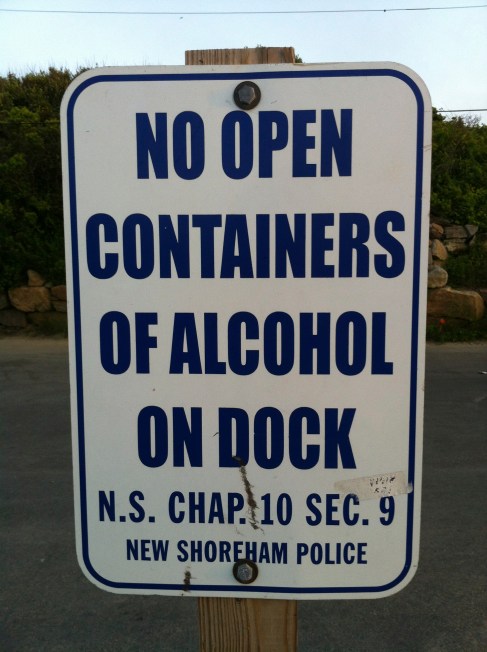
Fortunately, there’s nothing in Chapter 10, Section 9 about carrying a cold one out on a jetty.
Image

Friday: Right where he’s supposed to be

It’s good practice for any serious striper angler to know a spot – and know it cold. I’ve fished the Island long enough now to have a certain level of competency. I have a mental index of where to fish at what tide, wind direction, moon, etc. Tonight I had my heart set on catching a striper at X. There were a few problems with my plan. X is generally a two-hours-either-side-of-the-flood spot. Tonight was fireworks night with the family. That would put me there well into the third hour of the dropping tide. The best I could do would be to have the truck pre-loaded so I could make tracks even as the finale’s last boom! was echoing across the hills. There was enough bait in the water to keep me hopeful, even after a fruitless fifteen minutes of casting. Then, bump! Missed him. Mortal depression. This being such a mercurial week, that might be my only touch of the night. But somewhere out there, in the rapidly fading twilight, I could hear the mischief of a bass feeding. I couldn’t quite place him; there was enough wind chop to make sighting the rise rings impossible. Bump! He hit it again. I let the fly sit there. Gave it a short strip. Bump! What gives? Must be a small fish. Another strip. Whack! Got him now, a silvery ten-pound striper that was the perfect fish in a perfect place at a perfect time. As I’ve gotten older, I’ve tried to embrace the concept of, “I don’t need to be right.” But oh my goodness, sometimes it feels so damn good when I am.

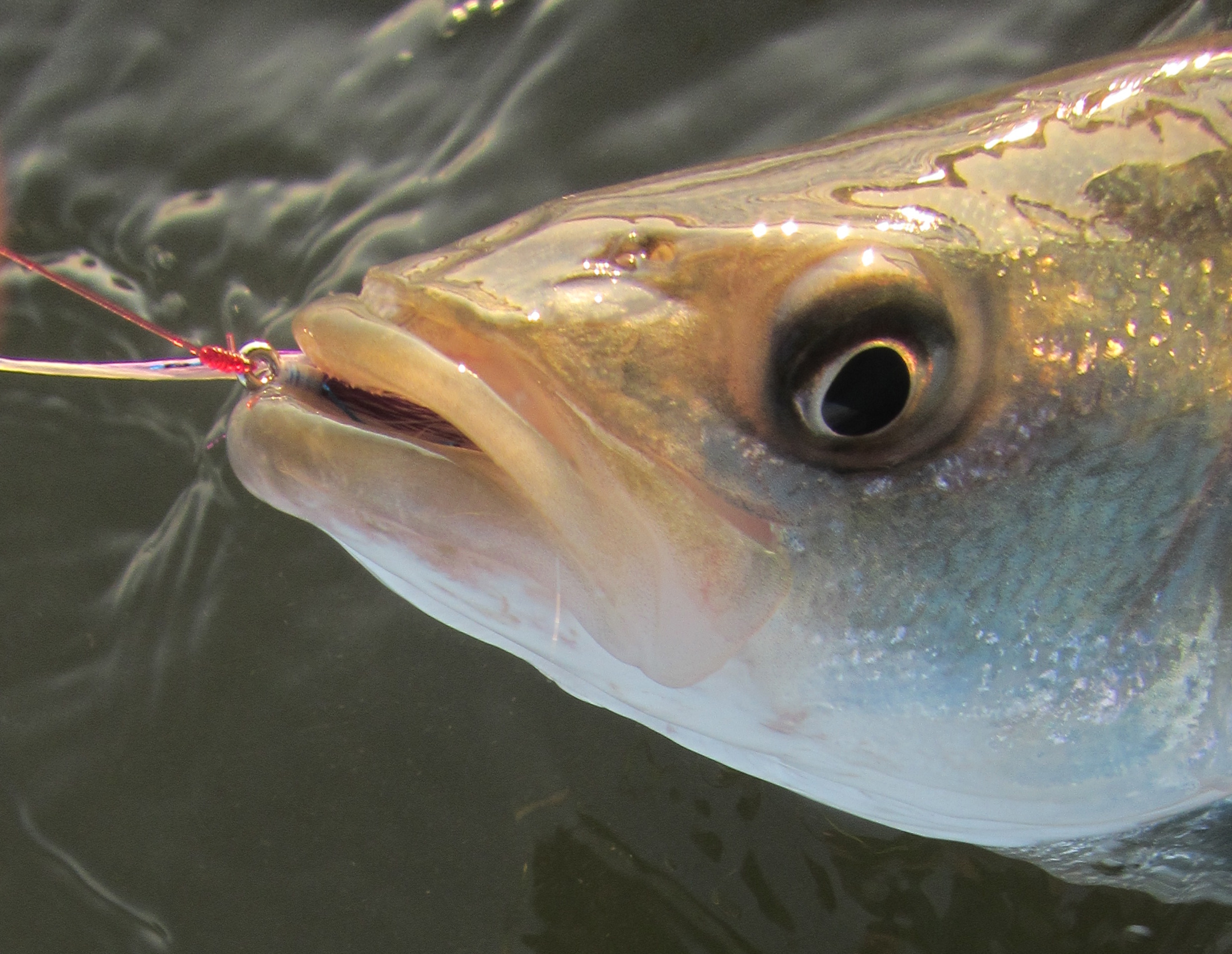
A perfect fish. Just what I needed to close out the week. As tradition dictates, taken on a Big Eelie in the original colors.

Image

And you can put your weeds in it

One of the more agreeable aspects of fishing salt pond outflows on a dropping tide is the conveyor belt effect: everything that was inside comes rushing past you on its way to the sea. Bait. Stripers. And sometimes, sadly, weeds. Lord, did I have my weeds Saturday night. Two of them were quite pleasant, a Cabaiguan Guapos on the drive down, then a Saint Luis Rey Corona Gorda for the trip back. The middle, not so much.

From an old, not-so-famous poem: “But all the outgoing tide decreed, was piles and piles of stringy weed.”

Image

Jon and I started out at dusk at Salt Pond A. We could see multitudes of bait in the water. But the only predators feeding on them were jellyfish, ranging in size from a salad plate to a more ominous-looking small platter. Off to Salt Pond B. Jammed with silversides, smaller unidentified baitfish, pods of worried mullet, needlefish, and — alas — precious few stripers. Jon managed a few small hickory shad, while I experienced a first: a mullet on a fly. I was fishing a team of three small bucktail baitfish patterns, ranging from two to three-and-a-half inches. Oh. I also caught weeds. Lots and lots of weeds. Dropper rigs excel at finding weeds. A 3/0 shot above the middle dropper provided a partial remedy, but I still got my limit of aquaflora.

On the way to Salt Pond C, disaster. Clumpthumplit! “What was that?” Jon asked, and immediately answered his question: he had left his rod on the roof of the car. A more fortuitous tumble might have kicked it into the breakdown lane, or even the grassy median. Positive waves were sent as Jon went off into the night to retrieve the fallen warrior. But no. DOA, including the reel. Last rites were given to both roadside, and Jon’s car, now playing the role of hearse, began the long, sorrowful journey back to Connecticut. But not without a detour. Salt Pond C still needed to be investigated. I made quick work of backing up the pool along a short channel. No fish. Several weeds. And lots of biolume.

So, it didn’t happen for us. Don’t bum out, man. Soon, those ponds will be holding.

Big Eelie Variant: The L&L

While I am loathe to use the phrase “go-to-pattern,” I beg to report that whenever there are large sand eels around, Ken Abrames’ Big Eelie is my go-to pattern.

The Big Eelie differs from 95% of other sand eel flies in that it is not an attempt to carbon copy the bait. Those legions of epoxy- and tube-bodied flies with eyes certainly work, but you can get away quite nicely with something far more impressionistic (if that’s your fancy) like the Big Eelie or Ray Bondorew’s Marabou Sand Eel.

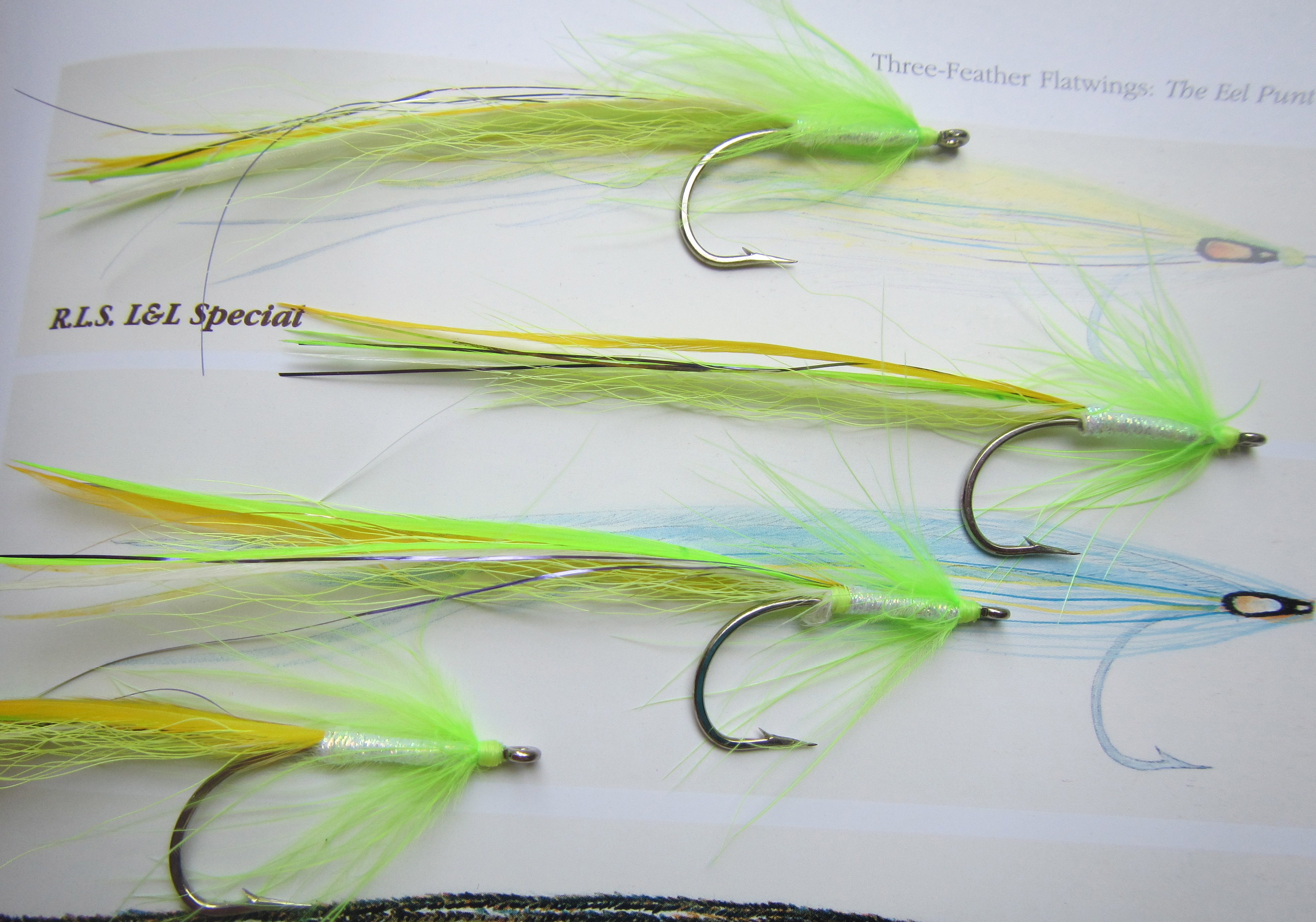
The classic Big Eelie is a four-feather flatwing/soft-hackle hybrid; it’s colors are white, yellow, olive, and blue. I’ve discovered over the years that the Big Eelie works in all kinds of color schemes. One of my favorites is taken from Ken’s three-feather flatwing, the L&L Special. This tart mix of yellow, fluorescent yellow, white, and chartreuse shines on sand flats, day or night.

The L&L Big Eelie

Image

Hook: Eagle Claw 253 3/0
Thread: Chartreuse 6/0
Platform: 30 hairs fluorescent yellow bucktail
Tail: A white saddle, under one strand each of gold and silver flash, under two chartreuse saddles, under two strands purple flash, under a yellow saddle.
Body: Pearl braid
Collar: 2-3 turns chartreuse marabou, tied in by the tip.

Tying notes: Sand eels are a slender bait, so make your saddles about the width of a pencil. You don’t want a flaring broom shape for the platform, so likewise make it slim, and take the bucktail from near the tip of the tail. All the saddles are tied in flat. The marabou adds the magic here, as it veils the body when wet, creating movement and an almost glowing effect. Feel free to play around with different colors on this pattern; some of my favorites are blue/black/purple and white/pink/olive. Stripers love them all. I like to tie this fly about 4  1/2 inches long.

Block Island All-Nighter VII: Ode To A Sleepless Night (with apologies to Robert Frost et al)

Every year in June, we head out to Block Island for the annual all-nighter. Small posse this year, consisting of a skeleton crew of your humble scribe and Dr. Griswold. Staying up all night striper fishing can be challenging, even when the bass are on. When the bite is off, like this year, it can be downright excruciating. Perhaps a little poetry will help ease the pain. And so, without further ado…

On Father’s Day it was decreed
That Bob and Steve would do this deed:
A journey to the Island Block
To fish for stripers ‘round the clock.
~
At 8pm our trip begins
With deep fried scallops fresh from Finns
Steaming hot, and by the way
Most tasty with an IPA.
~
Thus fortified, we hit the beach
To see if stripers were in reach
On my third cast I felt a chew
Alas! Fly gone. A freakin’ blue.
~
With toothies out I thought it wise
To tie on last year’s game-used flies
At 10pm right on the dot
I moved to fish another spot.
~
The hit was solid, hard and strong
The big bass’ run was nice and long
She tugged and pulled, I ‘bout fell back
In horror when my line went slack.
~
I reeled in to have a look:
You’re kidding, right? She broke my hook!
That’s what I get, such foolish settle
On older, tarnished, fragile metal.
~
Another bass took in a trough,
But moments later, he was off
‘Twas then I had but just one wish
Dear Lord, can I please land a fish?
~
Finally, there’s a striper hit –
Missed, but he came back (the git)
Reeled him in right near my feet
But he jumped off ‘fore we could greet.
~
Meanwhile Bob, my friend, poor sap
Had not even got a single tap
I wondered to myself, what’s worse?
No bites or losing fish (then curse)?
~
At half past one we made the call
To roll the dice, nothing or all
A place that surely would produce
Striped bass instead of eggs de goose.
~
But once again, the going’s rough
At 2am Bob says that’s enough
An hour later I did agree
Besides, I was cold and had to pee.
~
Bob awakened from his rest
And off we went with little zest
Depression, desperation near
Another crappy fishing year?
~
Bob’s lone striper came at five
And plus two fluke, now he’s alive
Meantime I was catching weeds
Just one more bass! I so did plead.
~
Sunup – 5:30 – and that is it
Time for us to call it, quit.
Coffee, pancakes, eggs and bacon
To fill an empty stomach’s quakin’.
~
And so dear friends we close this rhyme
Be back next year, same place, same time
This lousy fishing’s got to end
The only question now is – when?
 Before: Unhappy Coaster.

Image

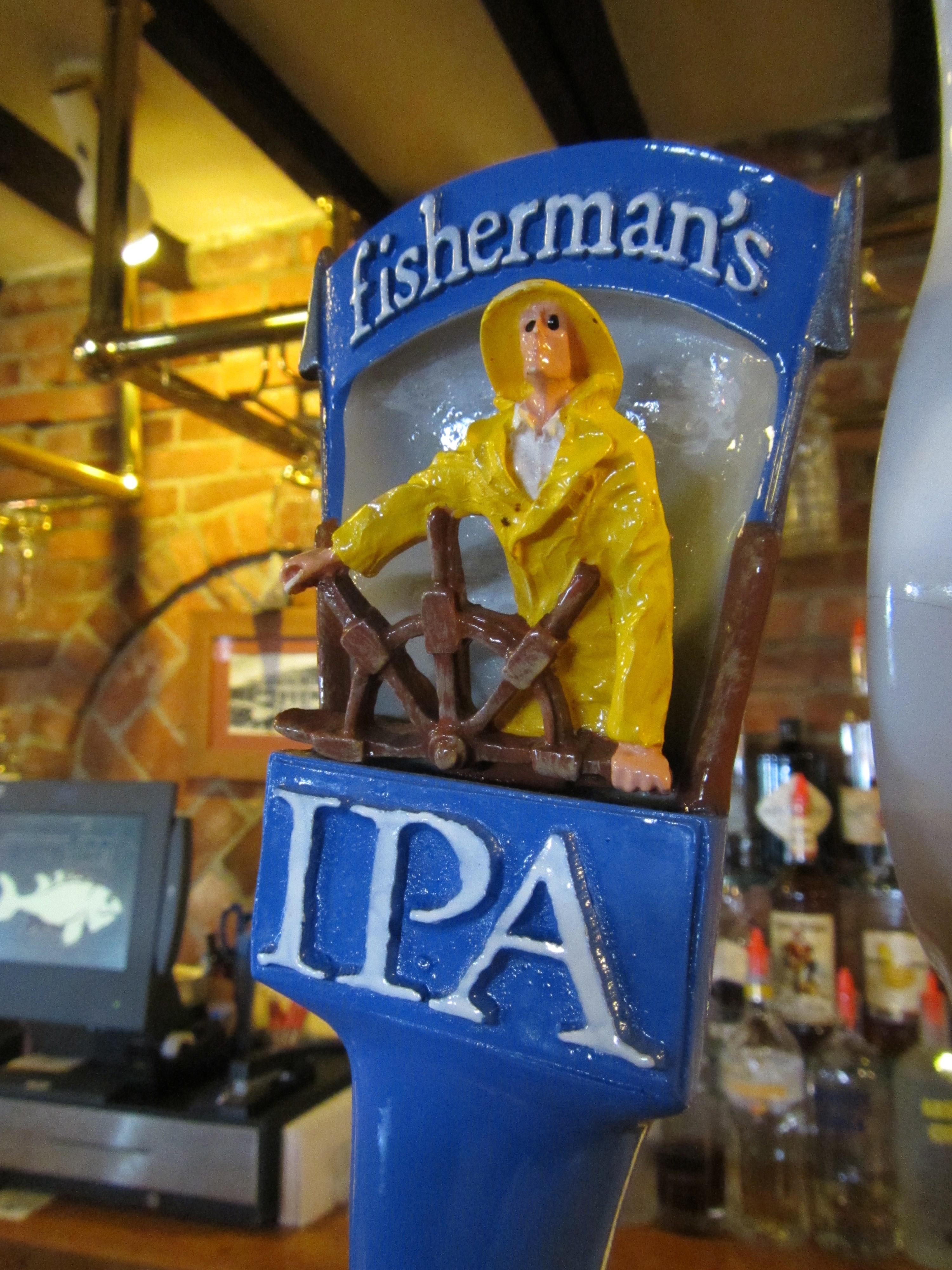
After: Coaster and friend, a pint of Fisherman’s IPA. Delicious, and a total hop bomb.

Image

Being a night owl, I usually miss sunup. Darn pretty, this one. You’ve been officially warned, sailor.

Image

Just completed a new article for the Mid Atlantic Fly Fishing Guide: “A Good Night For The Five-Weight.”

I don’t fish for stripers like most people do. Sparse flies with no eyes. Floating lines. And perhaps most of all, unconventional rods.

For five years now, I’ve been catching striped bass on my trusty five-weight. The first time I used it, I fished in fear. The second time, more excited than frightened. By the third outing, I had completely embraced the concept of using lighter tackle to fish for stripers. Every year I try to push the limits of what I can to with my nine-foot TFO TiCr. Every year, I discover that I have far more power with a lighter rod than I ever imagined. Not to mention fun.

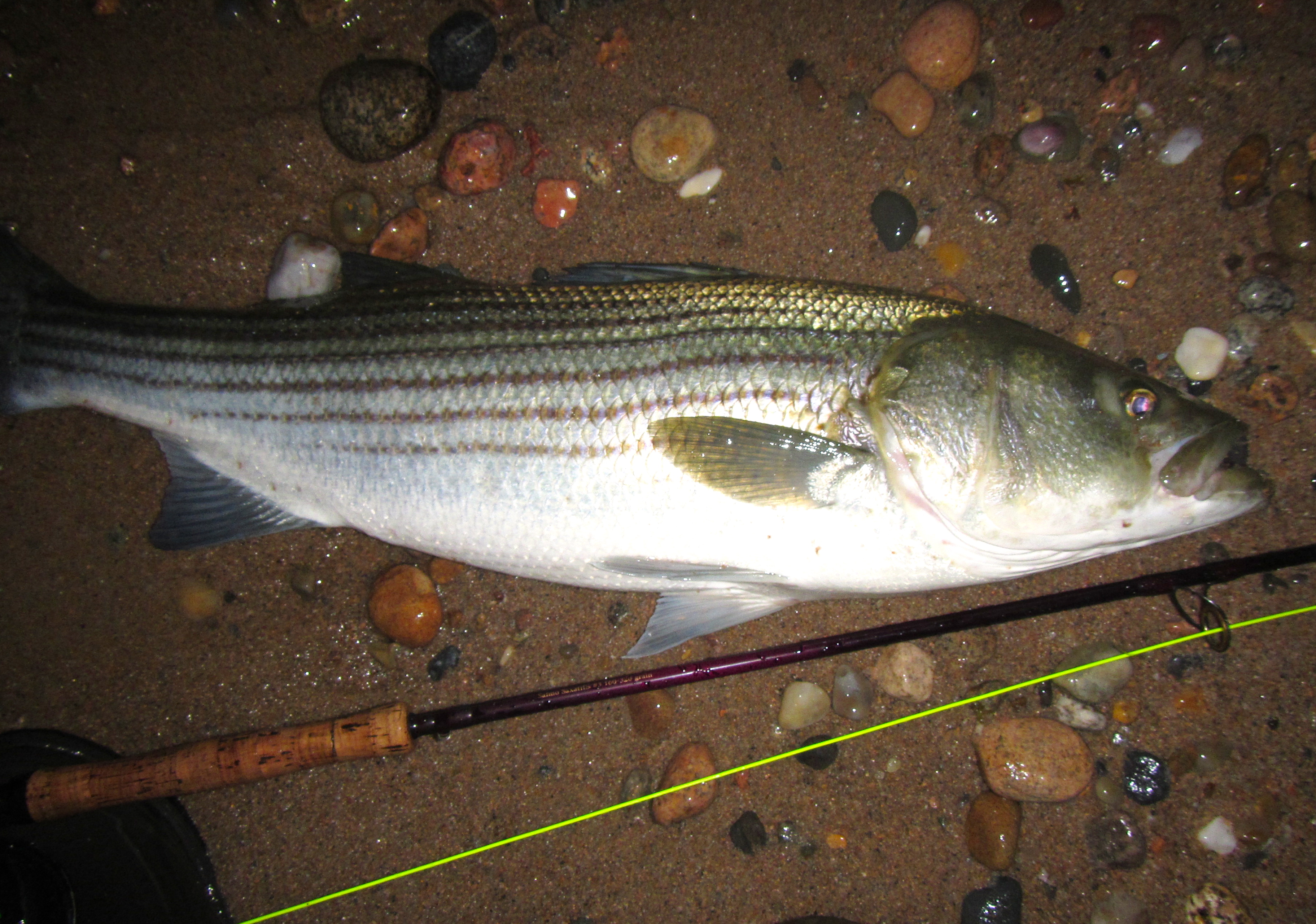
My new personal best on the five-weight, This 33″ chubette from a few weeks ago had some shoulders. She easily went 15 lbs.

Image

For those of you interested in exploring the wonders and challenges of catching bass on lighter tackle, “A Good Night For The Five-Weight” covers basics like rod selection, rigging, and how to play and quickly land larger fish.  It will be in the July 2013 issue of the Mid Atlantic Fly Fishing Guide. You can find a copy of the Guide in fly shops from southern New England to North Carolina, or though their Facebook page.

Let me know what you think.

Steve Culton Tying Demo at New England Spey Clave II

I will tying at The New England Spey Clave II, Saturday, May 11, 2013 at Matthie’s Grove, People’s State Forest, Barkhamsted, CT. If you have any interest in two-handed casting, this is a terrific place to explore, with casting demos, instruction, rod vendors, and more.

Yours truly will be tying flatwings and soft-hackles for stripers…

Image

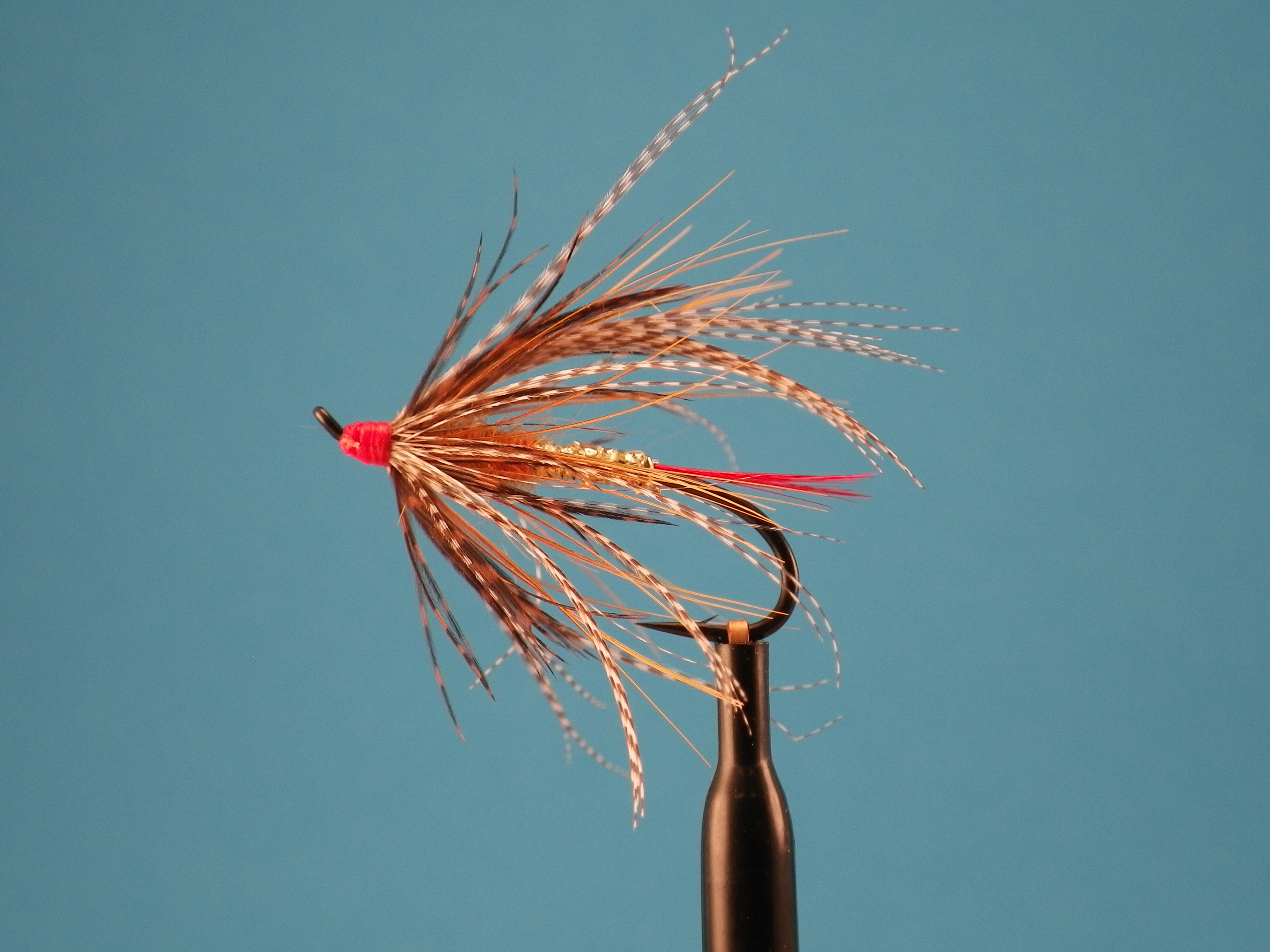
…and more traditional steelhead patterns like this Ginger Spider.

Image

Hope to see you there. Be sure to come say hi.

Last night, while you were sleeping…

…I was standing waist-deep in an estuary, searching for stripers.

33″ and well-fed. 15 pounds if she weighed an ounce. And a new personal best on the five-weight. She took a Striper Moon flatwing/bucktail hybrid about 8″ long on the dangle.

Image