Farmington River Mini-Report 3/21/13

The best time to go fishing is when you can, and all that. So even though I wasn’t stoked about overnight lows well below freezing, snow showers, and a NNW wind of 15mph, I made the command decision to ignore the piles of work on my desk and head to the river. Surely two hours on the Farmington beats the tar out of eight hours behind a desk.

Given the forecast and the fact that it was a weekday, the river was fairly crowded in the Upper TMA. Water was 35 degrees, clear and running about 435cfs. I had ice on my guides for the first hour. Then the sun came out, and with it some midges and an unidentified mayfly that looked to be about a 20 or a 22.

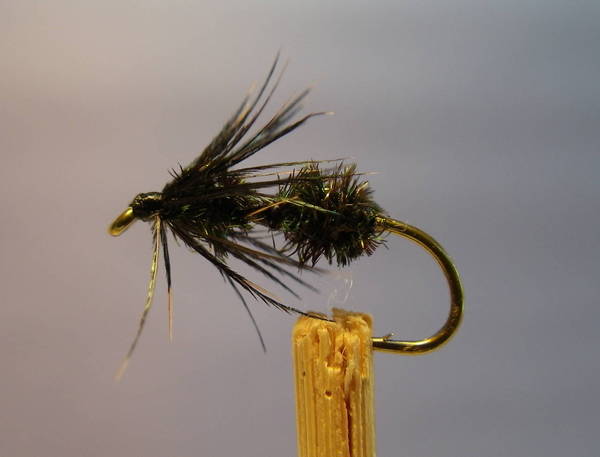
My suspicions about the weather knocking the bite down were confirmed. None of the other anglers I spoke with today had so much as a tap. Saw only one trout caught in two hours, and I’m delighted to report that it was at the end of my line. A standard-issue holdover brown who found my bead head, fur-hackled caddis nymph to his liking. Funny thing: I had been watching all my drifts up to that point like a hawk. On the one drift where I’m daydreaming, the indicator goes under. How often has that happened to you?

In a few weeks, the air and water will be warmer. And so will the fishing.

Classic Bergman Wet Flies Tied With Jungle Cock

Last week, someone used the search term “wet flies tied with jungle cock” to find currentseams. I found that intriguing because I had never tied a wet fly with jungle cock in my life. Sure, I’d done classic steelhead patterns. And untold numbers of flatwings and bucktails for stripers. But not a single wet with that most enchanting of feathers, the enameled nail from the cape of the male junglefowl.

Well, if someone took the trouble to navigate all the way to my humble site, they must have been disappointed when their search came up empty. And so, lonely internet sojourner, I took to the vise just for you. I have no idea who you are. But I hope you come back some day and find the little gift I left for you. And I thank you for the one you gave to me.

Here are four wets from Bergman’s classic, Trout. Clockwise from upper left: Silver Jungle Cock, Dr. Burke, Lord Baltimore, and Secret Pool No. 1. They are all tied on a size 8 1x short, 2x strong hook, the Orvis 1641.

Image

(upper left)
Silver Jungle Cock
Tail: Golden pheasant crest
Body: Silver tinsel
Shoulder: Orange floss, palmered with grizzly hackle
Wing: Jungle cock
~
(upper right)
Dr. Burke
Tail: Peacock sword
Body: Flat silver tinsel with oval silver tinsel rib
Hackle: Yellow
Wing: White with jungle cock
~
(lower right)
Lord Baltimore
Tail: Black quill
Body: Orange floss with black floss rib
Hackle: Black
Wing: Black with jungle cock
~
(lower left)
Secret Pool No. 1
Tail: Golden pheasant tippet
Body: Peacock herl butt and shoulder with gold tinsel center
Hackle: Claret
Wing: Slate with jungle coc

Tying notes: Some tie the Silver Jungle Cock with a longer shoulder; I kept mine more thorax-like. I think this would make a great steelhead fly. It was the easiest of the four to tie.

You can tie the Dr. Burke with as many or as few peacock sword hackles as you like. I chose four for this size. Trivia: Dr. Burke is Dr. Edgar Burke, the man who painted all the files in the color plates at the beginning of Trout. Dr. Burke is credited with creating the Secret Pool No. 1 pattern.

The Lord Baltimore is the first Bergman-style wet I tied with a quill tail. It was far less intimidating than I imagined.

I didn’t have any claret hackle for the Secret Pool, so I used wine marabou. I also tend to use more golden pheasant tippet fibers in my tails; again, that’s an individual choice for each tyer. No matter how many fibers you use, I like to show the second black band.

Another Good Night For The Five-Weight

“What?”

That was my wife’s response, delivered with no small amount of incredulity – or was it sympathy – when I told her I was going fishing tonight. I really couldn’t blame her. After all, I had been traveling home from Florida all day. Now it was evening, and I was on the phone with her, calling on a New Haven-bound Amtrak from Manhattan. I wouldn’t be home for another two hours, and then it’d be another two hours before I could leave.

But, you get to used to the oddball treatment from people who don’t obsess over tide times, heights, moons, and river levels like you do. Even if you’re married to them.

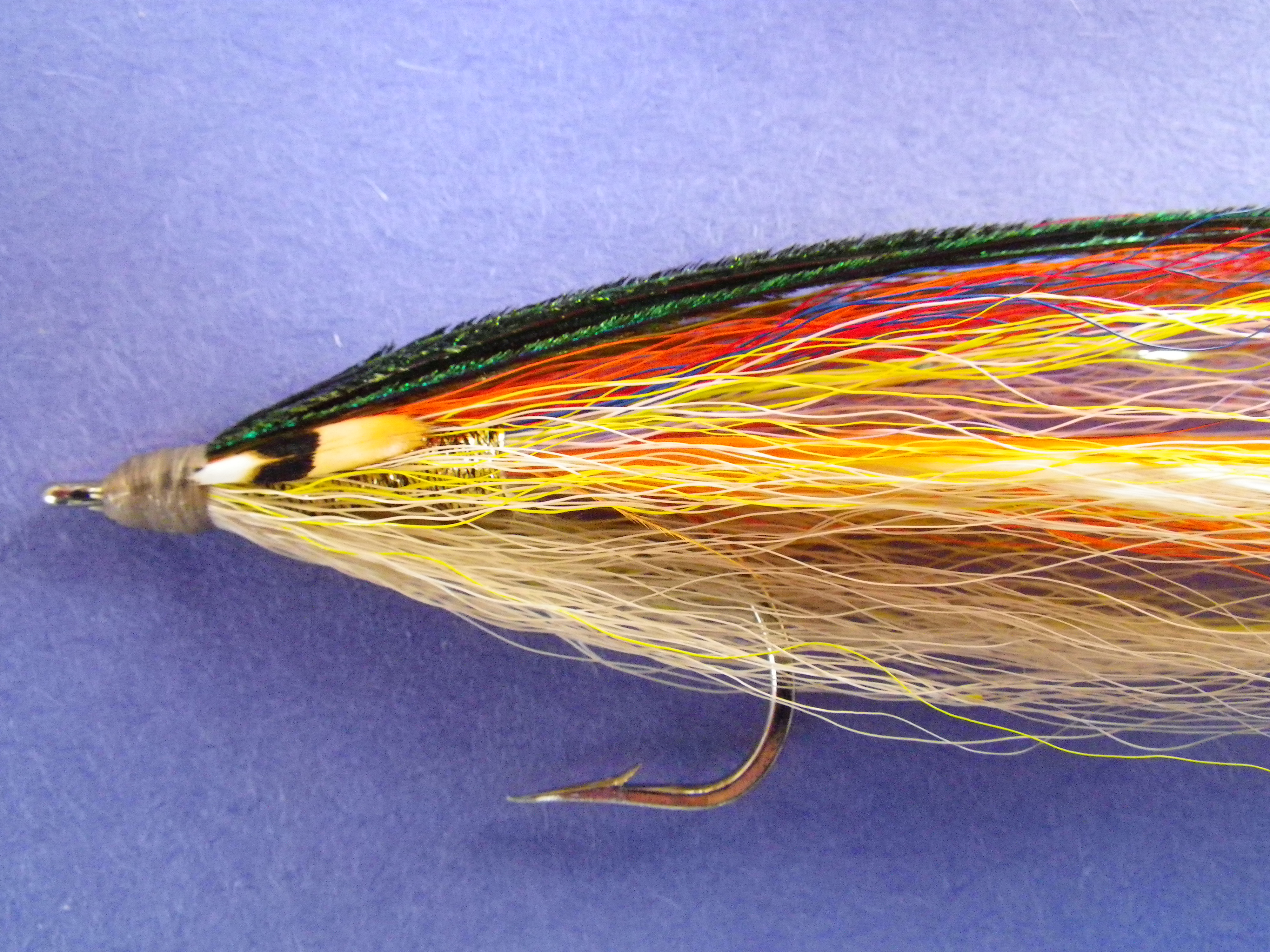
I hadn’t fished in over a week, so I had it bad for some stripers. Tonight would be a perfect night for the five weight rod. Not too windy, and the prospect of a striper in the 15 pound class. I attached a fresh 30-pound test leader about eight feet long to the line, then tied on a Herr Blue flatwing about eleven inches long from nose to flash. Everything looked just right.

Not even a nighttime roadwork traffic jam could slow my spirits. I ended up getting my spot ten minutes late. So what? The fish would still be around.

The current on the outgoing tide was moving at a slow walking pace. In what little ambient light there was, I could see the intricate cake-frosting swirls of the eddies as they passed over the hidden bottom structure. I tried to guess the water temperature with my index finger. 58? 62? The thermometer said 59 degrees. Not a bad couple guesses.

I began by working a deep little run between the rocks. Herring swirled near the surface right in front of me. I tried a few dead drifts, almost like high-stick nymphing, but there were no strikes. So I began to methodically walk down-current, greased line swinging the whole way.

The fish in this section of river tend to hit on or about my second mend, but forty minutes had gone by without a tap. The drill was comforting. Cast. Immediately throw an upstream mend. Then another. Let the fly swing around. Swim, pulse, and dance it in the current. A few short strips, then let it fall back. Even fishless, the presentation was pleasant and meditative. A glance at my watch showed it was well into the wee hours, and I was out here all by myself.

Except for her.

She took the fly as they often do on the greased line, slowly, with full confidence, inhaling the Herr Blue near the head, then turning back toward the bottom. I felt it as a sudden change in pressure on the line. Subtle, nuanced, yet distinctive from the unimpeded drift. No demonstrative WHACK! No explosion on the membrane between water and air. Not yet. I came fully tight to the line with a backward thrusting motion. The hook point found its seat in the corner of her mouth. Right where it was supposed to be.

Now she becomes unhinged, tail thrashing at the surface. At first, I’m unsure how large the striper is, and I under-guesstimate her to be in the 24”class. She’s moving toward me, and I’m hand stripping her in. Once she reaches the edge of the sand bar and discovers she no longer has the comfort of depth to rely on, she lets me know that hand stripping will be ill-advised. The fish begins her first run, taking the slack line out of my shooting basket through my thumb and forefinger at a jerky, frantic pace.

The drag protests as more line is peeled off. I ratchet things down a little tighter, and that stops her. Just to be sure, I re-set the hook. Line is regained, lost, and regained. She’s tantalizingly close now, about twenty feet out, but not quite finished.

Her last defense is her undoing. To escape the shallows of the sand bar I’m standing on, she heads for the deepest nearby water, which happens to be upstream. Between the current and the pressure I put on her, she tires quickly.

As I cradle her in the water, I wonder how many herring she’d eaten that night? Our time is all too brief together, not only the fight, but the release as well. I don’t have her in the revival position for more than a few seconds before she thrusts out of my hands and melts away from the beam of my headlamp into the darkness.

I climbed into bed around 4am. The birds were singing. I was, too. All the way home.

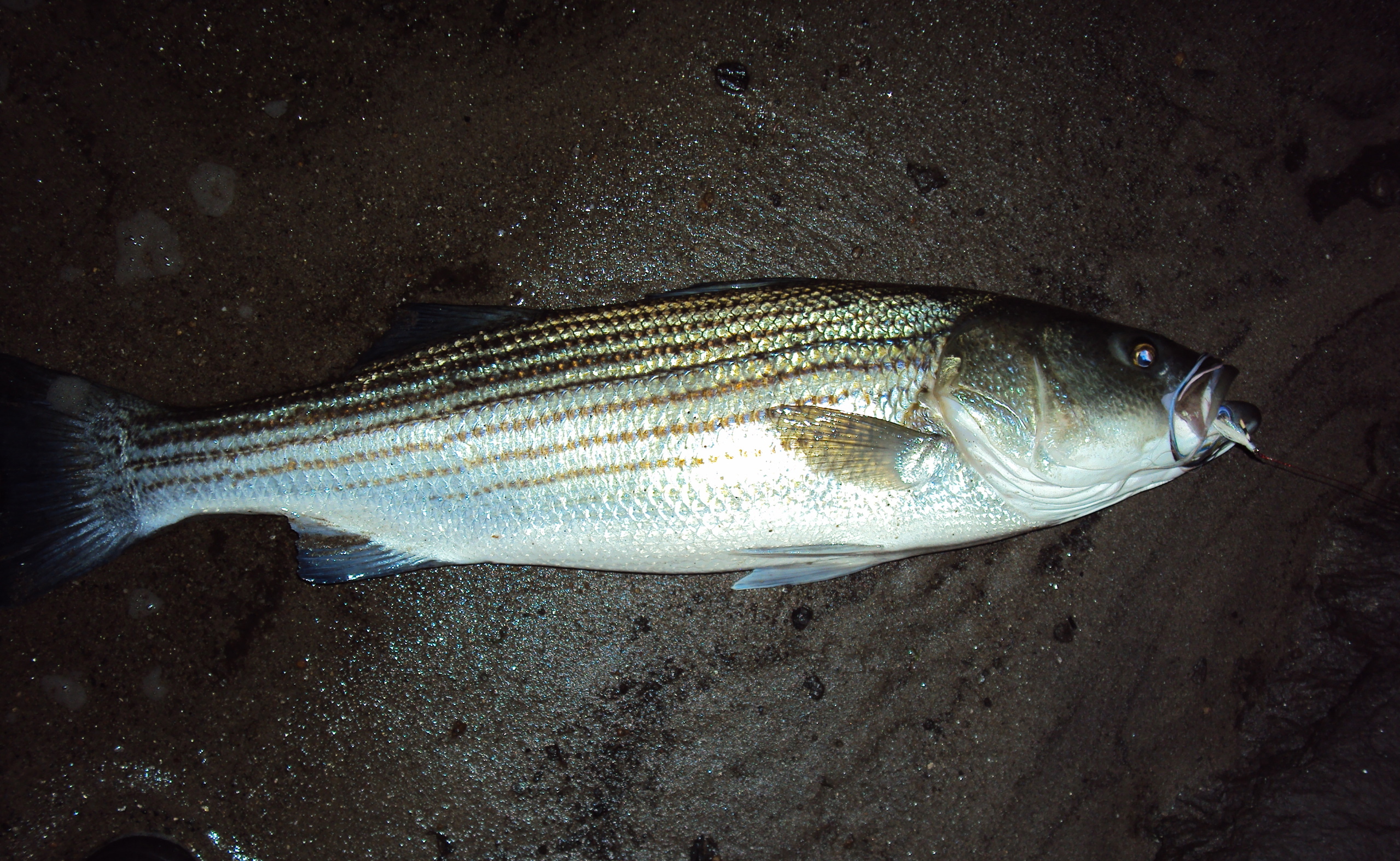
Miss Piggy poses for posterity. “Dang,” she’s thinking, “I really thought that was a herring.” For perspective, the fly, a Herr Blue flatwing, is about 11″ long.

Image

A close-up of the Herr Blue flatwing.

Image

This piece was written in May, 2012, and originally appeared in several online fishing forums.

The Peter Ross Wet Fly

The next time you fish the Peter Ross, be grateful that his name was not Aloysius Karbuncle. The Peter Ross is a traditional Loch style fly that dates back to the late 19th century. Ross based his pattern on the Teal and Red, another stillwater fly.

This fly is also a popular sea trout pattern, and you can easily see why. I like the contrast of the red, the black, and the dramatic barring of the teal. With its silver body, I’m thinking small baitfish or fry. Perhaps even something shrimpy. Something that looks alive and good to eat. I’ve already used it for steelhead, and I’m going to try it as the point fly on a team of three wets this spring.

The Peter Ross

Image,

Hook: 8-16
 (this is an Orvis 1641 size 10)
Thread: Black
Tail: Golden pheasant tippets
Body: Rear half silver wire, front half red angora goat
Rib: Fine silver tinsel
Hackle: Black hen
Wing: Teal flank

Tying notes: When you’re tying a small wet that calls for a body of “half this, half that,” it’s easy to mess up calculating how much area you need on the shank for each section. (Ask me how I know). You end up with a body that’s two-thirds one and one-third the other. Remember to take the head of the fly into consideration. Then, divide the remaining space between where you think the head will end and the end of the shank. There are many ways to tie in waterfowl wings. Some like to create an effect like a quill wing. Others like to fold the wing several times on top of itself, dull side in. Another way, the one I used here, is to tie the wing in small folded sections. For this size fly, I used three sections of teal flank about ¼ to 3/8 inch wide, folded them once, dull side in, and tied them on top of each other.

Thanks to the Saltwater Edge for tonight’s flatwing class

I spent a very enjoyable two hours tonight at the Saltwater Edge tying flatwings. We kept it simple with single-feather and two-feather patterns, like the Morning Glory and the September Night. Another great group, very enthusiastic, with lots of good questions. It is a privilege and a pleasure to be able to teach tying these magnificent flies. Thanks to Peter Jenkins and his gracious crew for having me. And thanks to Ken Abrames for leading the way.

Some flatwing-bucktail hybrids. Even at rest, they have a palpable energy.

Image

Today’s Blue Plate Special: the Rhody Flatwing

The Rhody Flatwing is an old pattern that was developed by Bill Peabody (of Bill’s Bodi-Braid fame). Being a Rhode Islander, Bill is said to have drawn his inspiration from fellow Ocean Staters Ken Abrames (flatwing design template) and Ray Bondorew (Ray’s Fly colors).

The result is pattern that makes a superb generic baitfish imitation. By altering the size of the fly, the tyer can match all manner of baits. The original pattern calls for a sparse tie. You can see from the picture that what I’ve used is more than enough material. Also note that there are no eyes on this fly – they’re just not necessary. Of course, if you must have eyes, jungle cock would be the appropriate choice.

This dozen was tied for a local fly shop, and the flies are about 5” long. Delicious!

A Dozen Rhody Flatwings

Image

Hook: Eagle Claw 253 1/0-3/0
Thread: White 6/0
Support: 30 hairs white bucktail
Pillow: White
Tail: 2 strands gold Flashabou under yellow or olive saddle hackle
Body: Pearl braid (Bill’s if you’re going for homage and tradition)
Collar: 30 hairs short white bucktail on bottom, 30 hairs long white bucktail on top
Wing: 15 hairs yellow bucktail under 8 hairs light blue bucktail under sparse olive Krystal Flash under 20 hairs olive bucktail
Topping: 5-7 strands peacock herl

Tying notes: The Eagle Claw 253 is a classic hook choice for flatwings. It is light and has a short shank that helps prevent fouling. You can use either an olive or yellow saddle –well, heck, you can use whatever colors you like. Try all black. Try all white with a hint of pink or chartreuse. I like a hollower, springy bucktail fiber for the support on this fly. I made the collars an even length because that’s what looked right to me. Adding flash to a fly is like applying cologne: easy does it. Less is more.

Thanks to everyone who attended my wet fly class at River & Riptide.

I love tying flies, but teaching others how to tie runs a close second. I am fortunate enough to be able to do it at a number of area fly shops. Today’s was at River & Riptide in Coventry, RI. Great group of guys, all eager students. It’s amazing watching the transformation that happens in someone’s tying in just a few hours. Our focus today was on wet flies. We covered basic soft-hackles, wingless wets, winged wets, and fuzzy nymphs. Thanks to R&R for letting me teach, and thanks to everyone who made the afternoon so enjoyable.

Drowned Ant Soft-Hackle

Image

I’ll be doing the same class tomorrow at UpCountry Sportfishing in New Hartford, CT.

The Crazy Menhaden three-feather flatwing

This flatwing draws its inspiration from Ken Abrames’ classic streamer, the Crazy Menhaden.

The original pattern calls for eleven saddles. But what if you don’t have all the right colors? Or, what if you have precious few saddles? One solution – the one I’ve chosen here – is to use bucktail instead of saddles to complete the proper color blend that makes this such an attractive fly.

Image

For this version of the Crazy Menhaden I’m using one white, one yellow, and one orange saddle to anchor the center of the fly, add length, and provide the swimming action flatwings are renowned for. (The exception is the biggest fly pictured, which has eight saddles.) The bucktail on the top half of the fly is tied like a Blonde, at the tail end of the shank and near the head. These fibers provide the bulk of the color and content, along with some flashabou accents and long peacock herl. The beige and yellow bucktail throat and sides remain true to the original pattern.

Along with the saddles, the rest of the color palette is bronze, pink, ginger, red, blue, chartreuse, olive, light green, and copper. The largest fly here is 12″ long; the smallest, just a bit over 7″.

I’ve had a lot of success with this fly at night on our rivers here in Connecticut. I like to fish it during the bottom of the tide, on a greased line swing.

You can find the original pattern in Ken’s book, A Perfect Fish, on page 93. When it comes to fly fishing and fly tying, I don’t usually speak in imperatives. But if you’re interested in flatwings and you don’t have this book, you need to get it. It’s the flatwing bible.

Image

Hook: Eagle Claw 253 3/0
Thread: Tan
Platform: Orange and yellow bucktail, mixed
Support: White neck hackle
Tail: Natural white saddle, under 2 strands copper flash, under a yellow saddle under an orange saddle, under 2 strands red flash, under 30 total hairs ginger, pink and violet bucktail, mixed, under 20 total hairs pink and chartreuse bucktail, mixed, under 2 strands green flash under 20 total hairs blue and red bucktail, mixed.
Body: Bronze braid
Collar: Beige bucktail on bottom, yellow and beige bucktail, mixed, on sides
Wing: 15 hairs orange bucktail under 30 hairs olive bucktail
Topping: Peacock herl
 Eyes: Jungle cock

 A closer look at the head detail and the color blends:

Image

A Classic Bergman Wet: The Fontinalis Fin

This is a fly with a great backstory.

The Fontinalis Fin Wet Fly

Image

Hook: 6-16 (this is a 1x short, 2x strong Orvis 1641 size 10)
Thread: Black
Tail: White hackle fibers
Body: Orange wool with fine gold tinsel rib
Throat: Furnace hackle fibers
Wing: Orange mallard married to a thin strip of black or natural grey mallard, then a slightly thicker strip of white mallard

The old-timers up in Maine (or down East, if you’re going for authenticity) who were fishing for brookies thought their quarry was highly territorial. So after they creeled a fish, they’d clip off one of the fins and use it for bait. And what an attractive bait it was: shiny, deep orange, contrasted against dramatic black and white bands.

An enterprising fly tyer named Phil Armstrong realized he could replicate this bait in the form of a married-quill wing wet fly. And thus was born the Fontinalis Fin. “Fontinalis” from the second half of the brook trout’s taxonomic name, Salvelinus fontinalis. “Fin” for rather obvious reasons. What a brilliant concept.

The real McCoy

Image

While it’s tempting to look at the flies featured in the color plates of Berman’s Trout (this fly appears on plate 10) as more of an exercise in tying legerdemain than practical fish catchers, I can tell you from experience that this fly does work. It’s pretty simple as far as married quill wings go, and the rest of the pattern is something anyone with basic tying skills can do.

Tying notes: If you’ve never tied a quill wing, don’t start. Your first quill wing can be the fly-tying equivalent of the Bataan Death March. While I was kidding (mostly) about not starting, I think it took me over a half hour to tie my first quill wing — and that was accompanied by a generous use of rather colorful language. Once you get it, though, the process becomes easier. I’m often asked at classes and demos, ‘How do you glue the different quill sections together?” You don’t. The edges of quill fibers are like velcro — they stick together quite nicely. There’s a specific technique to matching quills (the wings should be a mirror reflection of one another) and marrying the sections. Perhaps someday I’ll post them. In the meantime, you can probably find a good how-to by doing a web search. Also, the quill wings should sit a little higher on the shank so as to not hide the body; I was in a rush to finish this fly, so I plead sloth.

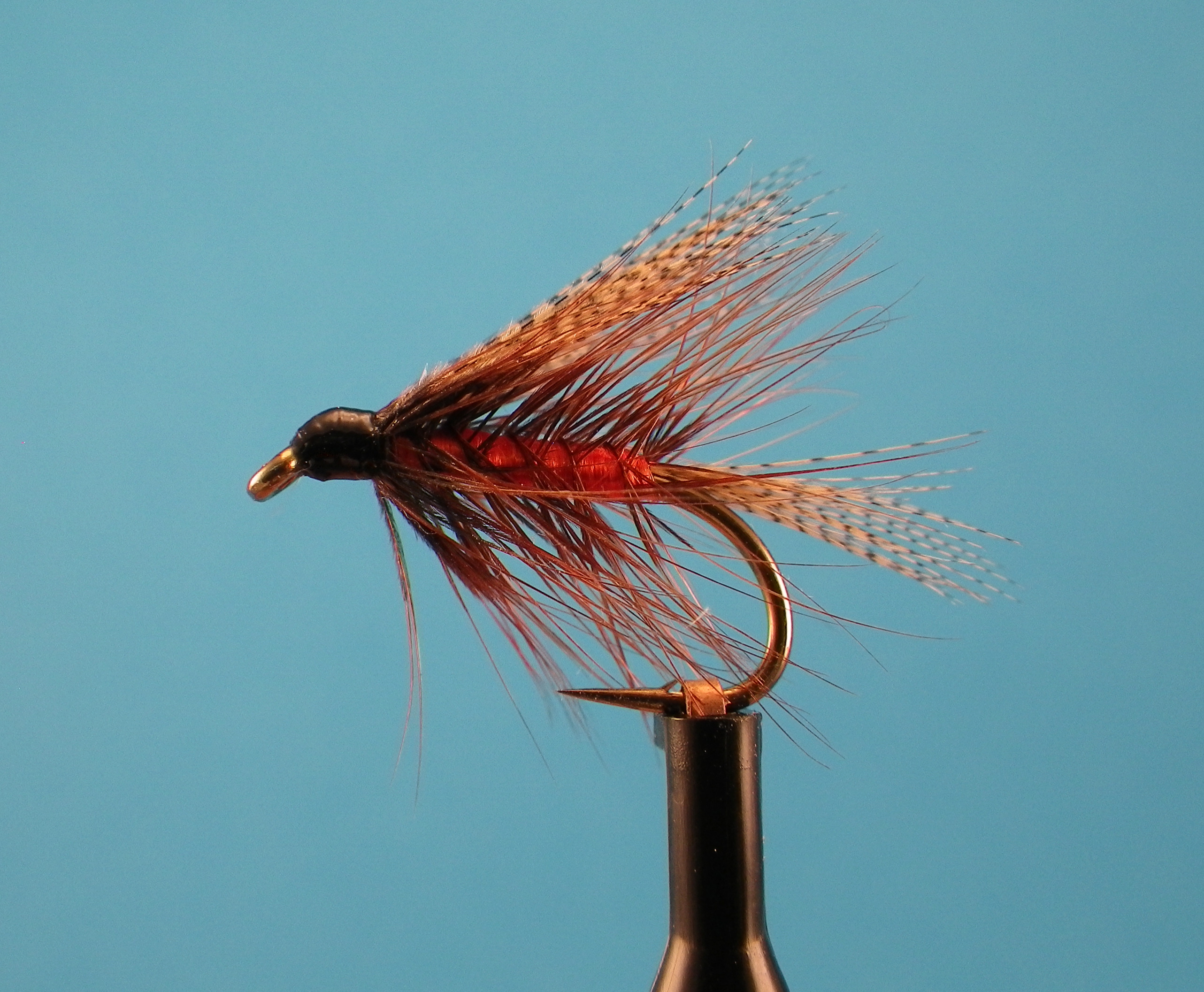
The Catskill Wet Fly

I first learned of the Catskill when I read Ray Bergman’s classic, Trout. While it lacks the garish palette of the majority of the flies that appear on the color plates at the beginning of the book, the Catskill is nonetheless an attractive fly – albeit in a rather understated way.

There’s something seductive and buggy about wood duck. The soft brown hen hackle will collapse and pulse in the current, contrasting nicely against the orange floss body. It’s easy to imagine this as an over-sized caddis. Or at least as something that looks alive, and good to eat.

I tied it large, but I can see going down to about a 16 or so with this fly. Although I have not yet fished it, I already have supreme confidence that it will be a fish catcher.

You can, too.

The Catskill

Image

Hook: 1x short, 2x strong size 8-16 (this is an Orvis 1641 size 10)
Thread: Black
Tail: Wood duck
Body: Orange floss under brown hen, palmered
Wing: Wood duck