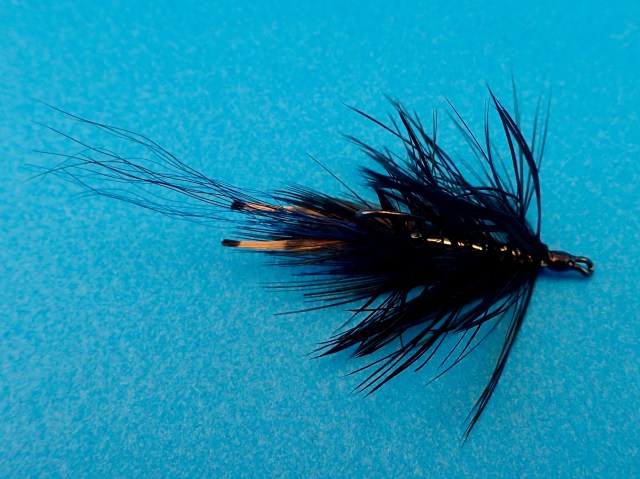
R.L.S. Black General Practitioner

What’s the best shrimp fly pattern? You could go with the philosophy of, “There ain’t no best,” and you’d get no argument from me. Or you could weigh in with the General Practitioner — and you wouldn’t be wrong.
General Practitioner = G.P. = Impressionistic shrimpy goodness.
OLYMPUS DIGITAL CAMERA
~

Trey Combs writes in Steelhead Fly Fishing that the original prawn was tied by Colonel Esmond Drury in 1953. The General Practitioner then got really famous as a west coast winter steelhead pattern. Today there are all manner of versions and colors; this one is a variant developed by Ken Abrames as published in A Perfect Fish.

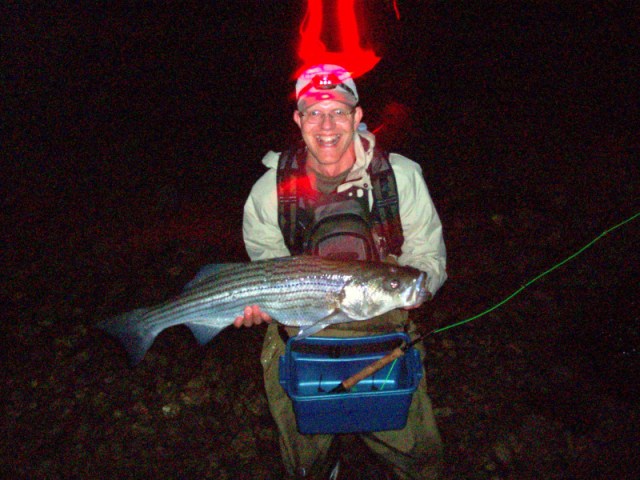
Ken introduced me to the pattern many years ago. He handed me a black G.P., and with a knowing confidence, told me to fish it as part of a three fly team. Sadly, I’ve long since lost that fly, but I still have one of Ken’s olive G.P.s. tucked away in the never-to-be fished-again archives. When tied just so, G.P.s are magical creations that bask in their impressionistic glory. Picture this fly near the surface on a greased line swing or a dead drift, easily visible to a striped bass even in the mucky outflow of a salt marsh. Wait to feel the weight of the fish — and then hang on. Stripers love shrimp, and when they are keyed on this bait, feeding on station, they will often ignore all other offerings and stripped presentations.

R.L.S. Black General Practitioner

OLYMPUS DIGITAL CAMERA

Hook: Atlantic salmon 2-8
Antennae: Black and blue bucktail, mixed
Head: Black golden pheasant neck feather
Eyes: Golden pheasant tippet
Body: Gold flat tinsel
Ribbing: Gold oval tinsel
Hackle: Natural black
Carapace: Metallic black turkey feather
Back: Same
Tail: Same
~
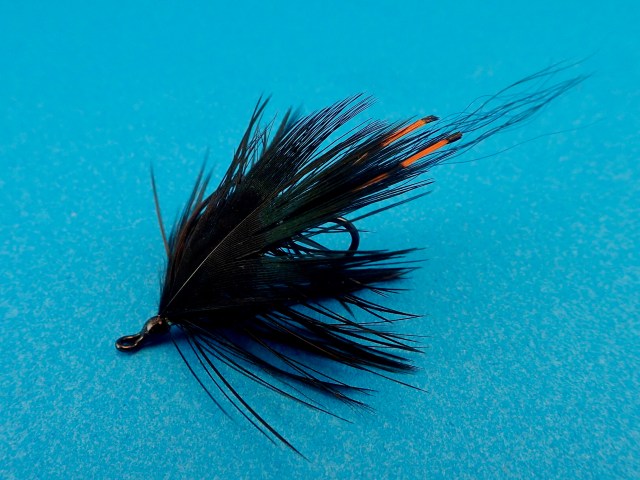
A view from below. You can imagine all those hackle fibers gently quivering in the current and whispering to a striper, “I’m alive…”

OLYMPUS DIGITAL CAMERA

~

Tying Notes: Ken called for an Eagle Claw 253, but I like the badass black of Atlantic salmon hooks. No gots turkey feathers? Me either, so I used dyed black pheasant rump. The majority of the black G.P.s I’ve seen use far too much bucktail; remember, you’re tying the antennae of a grass shrimp (the steelhead pattern calls for 10 bucktail hairs; I used 20) not an opaque jig. To form the eyes, cut a V-shape in the tippet and then lacquer with head cement. The “eye stalks” will narrow from the head cement. You don’t have to use the tinsels; gold braid works just as well. The body and top feathers are somewhat of a pain; tie in the carapace at the tail, then tie and wind the tinsel and hackle to the mid-point of the shank, tie in the back (like a little roof), continue forward with the tinsel and hackle, then tie in the tail feather, again like a little roof. Make a spiffy head and go fish.

Time to tie up some Soft-Hackled Flatwings

So simple, so elegant, so effective. The Soft-Hackled Flatwing borrows from many sources, all of them wonderful and good. I love this fly for early season school bass, and it makes a fine generic baitfish year-round. Just tailor the color and length to the bait you’re matching et voila! And remember: eyes on flies catch anglers. Not stripers.

Impressionism rules the day. If you’re interested in learning more about soft hackles for stripers, read “Soft Hackles for Striped Bass” from the Nov/Dec 2015 issue of American Angler.

SofthackledFlatwings

Here’s the basic template:

Hook: Eagle Claw 253 1/0
Thread: 6/0
Platform: 30 bucktail hairs
Tail: Flatwing saddle to match platform color, under 2-4 strands flashabou
Body: Braid
Wing: 30-45 bucktail hairs, under 10-20 hairs contrasting color, under 2-4 strands Krystal Flash or flashabou
Collar: Blood quill marabou, tied in at tip, 3-4 turns; 1 turn mallard flank (optional)

Bonus fly: Rat a Tat Big Eelie Variant

After tying the original large R.L.S. Rat a Tat flatwing, I couldn’t help but begin to imagine a translation into a Big Eelie. Those of you who are long time readers (and few of you who have stumbled across me on the beaches of Block Island and wondered, “What fly is that guy using?”) know that Ken Abrames’ Big Eelie is a Steve Culton summertime striper staple. (A little alliteration to jump start your post-lunch brain.) You also know I think it’s a profile and action fly, and that while colors may be irrelevant, I nonetheless love to play around with different combinations. I have to admit I’d never think of grouping these colors in a sand eel pattern. But I’ve got a hunch this is one is going to produce a big bass for me. And for you as well!

Rat a Tat Big Eelie

OLYMPUS DIGITAL CAMERA

Hook: Eagle Claw 253 3/0
Thread: Chartreuse 6/0
Platform: 30 hairs black bucktail
Tail: A yellow grizzly saddle, under 2 strands each of gold and red flash, under a chartreuse grizzly saddle, under a turquoise grizzly saddle, under a yellow grizzly saddle.
Body: Gold braid
Collar: 3-4 turns ginger marabou, tied in by the tip.
~

Tying notes: Sand eels are a slender bait, so make your saddles about the width of a pencil. You don’t want a flaring broom shape for the platform, so likewise make it slim, and take the bucktail from near the tip of the tail. All the saddles are tied in flat. The marabou adds the magic here, as it veils the body when wet, creating movement and an almost glowing effect. I like to tie this fly about 4  1/2 inches long.

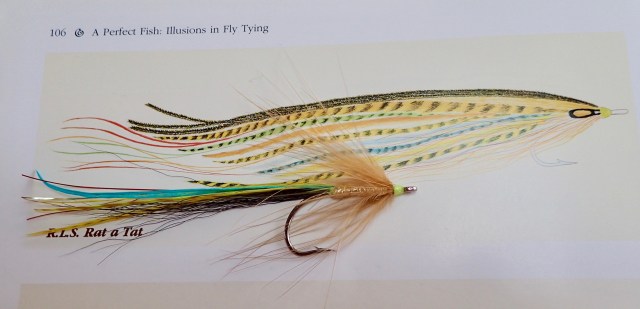
Eight-feather flatwing: Ken Abrames’ R.L.S. Rat a Tat

I’ve been eyeballing the RLS Rat a Tat in the back of A Perfect Fish for about as long as I’ve owned the book. At first I didn’t really know what to make of this pattern. Over the years, its energy grew on me. Finally, this winter, I found the saddles I needed to tie it. Ken described the Rat a Tat’s genesis this way: “That’s a fly I designed just to irritate fish. It’s the kind of a fly that will get a reaction strike.”

I’ll be sure to hold on tight.

Ken once told me that he sometimes includes yellow elements in a fly to indicate the presence of fat, so this should make a fine greasy baitfish pattern (think herring or menhaden). Note how naturally the jungle cock nail integrates with the random black of the grizzly. Lots of magic going on here.

Ken Abrames’ R.L.S. Rat a Tat. This tie is about 11″ long.

OLYMPUS DIGITAL CAMERA

Hook: Eagle Claw 253
Thread: Chartreuse 6/0
Platform: Black
Pillow: Chartreuse dubbing
Support: Chartreuse neck hackle
Tail: First, a yellow grizzly saddle, second, a chartreuse saddle, third, 2 red Flashabou, fourth, a turquoise grizzly saddle, fifth, a light blue saddle, sixth, 2 gold Flashabou, seventh, yellow grizzly saddle, eighth, a ginger saddle, ninth, 2 emerald green Flashabou, tenth, a fluorescent green grizzly saddle, eleventh, 2 red Flashabou, twelfth, a yellow grizzly saddle
Body: Gold braid
Collar: Bucktail, ginger, bottom and both sides.
Wing: Bucktail, yellow
Cheeks: Bucktail, 3 hairs each turquoise, orange, chartreuse, dark blue and emerald green
Topping: Seven strands of peacock here
Eyes: Jungle cock

~

A closer look at the zebra-like tail section reveals great gobs of grizzly goodness.

OLYMPUS DIGITAL CAMERA


Many questions (rhetorical and otherwise)

I once read that a good way to learn things was to ask a lot of damn fool questions. I tend to do that in my fishing, whether I’m wondering to myself, trying something new, or picking the brain of someone who knows a lot more than me. Here are some recent points I’ve been pondering:

Is “pushing water” the most trite, overused, overhyped concept in streamer construction today?

How do all those stripers find my 1″ long sparse grass shrimp flies at night with no moon in water with visibility of under 2 feet?

Why don’t more striper anglers think in terms of matching the bait, and presenting the fly like the naturals are behaving?

When it comes to choosing lines and leaders, is there a more important question than: “What do you want the fly to do?”

If intermediate lines are the most versatile, why do the vast majority of striper anglers use only one presentation with them?

Is there a striped bass swimming today that cares if your fly turns over?

Last but not least: why the hell didn’t I get out and fish in the wake of last weekend’s storms?

If you want to consistently catch bigger bass on the fly from shore, fish how, where, and when most other people don’t.

Block Island All-Nighter first keeper

TU 225 awarded the Order of the Triple Jalapeño Burger with Octoberfest Clusters

You know it’s going to be a good night when you sit down at the table and moments later a server brings you a cold, crisp Octoberfest — which you didn’t order, but would have. Sometimes things just fall into place. Many thanks to my good friends at the Narragansett Chapter of TU who demonstrated once again their mastery of the concept of a fed presenter is a happy presenter. Always a pleasure talking fishing over dinner. The topic for the club was “Trout Fishing for Striped Bass,” and we had a some good Q&A afterwards. Now, I gotta make a new presentation for next year!

If you do what you’ve always done, you’ll always get what you’ve got. (And if it’s stripers like this, you’re probably doing something right.)

OLYMPUS DIGITAL CAMERA


The best sand eel fly is the one that gives you the most confidence. (Like the Bruiser Big Eelie.)

Here’s another sand eel fly pattern that I can’t do without: the Bruiser Big Eelie. Faithful followers know that Ken Abrames’ Big Eelie template is a tried-and-true favorite that lends itself to all kinds of color variations. “Bruiser” because it’s black and blue and purple — and because this fly has accounted for some of my biggest stripers. Perfect for those dark of the moon nights when the bass are looking up and tracking those telltale thin silhouettes across the surface. I’ve been fishing this fly for close to a decade now, and while the Bruiser has appeared elsewhere, I haven’t presented it here until now. Speaking of presentation: swing it, dangle it, dead drift it, and strip it in ultra-short jerky bursts (my favorite).

OLYMPUS DIGITAL CAMERA

Hook: 3/0 Eagle Claw 253
Thread: Black 6/0
Platform: 30 hairs blue bucktail
Tail: First, a purple saddle, second, another purple saddle, third, 2 strands blue flash and 2 strands purple flash, fourth, a black saddle, fifth, a black saddle. (All saddles pencil thin and tied in flatwing style.)
Body: Purple braid
Hackle: 3-4 turns purple marabou, tied in at the tip
~
The Bruiser Big Eelie Rogues’ Gallery:
Block Island, 20+ pounds
900x900px-LL-8da1a41d_38incher-1

Everyone’s invited to tomorrow night’s “Trout Fishing for Striped Bass” presentation.

The Long Island Flyrodders have graciously offered to open my Tuesday evening presentation to all currentseams followers. So, that’s tomorrow night, September 4, 8pm in Levittown, NY. Hope to see you there, and in fine Steve Somers fashion, directions here.

Want to catch more — and bigger — stripers? Then come to this presentation.

TFFSB_Cover


Sand Eel Secrets

There are several baits that give striper anglers fits: clam worms, grass shrimp, and truly tiny stuff (like crab larvae), just to name a few. You can also add sand eels to the list. I see the forlorn souls trudging off the beach, beleaguered and bewildered, always with the same mournful complaint: “There were all these fish feeding and we couldn’t catch them.” Sand eels might be the sulphurs of the salt. They’re a plentiful bait, easy to identify, the fish love to eat them — and most anglers approach the situation the wrong way.

I love fishing for striped bass that are feeding on sand eels. Some of my best nights of striper fishing have occurred during a sand eel hatch. Here are some things I’ve observed that will help you catch more bass that are feeding on sand eels.

— Striped bass are very much like trout. They like current, and they will key on certain food sources at certain times at the expense of all other menu options. What’s more, they will feed in a certain manner in a certain part of the water column. Sound like trout taking emergers just below the surface film? Good! Once you grasp this concept, you’re halfway home.

— When confronted with the scenario of stripers crashing sand eels on the surface, most anglers attack the problem with sinking lines and/or weighted flies. This is the equivalent of wading into a trout stream where trout are sipping Trico spinners, then tossing a tungsten cone head Woolly Bugger. (Sidebar: yes, stripers will root along the bottom for sand eels, then eat them as they shoot for the surface. Dredging the bottom with a weighted fly can be productive. But if you see the fish leaving rise rings or splashy boils, that should be your first clue that a floating line and an unweighted sand eel pattern is a good place to start.)

A floating line, a sparse, unweighted sand eel pattern, and a very happy angler. My friend John, who was fishing next to me, caught a bass in this size class on 11 consecutive casts.

900x900px-LL-8da1a41d_38incher-1

— This is not rocket science. Recall Fly Fishing 101: What are the fish eating? How are they eating it? What do I have in my box that most closely resembles the bait (size, color, profile)? How can I present my fly to mimic what the naturals are doing?

— It’s almost never a bad idea to target an actively feeding bass.

— Aggressive feeders will take a stripped fly with gusto. I like very short (3″ or less) rapid strips. Wait until you feel the weight of the fish before you set the hook. Always strip set.

— There often comes a time in the hatch when the bass will no longer chase. The stripped fly is rendered useless. But the catching doesn’t have to end. The smart angler will change tactics. He or she might use a dropper rig, suspended in the surface, managing it like a dry fly presentation (dead drifting over a feeding lane) or every-so-slightly maintaining tension on the line (not so much a retrieve as it is a gathering of slack). The takes in this scenario will be sublime. Again, strip set.

If the rise rings become softer and the stripers won’t chase a stripped fly, try a dropper rig suspended in the film.

OLYMPUS DIGITAL CAMERA

— Just because you don’t see stripers feeding on the surface doesn’t mean a) they’re not there, and b) they won’t take a sand eel fly at the surface.

— I like to shuffle into a beach trough or across a flat to see if I can roust some sand eels. On the dark of the moon I look for their biolume contrails, or feel for their crazy bounces off my legs. If I’m lucky, a nearby striper will ghost his position by stomping on the fleeing bait. Now I have a target.

— Confidence catches fish.

Find sand eel patterns that you have confidence in, then go forth and prosper. I happen to love Ken Abrames’ Big Eelie, shown here below the glasses and in the left side of the box. Note the vast array of colors; I’ve never experienced that stripers have a preference. I also like Ken’s smaller Eelie, and Ray Bondorew’s Marabou Sand Eel. And for the record, I haven’t caught a striper on sand eel fly that had eyes in over a decade.

Block Island All-Nighter Flies Big Eelies


Olive Fireworm Big Eelie Fireworks

Flies don’t catch fish — anglers do. Still, I sometimes like to fish by feeling, and the Olive Fireworm Big Eelie is my traditional choice on the 4th of July.

On our nation’s birthday, this 15-pound striper said yes to the Olive Fireworm Big Eelie. What a tremendous battle. I’m always in awe of the power of Block Island bass.

OLYMPUS DIGITAL CAMERA