“To play him long is to play him wrong” redux

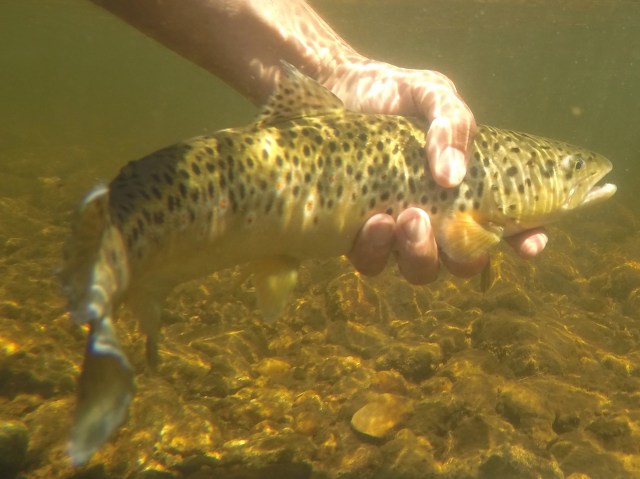
Glass houses, stones, and all that. So this week when I hooked into a 20+” Survivor Strain brown on the Farmington, I started the clock. 93 seconds — hand-stripped, no reel — from hook set to net. (And it was only that long because I had trouble fitting him into the net first swipe.)

Unfortunately, I had camera disasters. I was using my main shooter for a different project earlier in the day and hadn’t changed the setting, so I ended up with out-of-focus mush. Then I attempted a GoPro movie of the release, only to discover that the battery was dead. So you’ll have to use your imagination: kype, clipped adipose, leopard spotting, brawny, and no match for an angler with a sharp hook and a reliable leader.

Farmington River Report 5/1/17: No bugs? No rises? No problem.

I guided Mina yesterday — a cool, dreary day for most of it. We headed to the permanent TMA and for the first hour we had the place all to ourselves. Mina wanted to delve into the black arts of wet fly fishing. Water was a little higher than I like for wets (440cfs — they’ve since (of course) dropped the flow — and it was cold! 45 degrees made for some chilly legs and feet. Bug activity was also low — some micro midges and a couple caddis, and no H-bombs, at least not while we were there. We covered lots of water before we found some customers. A couple bumps, a couple dropped fish, and a couple to net, but that was more action than I saw elsewhere. Ya done good, Mina, under some tough conditions.

Mina is a thoughtful angler who came armed with loads of questions and a strong desire to learn. Here she is, acing a pop quiz. I have to give props to my last two clients. Both Mina and Vicky were confident waders who weren’t afraid to venture into some more challenging water to get their flies in front of fish. Sometimes the angler that covers more water is the angler who catches more fish.

DCIM100GOPROG0033987.

~

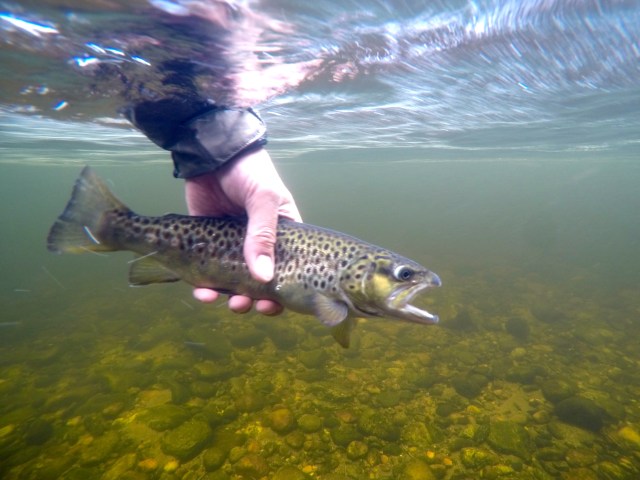
We used a bead head soft hackle of Mina’s creation on point to help get the flies down in the higher flows. This guy (who’s beginning to sport a kype) took that fly on the dead drift. Note the cool cirrus cloud effect on the surface.

DCIM100GOPROG0034182.

Farmington River Report: Nature finds a way

In the interest of some informal field research for the DEEP — not to mention my own curiosity — I did a little recon yesterday on a part of the river where the fish would have faced significant stress in the last 50 days. I purposefully went in the afternoon, when the water temperatures would be highest. I wanted to know if, on an unseasonably warm September day, the water temps would be below 70. If they weren’t, I would not fish. Most of all, I wanted to know if anyone made it through the long, hot summer. I visited three locations, staggered downstream at varying distances. Spot A was 67 degrees; Spots B & C were a hard 68.

I found active, healthy fish in all three places. I nymphed up a nice, fat brown, over a foot long, in the first location. He was in the net before he knew what hit him. One quick digital shot and back he went. There were two trout actively feeding on emergers in the second spot; I gave them a few quasi-wet presentations with un unweighted nymph rig, had a bump, and left them to their feeding. Ironically, the spot farthest downstream had the most action: three active feeders. Wanting to err on the side of caution, I didn’t bother trying to catch them.

To be safe, I would wait another week before venturing below the permanent TMA. We’re supposed to have some cooler temps, both day and night, after today. Most of all, a week will give the trout a chance to restore their vigor.

Looks like we made it! This guy was hanging out in about 18″ of whitewater right below a boulder. He took a size 18 soft-hackled Pheasant Tail.

OLYMPUS DIGITAL CAMERA


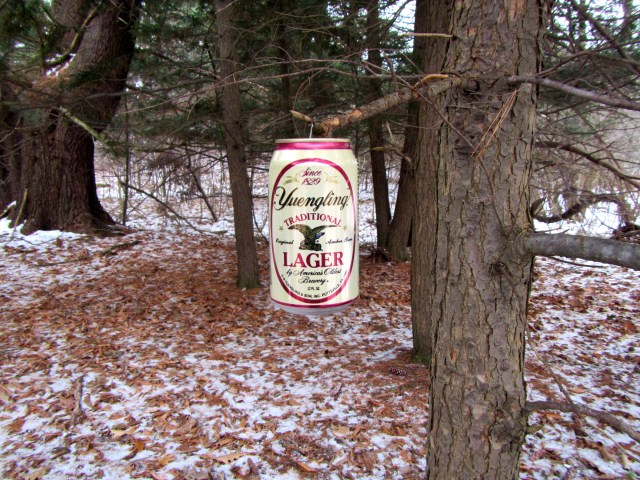
North Jersey Chapter of TU awarded the Order of the Pepperoncini Cheeseburger with Yeungling clusters

We began the fall 2016 presentation circuit in fine fashion. A fed presenter is a happy presenter, and a beer for dessert is always welcome. The members of the North Jersey Chapter of TU treated this road warrior with great kindness, and I’m grateful to them.  The best part was that they let me go on before the business end of their meeting, knowing that I had a long drive home. How thoughtful, and again, very much appreciated. A good crowd turned out to hear all about the Farmington River, and we had a strong followup Q&A. Now all we need is rain.

The Pulaski Christmas Tree, stumbled upon in the woods near Pineville, December 2014.

IMG_2628

Farmington River sampling, stocking, and spawning, or: we really, really need rain

Yesterday’s rain was nice for the garden, but it was statistically insignificant for the Farmington River. Our favorite trout water continues to be battered by low flows (60cfs out of the dam as of this morning) and unseasonably warm temperatures. If you decide to fish, please use common sense.

To the trout: DEEP crews sampled the river last week. They extracted 99 browns from the permanent TMA for Farmington River Survivor Strain broodstock. These aren’t all necessarily big, wild fish — the goal is genetic elasticity, so there is a mix of sizes covering both wild and holdover fish. I spoke with Fisheries Biologist Neal Hagstrom today, who said there were “a fair number of wild fish. The holdover Survivors didn’t look as plump as I would have liked, but not as bad as I had feared.”

In past years, the post-spawn Survivor Strain broodstock have been reconditioned, then returned to the river. But Neal told me there is some discussion about keeping those fish in-house for genetic insurance until flows become more stable. (If I may editorialize, that sounds like a damn good idea.) There is also concern that the current low flows will inhibit natural spawning this fall. Likewise, a spike in flows would be bad, as it might cause the fish to create redds in unsustainable locations. How this all will play out, only Mother Nature knows.

Once water temperatures enter more trout-friendly strata, the DEEP will restock the lower river with yearling trout (7″-9″). “Hopefully, this will help rebuild the lower river trout population,” says Neal.

Kudos to the DEEP for everything they do for the trout and the river. 

Likewise to the MDC, who have done everything they can to maintain flows. Let’s not forget that the MDC’s first priority is to supply potable water to the community. That we still have cold water and healthy trout in an officially severe drought is a blessing.

So, go out and do a rain dance when no one’s looking, and remember — it’s only stupid if it doesn’t work.

Hang in there, dude. Help is on the way.

Brown release


Shocking news from the DEEP (2016)

The DEEP will be conducting its annual electroshocking/brood stock collection tomorrow, Tuesday, September 13. The following, in italics, is from an email I received from Fisheries Biologist Neal Hagstrom:

Farmington River Report 7/21/16: The best time to fish in summer is…noon?

Conventional wisdom holds that in summer, Farmington River trout will be most active early in the morning and late afternoons into dark. You won’t get any serious arguments from me. After all, I was plumbing the depths with my drop-shot nymph rig before 8am. Then again, I’ve always been fond of the old saw, “The best time to go fishing is when you can.” I stayed through 1pm, and my best fish of the day came at high noon under blazing, brilliant sunshine.

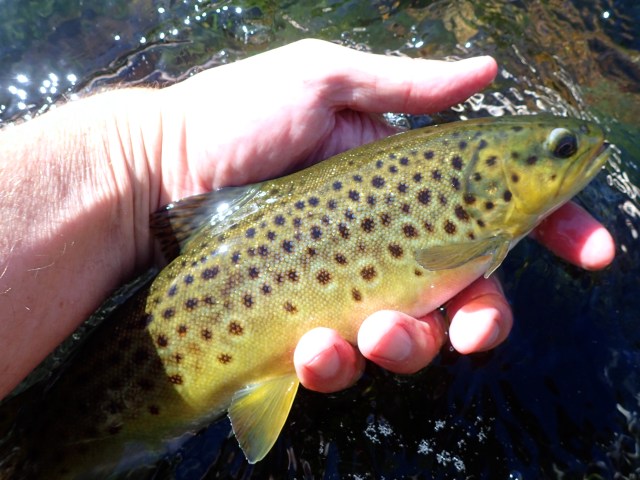
A Survivor Strain brown in the high teens, taken at noon of one of the warmest days of the summer in about two feet of water. Top dropper was the winning fly, a size 18 soft-hackled  Pheasant Tail.

DCIM100GOPROG0013432.

The action continues to be slow; I managed six fish in five hours. Of the dozen or so anglers I fished near yesterday, I saw only one hook up. I believe one of the keys to success this time of year is to aggressively cover water. I visited seven spots yesterday, blanking in two of them (the method was nymphing) and taking two on four casts in another. I also did some playing around fishing without my beloved indicator, using a section of 12-lb. yellow Stren as a sighter. (I still like the indicator better. So there.)

Farmington River Report 3/16/16: Ah, ah, ah, ah, stayin’ alive.

I had the good fortune to spend several hours in the permanent TMA today, and what the catching lacked in numbers was more than made up for in overall size. Three trout, one mid-teens wild brown, and two high teens Survivor Strain browns. You can always tell when you have a substantial fish on from the head shaking and the sulking along the bottom — and if those fish are stream-born or long-term residents, they come even less quietly.  The water was cool, clear, and running about 480cfs. Midges, early grey stones, and some un-IDed spinners about a 16-18. And, lest we forget, a magnificent Casa Fernandez Toro from Miami.

What the hellgrammite? I fished him out of the water as he was making his way downstream. As General Patton would say, you are one ugly sonuvabitch.

OLYMPUS DIGITAL CAMERA

~

All my fish today came on the top dropper, a size 14 Hare-and-Copper variant (you can see the fly here). This was my second Survivor Strain and the last fish of the day. No mistaking the takes today, as the indicator went under hard each time.

OLYMPUS DIGITAL CAMERA

~

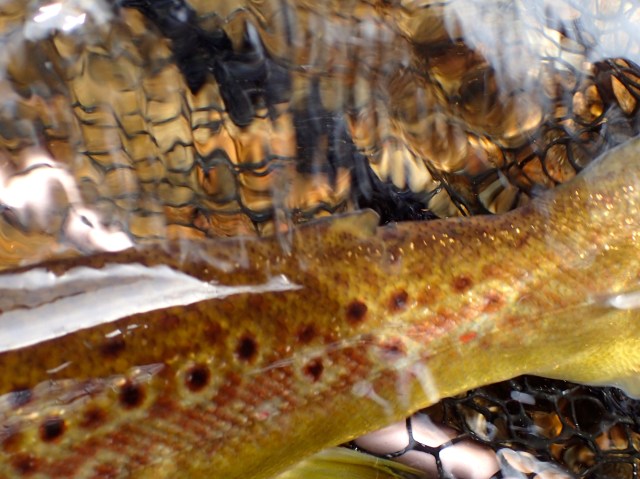
Stayin’ alive. You can identify a Survivor Strain brown from its clipped adipose fin.

OLYMPUS DIGITAL CAMERA

~

Off you go. One of the more satisfying aspects of landing a nice fish is giving it the opportunity to swim away. When next we meet…because I know where you live.

OLYMPUS DIGITAL CAMERA


Survivor: Farmington (Browns Built To Last)

“Survivor: Farmington,” an essay about the CT DEEP’s Farmington River Survivor Strain Program, first appeared in the Spring 2014 issue of The Drake. The photo and caption did not appear in the article, and this is my original text. 

by Steve Culton

They took her from the river in September, 2012. She was chosen for her wild traits and rounded belly that indicated a healthy female ready to spawn. Once her eggs were harvested, she was returned to her home waters. But not before a red elastomer was inserted near her left eye. That color and placement would forever identify her as a broodstock female, one of many mothers of the Farmington River Survivor Strain Class of 2013.

The next April, I fished the West Branch of the Farmington. The Hendrickson hatch was winding down, and the trout were transitioning from taking emergers in the film to picking off duns that haphazardly lingered on the surface. Her take was powerful enough to rip the line from my fingertips and cause my drag to buzz in protest. I rarely put trout on the reel; this was going to be my first of 2013. What’s more, this fish was not going to come easy. I ended up walking a fair distance downstream to land her. It wasn’t until I was reviewing the day’s photos that I noticed the elastomer. I had sensed there was something readily distinguishable about the way she hit, bulldogged, and refused to come quietly. Now, it all fell into place. Survivor Strain.

Here she is in all her glory: the actual fish I was writing about.

Big Survivor Strain brown hen

The Farmington River Survivor Strain program was initiated in 1993 by what is now known as the Connecticut Department of Energy & Environmental Protection (DEEP). Neal Hagstrom, DEEP Senior Fisheries Biologist, describes the program as, “an attempt to use the river to select the best possible animals for that environment. We take certain trout to the hatchery, spawn them, then put their progeny back in the river, assuming that those fish will be best adapted for the conditions they’ll face.”

Survivor Strain’s inaugural class were descendants of stocked Cortland, Rome, Bitterroot, and Seeforellen browns. “The hope was that we would get improvements in production and survival,” says Hagstrom, “and we saw that in the first year. We went from about a 20% holdover rate to about 50%. We now find fish in the West Branch that are upwards of eight years old.”

Broodstock for the program are collected through electroshocking. Each September, the Metropolitan District Commission draws down the flow from Hogback Dam so that DEEP crews can complete their harvest. Their goal: one hundred brown trout worthy of producing the next generation of Survivor Strain. Like an NFL scout on draft day, Hagstrom explains the DEEP’s talent evaluation process. “We try to get fish that have spent at least a year in the river. We want genetic diversity. We want browns from multiple age classes, and multiple sources like Survivor Strain, and most importantly, wild fish. We want a lot of different parents to get as many possible combinations of genetic material.”

The DEEP harvested approximately 80,000 eggs in 2013. That biomass will generate 70,000 fry. In keeping with the tenet of genetic strength and diversity, the hatchery will set up dozens of parental combinations for the young ‘uns: wild mother/ wild father; wild mother/Survivor father; small wild father/large Survivor mother; and so on. This elasticity creates a population that is well equipped for the natural challenges of the river – not to mention heavy fishing pressure. Young-of-year Survivor Strain are wary of humans, even in their hatchery pens. Where standard-issue stockers are indifferent to people, Survivor Strain fish will dart away. “When we first saw it, it was like, wow, this is really cool!” says Hagstrom. “We had two tanks together, and their behavior was like night and day.”

To facilitate their annual trout census – and inadvertently, enable you to track your catch – the DEEP color codes Survivor Strain trout with elastomers. Left eye placement means the fish is an adult; right eye, a yearling. Colors change every year; 2011 yearlings received red or yellow, while 2012 yearlings received green. Thankfully, for those of us who are color blind, Survivors also have their adipose fin clipped off.

Not surprisingly, anglers are the program’s biggest fans. What’s not to like about cantankerous trout with breathtaking colors that grow to trophy size? As a bonus, the West Branch has seen an explosion in the wild brown population since the introduction of the program. A new record was set in 2013 of just over fifty percent of trout that were naturally spawned in the river. That bodes well for those of us who live for chasing gator browns. Mike Humphries, DEEP Inland Fisheries Biologist, says it’s a myth that the river’s lunkers are pen raised. “The highest percentage of big trout on the Farmington aren’t hatchery fish. They’re wild.”

And to think it all started with one tough mother of a stocked brown.

No cuts for hatcheries!

Good news, but something that never should have been under consideration.

For more information, visit the Farmington Valley TU site here.

Fred says, “Thanks for all those emails to your representatives.”

DCIM100GOPROG0020591.