When you’re expecting small, be prepared for big

If you’ve taken a lesson with me or attended one of my presentations, you’ve heard me say that we all put our waders one leg at a time. So, even though I may be considered an authority of sorts, I’m still human — and I still make mistakes on the water.

Twice now, on my last two trips to the Cape, the catch has been trending small. Twice, I’ve subsequently hooked into something very large, and lost the fish.

Now, you could make a case that I was a little unlucky. There’s probably some truth to that. But the single biggest reason I lost those potential cows is because I wasn’t ready for them. I didn’t make a powerful initial hookset. And by the time I realized what was happening, I’d already lost the fish.

Gordo hooking up. At least someone on this crew knows what they’re doing.

My most recent tale of woe came earlier this week on the Brewster Flats. I was fishing a small weighted crab pattern, probably on a size 4 hook, letting it bounce along the bottom, then swing up at the end of the drift. It had been a slow morning — Gordo, who was spin fishing with a jig head small soft plastic, had connected with two smaller bass. So that’s what I was expecting. I hadn’t had a touch all morning, and had been cycling through patterns in a desperate attempt to find something the fish might eat. The crab fly was on the dangle below me just over a deep hole, and I was daydreaming.

WHACK! The bass hit the fly like a bullet train. Immediately, line began screaming off the reel. The fish made a textbook striper series of runs: one good, long one, then a pause (where I attempted to reset the hook and gain some line). Then a second powerful, albeit shorter run. I reset again, but it felt wrong. I was furiously cranking the reel when the line went slack. Heartbreak.

So. I hoping that I’ve learned my lesson. It’s OK to expect small, but be prepared for big. I certainly will be.

Next time.
Making sense of the changing striper management landscape, or: thank goodness for the ASGA

On the difficulty scale, keeping current with how the ASMFC plans to manage (I’ll be kind and not place quotes around manage) striper stocks is somewhere between Calculus II and Organic Chemistry. Flux and fast and fluid also come to mind as good descriptors. (And as always, alliteration.) But thanks to our friends at the American Saltwater Guides Association (ASGA) it’s become easier.

Next up will be draft Amendment 7. Public comment will be open later this year, and I’ll be sure to get you the links. To help you understand what’s going on before then — no degree in Chaos Theory required — here are some helpful links.

If it looks like a moratorium proposal, is it really? Nope. Here’s why.

Once again, recreational anglers will need to mobilize and speak loud and clear when Amendment 7 comments are requested. Here’s a primer on the highlights and landmines of Amendment 7.

If you’re finding this stuff helpful, and you really care about stripers, you should join the ASGA. You can do that here. And of course, any donation you can make helps them continue their outstanding work.

Last but not least, here’s a great piece from our friend (and friend of striped bass) Charles Witek on the importance of getting Amendment 7 right.

Thanks for taking the time to read. And thanks for caring about striped bass.

We have to do our best to make sure the resource is handled with care. Getting involved with Amendment 7 is the best way you can do that.

Cape Crusaders

Got back yesterday from a 36-hour Cape Cod stripers on the fly trip. I met a friend from England who fishes out there several weeks this time of year, and a couple other guys I knew from the SOL forum.  Tuesday night we fished an outflow. I took a 20″ bass on my first cast, and I supposed that it was going to be one of those lose-track-of-the-count-after-a-dozen nights. Or not. That was my only striper of the evening.

Wednesday AM we fished the mouth of an estuary. I could sense almost right away that it wasn’t going to happen, and it didn’t. The most fun I had that morning was casting Mike’s (the Englishman who is also a rod maker) cannon of a two-hander. (Good Lord, I need one of those for windy days.) Or maybe it was breakfast. It was pretty tasty. I think I’ll go with breakfast. We headed for a bay to catch the last of outgoing, but with the wind in my face, a tired body, and the only bass around being in the stocked trout size range, I decided to save my chips for later.

Good call. The Wednesday dusk and night bite was off-the-charts good for numbers (not so much for size) but you take what the striper gods give you and offer thanks. Mike and I started by working a beach, and we ran into a good old-fashioned classic blitz, with terns dive bombing the bait and a striper on just about every cast-and-strip. We were fishing about 25 feet off the beach, walking down current, casting parallel to the shore. This went on until dark, and we fairly giggled about it on our walk over to where Chris and Chuck were fishing.

I loved this second spot: an outflow with stripers holding on station, unwilling to chase, feeding on something small. I was feeling lazy, but after Chris mentioned the deer hair grass shrimp he’d seen in my box the night before, I realized that the standard baitfish fly was going to be nothing but casting practice. While bass popped around me, some within a rod length away, I tied up a three fly dropper team with the shrimp on top, a 1.5″ saltwater Hornburg, and a Gurgler on point to suspend the rig. I generally avoid the phrase “that was the ticket,” but I beg to report that that was, indeed, the ticket. For the next hour, the skunk turned into a touch or multiple touches on just about every cast. The fish were small and hard to hook, and with the action winding down, I decided to end on a high note after I took a double.


Mike demonstrates the proper technique for serving tea in the field, taken directly from the pages of the British Commando manual. Tea and milk on the beach after a night’s fishing. How civilized! Yes, the weather was October cold.

OLYMPUS DIGITAL CAMERA

~

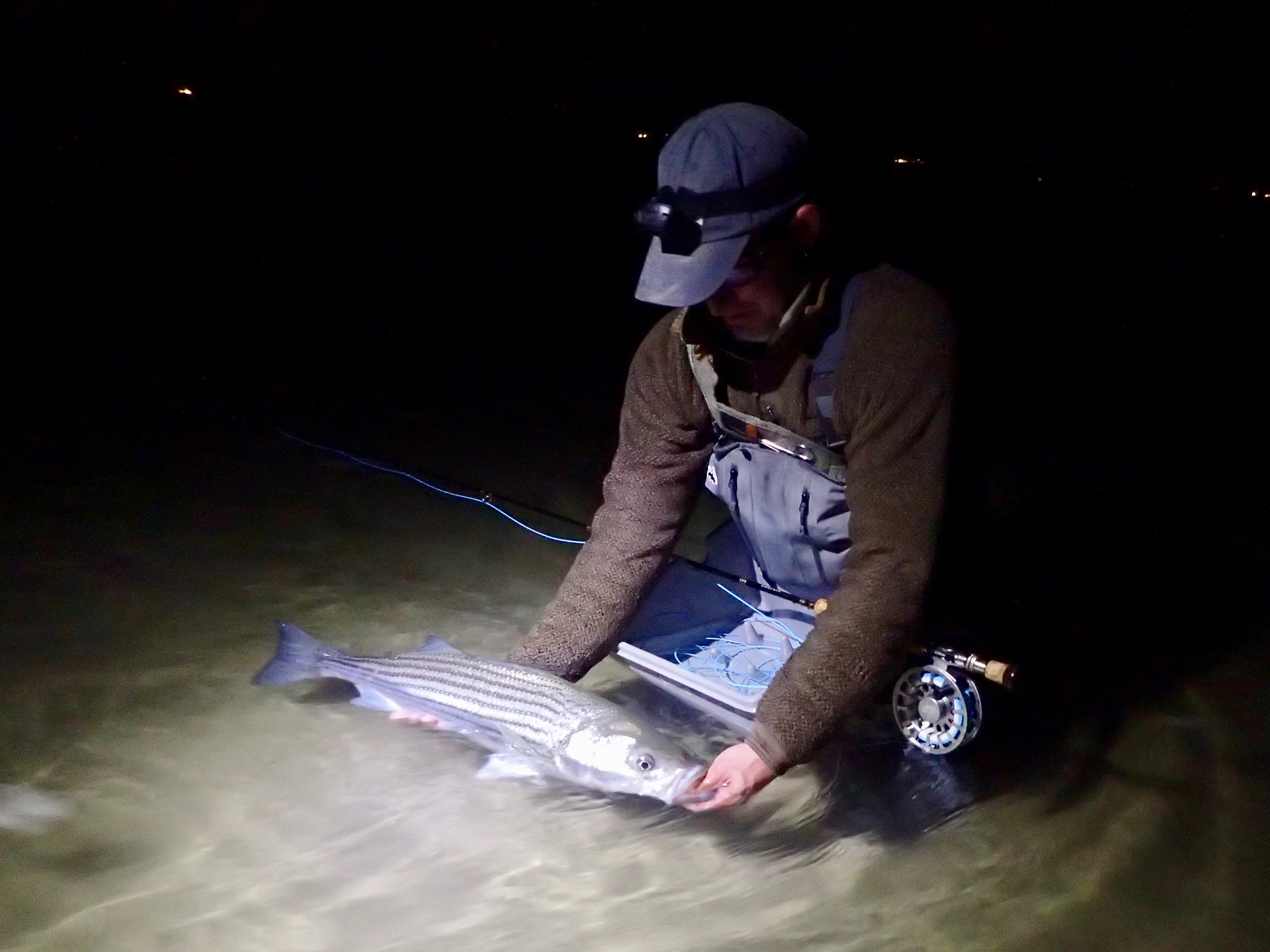
Chris with the best fish of our 36 hours, taken in an outflow on a Big Eelie. A fine demo of proper catch-and-release.

OLYMPUS DIGITAL CAMERA