Ok, so it’s not my pattern — it’s Jeff Blood’s pattern. But the Blood Dot Egg is a classic guide fly, and I was delighted to share it with the readers of On The Water magazine‘s “Guide Flies” column, written by Tony Lolli. (Thanks again, Tony, for letting me play!) This is the single best egg pattern out there, and it’s so ridiculously easy to tie that you won’t fret when you sacrifice one or three or a dozen to the bottom gods. Steelhead season is upon us. Now, if we can only get some rain.
When I was a kid, I counted every fish. That continued for a few decades, along with a resurgence when I started fly fishing. Numbers was how I measured success.
As I’ve gotten older and more experienced, I find the energy has drifted away from “how many? and moved toward other questions. Were the people nice? Were there any people at all? Did I enjoy myself? Did I fish well? I think on a subconscious level, I still track numbers. Everyone likes catching a lot of fish, right? In the case of a dwindling supply of stripers, numbers tell a story outside of personal pride. But if it’s just about numbers, sooner or later you’ll be disappointed. If there is a state of Nirvana to be reached in fly fishing, surely it cannot be connected to volume.
Steelhead are different.
They can be maddeningly difficult to hook and land. One day they’re eating, the next day they’re not. You can do everything right during a battle and lose the fish (and that may be your only hookup of the day). The conditions under which you fish for them can be downright unpleasant, if not brutal. And, more often than not, you’re jockeying for position and territory, first finding it, then maintaining it, something that I do not enjoy.
It took me 40 hours of fishing time to land my first steelhead. Then it took me about 13 years to land the next 99. Astonishingly — at least to me — it took me just 2 and 1/2 years to get to 200.
Part of it was good fortune — being able to find and fish water that held a lot of willing steelhead. Part of it was a renewed commitment to steelheading, due to some very good runs in recent years. Part of it was branching out to new waters. A lot of it was newfound skill and acumen and careful observation and study, thanks to guide friends Bob Packey and Row Jimmy, who present a master course in steelhead fishing every time I head out with them. Gentlemen, I have learned so much from you!
And so, dear reader, you’ll forgive me for counting each and every steelhead. In fact, I hope you’ll celebrate along with me. 200 in the hoop!
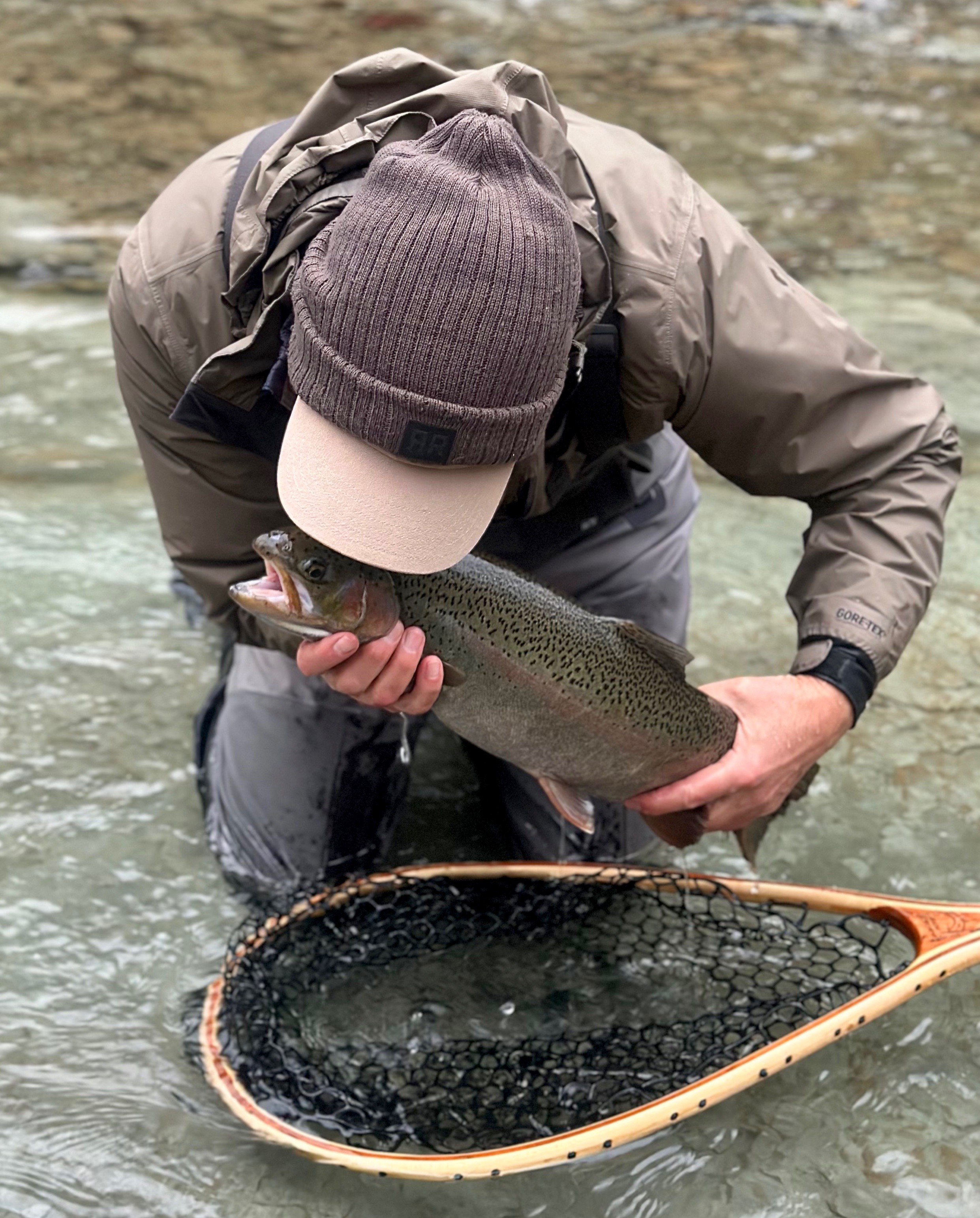
“He gave her three kisses and great was the smack.” — nearly the lyrics from an old folk song. Number 200, the second fish of the morning, gets the now traditional buss. It felt good to get it done early. How could I know there would be 19 more to come that day? What an embarrassment of riches!
~
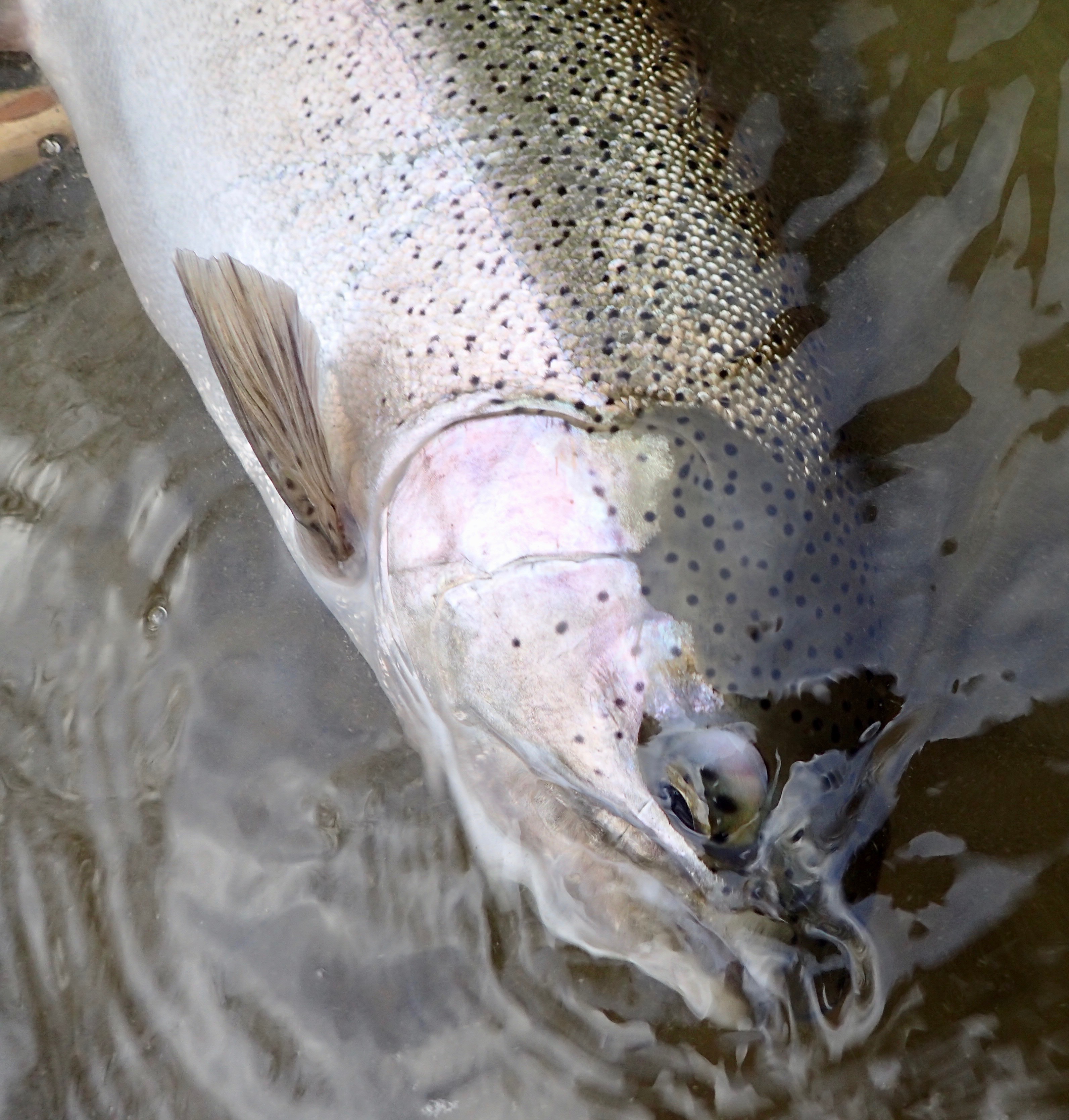
On that grey, damp day, the steelhead ranged from dime-bright freshies from the lake……to the darkest horse I believe I’ve ever seen, courtesy of Cam. What a fantastic job he did. For someone who doesn’t fly fish all that much, he turned in an impressive performance. Yup, we’re as happy as we look. The number sits today at 219. And April is coming.
Many thanks to you, my readers, for subscribing, reading, asking questions, and, most of all, for your support, kind words, and enthusiasm. I wish you a happy and prosperous new year, and the tightest of lines in 2024.
After fishing two Erie tribs in OH and PA last December, I knew I would have to get back there. Soon, nine-ish hour drive be damned. I had to wait a full 10 months to do it, but it was so worth the wait.
Unlike the northeast, Steelhead Alley has seen very little rain this summer and fall. The timing for my trip could not have been better, with a decent slug of rain before the weekend that marked the true start of the fall run for many tribs. Still, the water was on the high side of low — if that makes sense — meaning that 90% of the fish would be in 10% of the water. The spook factor would likely be very high, along with angler traffic.
Adding to my challenges was that I had zero experience fishing public waters. So I hired the guide I used last year, Bob Packey of Solitude Steelhead Guide Service. Bob focuses on fishing private water — an absolute treat — but that would do me no good when it came to public water. So we formed a game plan: fish Wednesday morning on private water for a few hours, catch a few fish, then bounce around to some public access marks so I could learn some spots. Since Bob has deep domain experience on Erie tribs, I knew I’d be in good hands.
The dread cold front hit the night before day one, putting the steelhead in winter mode. We saw runs and slots that held dozens of steelhead, but even with precision casts and presentations, they were just not having it. Once the sun rose and the water inched up a precious degree or two, the natives decided to play. We had success with sz 14 Blood Dot eggs and sz 10 White Deaths fished as the point fly on a two-fly rig under an indicator. Switching to the White Death fly was a revelation, as fish that couldn’t be bothered with eggs suddenly opened their mouths and moved to take the fly. Bob is a terrific guide, and I’m learning so much from him about this unique fishery. Photo by Bob Packey.We had to work for our fish in the morning of day one, but beauties like this always make it a labor of love. I also stuck a big ol’ brown trout — funny how that’s considered by-catch when back home it would be a trophy. By 11:30am we were at a public access point on Elk Creek. Although there were plenty of anglers — “crowded” on Erie tribs is not the same as “crowded” on the Salmon River in Pulaski — we were able to find a half dozen highly productive marks because so many anglers were fishing in the wrong place. Cracking the Erie tribs fish-finding code is a major part of success. Once Bob showed me what to look for, finding the fish was much simpler task. The answer to the question, “Was that the bottom or a fish?” On all three mornings I fished, the steelhead were sluggish at first light. Once they turned on, there were far fewer fouls. When I foul a steelhead, I try to rope it in fast. I find I have very few breakoffs; most of the time, the hook comes away without breaking the tippet. I caught and released several fish that had hooks imbedded in their fins or bodies.What a rugby ball of a hen! She took the top fly on my rig, Clyde Murray’s Spider, size 12, in low light. My strategy on days two and three was to focus on a few marks and learn them cold (as much as I could in a few hours). Not all of the water was productive over the course of two days — steelhead are on the move this time of year — but I certainly had fun trying different flies and different combinations in different runs at different times of the day.So that’s why I lost that fish…Elk Creek living up to its name, a small window of wonder on an early morning when I was the only angler on the water for a few hundred yards. My final tally over 2 days and 3 hours was 20 steelhead landed, a bunch lost, and immeasurable fun. A little more rain, a little more flow, no bitter cold. Those are my hopes for December. Steelhead dreaming is a thoroughly enjoyable pastime.
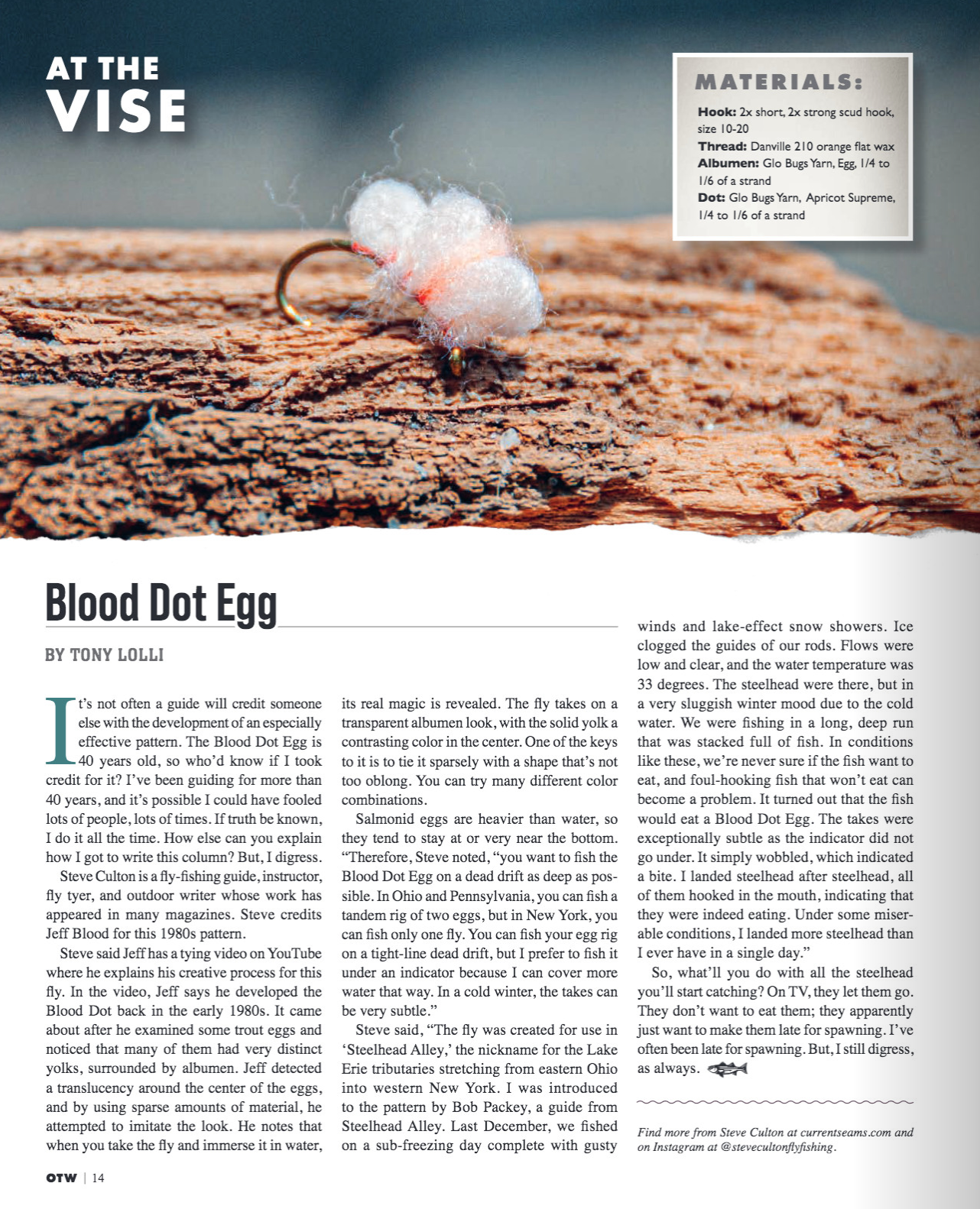
I first heard about Jeff Blood’s Blood Dot egg pattern years ago, but I’d never tied nor fished it until recently. Steelhead Alley guide extraordinaire Bob Packey of Solitude Steelhead Guide Service turned me on to it during last December’s smackdown on the OH and PA Erie tribs. I figure I caught about 90% of my fish on the pattern. Now, to be fair, it was also point fly on my leader the vast majority of time. But in some painfully low, clear flows, the Blood Dot proved itself over and over.
Then I took the Blood Dot to the Salmon River last month and again, it produced bites. When properly tied — and dunked in water — the fly does a wonderful job of transforming into a translucent, eggy mass with a suggestion of a yolk sac. It all stems from a very sparse tie using Egg colored GloBug Yarn with a contrast color dot. Here’s a tying video from the pattern’s creator, Jeff Blood.
Two dozen eggs, Blood Dot style. These all have a base color of Egg, with contrasting dots of Apricot Supreme (Bob Packey’s personal favorite), chartreuse, or blue. You can and should experiment with other color combinations. A classic steelhead guide fly. These are size 12.




 currentseams.com