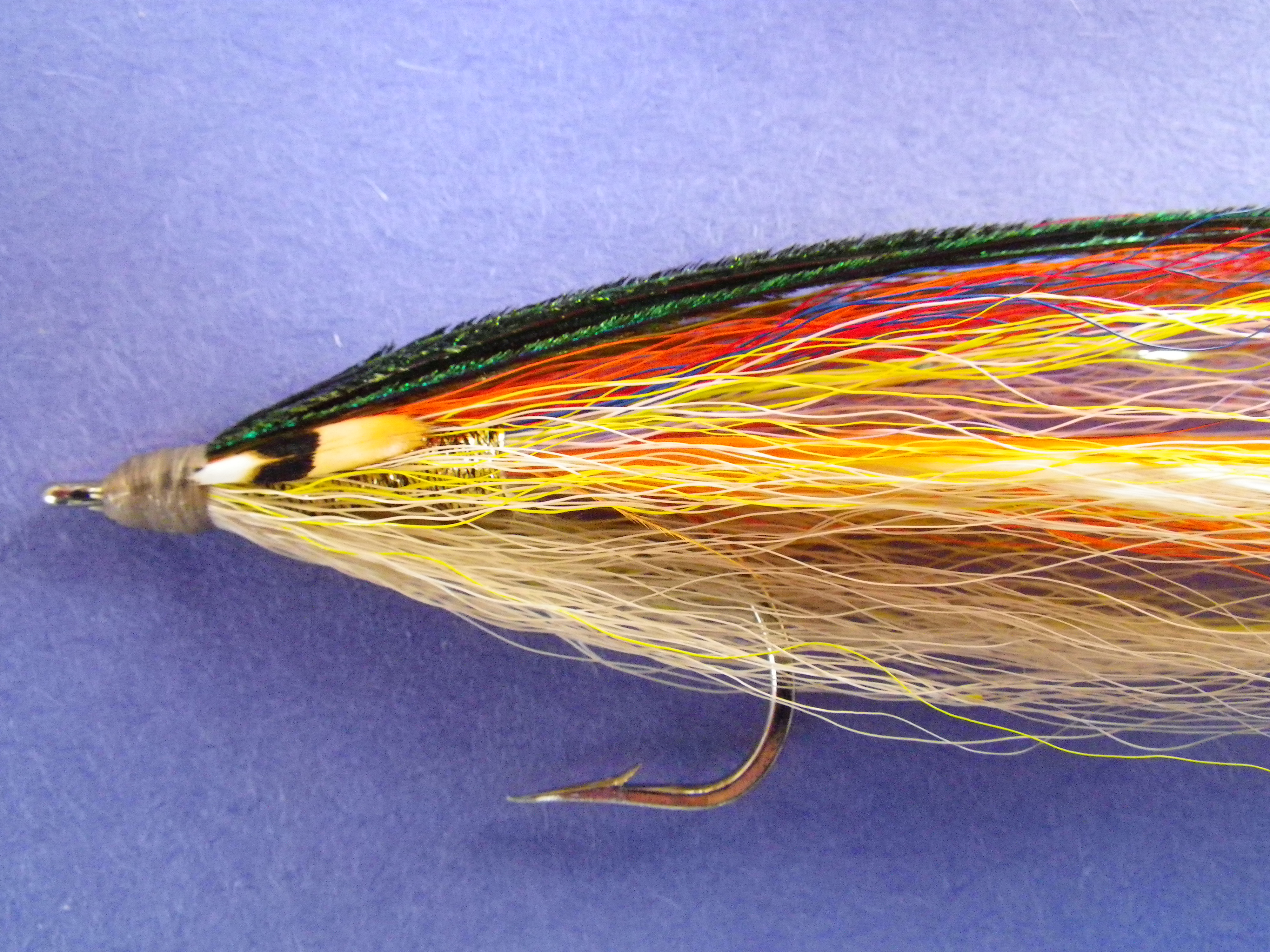
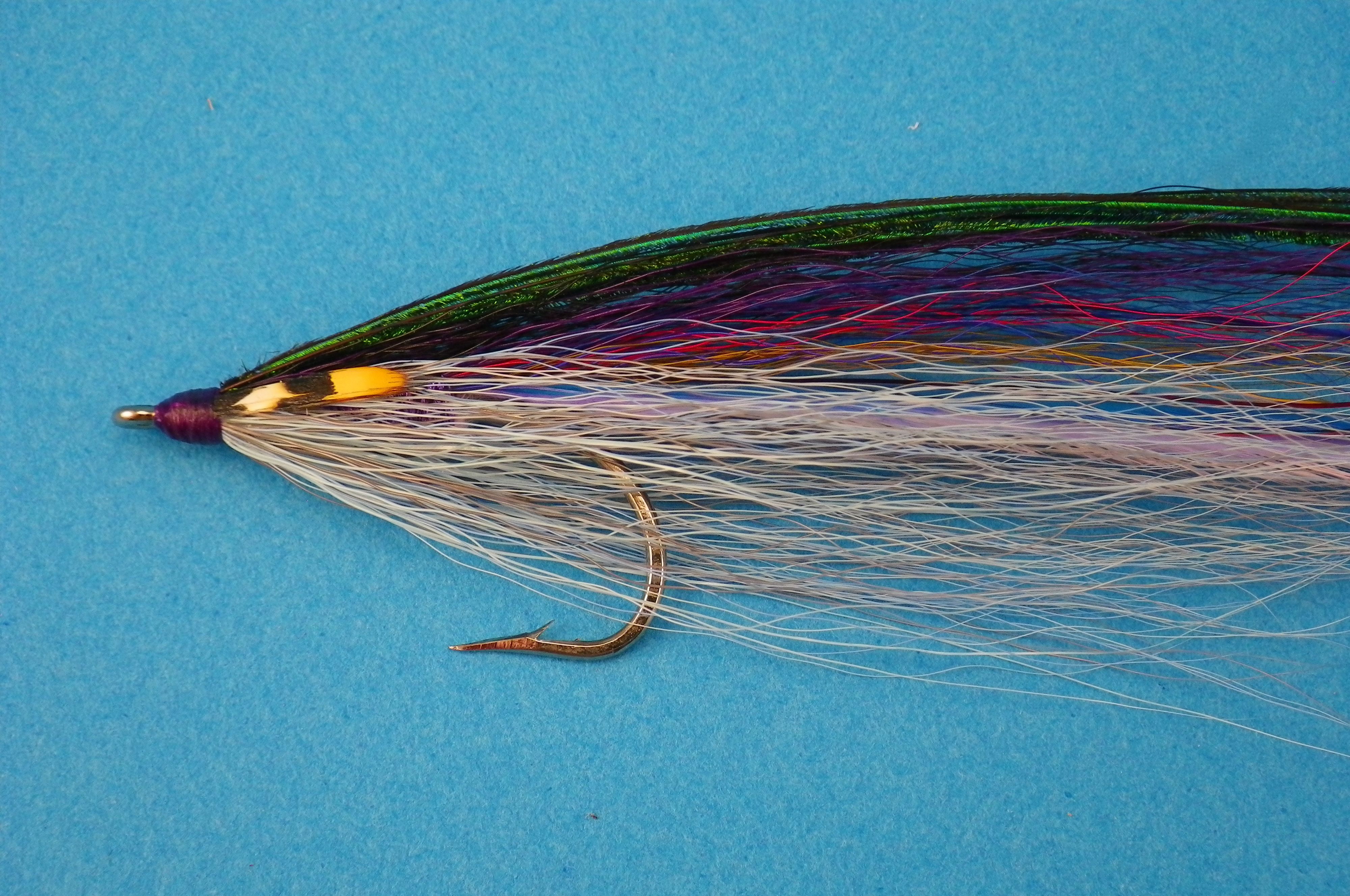
The R.L.S. Herr Blue

In a vast Sargasso Sea of opaque, doll-eyed baitfish patterns, the R.L.S. Herr Blue shines as an understated alternative. This is my favorite fly when the bait is juvenile herring.

Sparse construction and impressionistic design are hallmarks of the R.L.S. bucktails, outlined by Ken Abrames in Chapter 2 of A Perfect Fish. There are 14 flies listed. You’re probably familiar with the most famous of them, the Ray Bondorew classic, Ray’s Fly. There are enough color combinations among the R.L.S. Bucktails to match many of the baitfish stripers favor – or match or contrast the color of the sea and sky on any given day. (Think I’m crazy on that last one? Tie up an R.L.S. Easterly on a grey, foul day when the wind is blowing 20 knots out of the east and see what happens.) Size-wise, you’re only limited by the length of the bucktail you have on hand.

Like Ray’s Fly, the Herr Blue embraces the philosophy that less is more – with only 66 total bucktail hairs, you can easily read the newspaper through its body. It’s also a fascinating exercise in color blending, with no less than nine different bucktail colors that create all kinds of secondary and tertiary hues.

Herr Blue is the kind of fly that doesn’t get a lot of attention on internet forums or in flyshop bins. That’s easy to understand. When it comes to popular perception of saltwater patterns, impressionism always takes a back set to realism. That’s a shame, because flies like this reveal to you just how low on the intelligence scale fish really are.

But now, you’re in on the secret. And you’re going to love the look on other people’s faces when you show them the fly you’ve been catching all those stripers on.

Ich bin ein Herr Blue (click on image to enlarge)

Image

Thread: White
Hook: Eagle Claw 253 or Mustad 3407 (this is the EC 253 size 1/0)
Body: Silver mylar braid
Wing: Bucktail, 15 hairs white, 5 ginger 1.5x hook length, mixed, under 8 violet, 4 pink, 10 light blue mixed 2x hook length, under 2 strips silver and 2 strips purple flash (I only use one of each for the smaller versions) under 10 dark blue, 4 emerald green, 6 smoky blue/grey, 4 orange mixed 3x hook length.
Topping: 5-7 strands peacock herl a half inch longer than the longest bucktail
Eyes: Jungle cock (optional)

Tying notes: This fly is 3½” long. I usually tie it from 2½” to 6”. In the smaller sizes, I use only one strand of flash per color. You don’t have to make yourself crazy trying to calculate bucktail lengths for different sizes; sometimes I just make each section about a half-inch to an inch longer than the previous one. The jungle cock eyes are a nice touch, but most of the time I fish this fly neat – no eyes. One question I get a lot is, “Do I have to actually count the bucktail hairs?” Today, my answer is yes. Two reasons. One, I’d like you to see just how few 66 bucktail hairs really is. Two, you are embarking on adventure in controlled color blending. Think of it as a custom color you order in a paint store. They take the base and add precise shots of pigment to it to create the same color over and over. Same thing here. This fly was created by a painter with an exceptional eye for color. I trust his judgment, and I want to try to see what he envisioned when he specified this blend. Having said that, the universe will not implode if you use 12 violet, 6 pink, or 15 light blue bucktail hairs. So, do it by the book, then improvise to your heart’s desire. Try to keep things sparse, though. A little bucktail goes a long way.

The (Super-Sized) Magog Smelt Flatwing

It would be pretty fair to say that I’ve got a jones for the Magog Smelt. The Magog Smelt is a classic landlocked salmon streamer that originated in Maine. It sports a striking color palette: white, yellow, and purple bucktail. Silver flash accents. Flowing red marabou, offset with barred teal flank and iridescent peacock herl.

Up until a few years ago, I’d never heard of the Magog Smelt. Then one day I was having a conversation with Ken Abrames about old time striper flies, and he told me the Magog Smelt was his father’s favorite fly for Rhode Island bass. So I looked up the pattern and tied a version based on the Ray’s Fly design. The first time I fished that that fly was at night in a breachway, and when I caught a striper on it, I could almost picture Ken’s dad standing on the shore, nodding in approval.

I started playing around with the color scheme of the Magog Smelt in different formats, from soft-hackle to single feather flatwing. They all worked in the salt. Then I got ambitious and tied up a 10” long, nine-feather flatwing. A substantial morsel to tempt the stripers when the big bait is in. Bold. Daring. More of a caricature of a herring than a formal portrait.

And here it is.

The Super-Sized Magog Smelt

Hook: Eagle Claw 253 3/0
Thread: Black
Platform: White bucktail
Support: White neck hackle
Tail: 3 white saddles, under 2 strands pearl flash, under one yellow saddle, under 2 strands pearl flash, under 2 yellow saddles, under 2 strands silver flash, under one lavender saddle under 2 strands silver flash, under one lavender saddle under 2 strands red flash, under one lavender saddle under 2 strands purple flash.
Body: Silver braid
Collar: a 2/3 veil of long white bucktail one hair thick
Throat: Full tip of red marabou
Wing: 30 strands purple bucktail
Topping: 7 long peacock herl strands
Cheek: Teal flank feather tip
Eyes: Jungle cock

A closer look at a fly that fishes big, casts small.

Tying notes: Since I didn’t have the darker purple the original calls for, I used lavender saddles and some deep purple bucktail in the wing. There’s something magical about the effect created by placing the jungle cock over the teal flank cheeks. This fly is tied Razzle-Dazzle style with the flash about an inch longer than the saddles.

You can see the stiff, white neck hackle I’m using for a support along the arm of the vise. A properly constructed big flatwing like this will not be prone to fouling.

Today’s Blue Plate Special: the Rhody Flatwing

The Rhody Flatwing is an old pattern that was developed by Bill Peabody (of Bill’s Bodi-Braid fame). Being a Rhode Islander, Bill is said to have drawn his inspiration from fellow Ocean Staters Ken Abrames (flatwing design template) and Ray Bondorew (Ray’s Fly colors).

The result is pattern that makes a superb generic baitfish imitation. By altering the size of the fly, the tyer can match all manner of baits. The original pattern calls for a sparse tie. You can see from the picture that what I’ve used is more than enough material. Also note that there are no eyes on this fly – they’re just not necessary. Of course, if you must have eyes, jungle cock would be the appropriate choice.

This dozen was tied for a local fly shop, and the flies are about 5” long. Delicious!

A Dozen Rhody Flatwings

Image

Hook: Eagle Claw 253 1/0-3/0
Thread: White 6/0
Support: 30 hairs white bucktail
Pillow: White
Tail: 2 strands gold Flashabou under yellow or olive saddle hackle
Body: Pearl braid (Bill’s if you’re going for homage and tradition)
Collar: 30 hairs short white bucktail on bottom, 30 hairs long white bucktail on top
Wing: 15 hairs yellow bucktail under 8 hairs light blue bucktail under sparse olive Krystal Flash under 20 hairs olive bucktail
Topping: 5-7 strands peacock herl

Tying notes: The Eagle Claw 253 is a classic hook choice for flatwings. It is light and has a short shank that helps prevent fouling. You can use either an olive or yellow saddle –well, heck, you can use whatever colors you like. Try all black. Try all white with a hint of pink or chartreuse. I like a hollower, springy bucktail fiber for the support on this fly. I made the collars an even length because that’s what looked right to me. Adding flash to a fly is like applying cologne: easy does it. Less is more.

The Crazy Menhaden three-feather flatwing

This flatwing draws its inspiration from Ken Abrames’ classic streamer, the Crazy Menhaden.

The original pattern calls for eleven saddles. But what if you don’t have all the right colors? Or, what if you have precious few saddles? One solution – the one I’ve chosen here – is to use bucktail instead of saddles to complete the proper color blend that makes this such an attractive fly.

Image

For this version of the Crazy Menhaden I’m using one white, one yellow, and one orange saddle to anchor the center of the fly, add length, and provide the swimming action flatwings are renowned for. (The exception is the biggest fly pictured, which has eight saddles.) The bucktail on the top half of the fly is tied like a Blonde, at the tail end of the shank and near the head. These fibers provide the bulk of the color and content, along with some flashabou accents and long peacock herl. The beige and yellow bucktail throat and sides remain true to the original pattern.

Along with the saddles, the rest of the color palette is bronze, pink, ginger, red, blue, chartreuse, olive, light green, and copper. The largest fly here is 12″ long; the smallest, just a bit over 7″.

I’ve had a lot of success with this fly at night on our rivers here in Connecticut. I like to fish it during the bottom of the tide, on a greased line swing.

You can find the original pattern in Ken’s book, A Perfect Fish, on page 93. When it comes to fly fishing and fly tying, I don’t usually speak in imperatives. But if you’re interested in flatwings and you don’t have this book, you need to get it. It’s the flatwing bible.

Image

Hook: Eagle Claw 253 3/0
Thread: Tan
Platform: Orange and yellow bucktail, mixed
Support: White neck hackle
Tail: Natural white saddle, under 2 strands copper flash, under a yellow saddle under an orange saddle, under 2 strands red flash, under 30 total hairs ginger, pink and violet bucktail, mixed, under 20 total hairs pink and chartreuse bucktail, mixed, under 2 strands green flash under 20 total hairs blue and red bucktail, mixed.
Body: Bronze braid
Collar: Beige bucktail on bottom, yellow and beige bucktail, mixed, on sides
Wing: 15 hairs orange bucktail under 30 hairs olive bucktail
Topping: Peacock herl
 Eyes: Jungle cock

 A closer look at the head detail and the color blends:

Image

A new flatwing from the Culton bench: the Rock Island

Rock Island Flatwings

Depending on your cultural exposure, Rock Island Line is a blues, country, or skiffle song. I won’t go into the details of the story, but there’s a railroad and a train involved. It takes place ‘way down south, miles away from the Metro North line, but that’s the route I take when business calls in the City. That train parallels the shoreline, and it goes over plenty of marshy, salty estuaries — you know, the kind stripers like to hang out in. If you’re a bass angler, you can’t help but notice them, especially that rocky island right next to the channel that’s just got to be holding some decent size fish.

The Rock Island is a flatwing bucktail hybrid about 8″ long. Like a lot of the flies I make up, the tying process wandered around a bit before the pattern discovered where it wanted to be. For example, I started with black thread, then switched to purple. Then changed some of the bucktail color blends. I really like the contrast in this fly from bottom to top.

The Rock Island will get fished on a greased line swing on a cool May night when the herring are in. A’board!

A closer look at the head detail:

Rock Island CU

Thread: Purple
Pillow: Pink
Platform: Gray bucktail
Tail: Pink saddle, under 2 strands blue flash, under lavender saddle, under blue saddle, under 2 strands red flash, under 30 total hairs royal blue, amber, and olive bucktail (mixed), under 20 total hairs dark blue and red bucktail (mixed), under 2 strands purple flash, under 20 strands purple bucktail.
Body: Purple braid
Collar: Pale blue, light blue, and gray bucktail, mixed
Wing: 15 strands purple and 30 strands black bucktail, mixed
Topping: 7-8 strands peacock herl
Eyes: Jungle cock