Secrets to Catching Bigger Smallmouth on the Housatonic

It’s the time of year when this question begins to flood my mailbox: “I’m catching a ton of little smallmouth bass. Where do I go on the Housatonic to find the bigger fish?”

There’s no single, simple answer. And it’s not just a matter of where. It’s also when. And how. Here are a few tips to help you catch the big one.

It’s 8:15pm. Do you know where your trophy Housy smallie is? My money’s on “at the business end of a Countermeasure.”

OLYMPUS DIGITAL CAMERA

– Fish near deep(er) water access. Big smallmouth like the cover and security that deep water provides. Picture them hanging out on the bottom of a deep hole during peak daylight. They didn’t get to be big by accident.
– Your chances of catching a big smallmouth bass increase exponentially as the day transitions into night. There will come a point where the bite will shut down, which is usually about the time you can no longer see your fly.
– Target shallows in low light, particularly shallows near deep water. Like many predators, big bass will move onto flats as twilight builds. They’re feeding with confidence under the cover of darkness. Last week as I was walking out of the river at 8:45pm, I nearly stepped on a monster smallie that was cruising in about a foot of water.
– Take the road less traveled. There are often rich rewards awaiting those willing to walk. If you were a big smallmouth, where would you be? Finding the answer to that question is half the fun.
– Cull the pipsqueaks with bigger flies. Four inches is a good cutoff point. Some of the little guys may want to fight outside their weight class, but often can’t get the hook in their mouth.
– Land your fly with a splat! For example, when I’m fishing a Countermeasure, I like to give it a noisy landing on soft water. Big bass will frequently crash the fly moments after it hits.
– This goes without saying: put in your time. The more you fish, the more chances you’ll have to hook up with a big one.

Dusk can be a magic time, but the big fish bite window is sometimes frustratingly short. 

OLYMPUS DIGITAL CAMERA

Adding weight to a wet fly team: when and how

“Do you ever add weight to your wet fly rig? If so, where do you place the weight on the leader?” “Do you ever use weighted wet flies?” I get these questions a lot. Here are the answers.

This is how we do it. Two options for adding weight or a weighted fly to a wet fly team. There’s a downloadable pdf link below. FYI, the Maxima I use most often is 4# Ultragreen.

AddingWeightWetFlyTeam

AddingWeightWetFlyTeam

Let’s start with the last one. I hardly ever use weighted flies, and when I do, it’s with a specific purpose. Syl Nemes was of the opinion that if you were using beadheads or weighted flies, you weren’t wet fly fishing. I have a lot of respect for Syl — he is, after all, a giant in the pantheon of American wet fly fishers — but I find the weighted wet fly a practical arrow to have in one’s quiver.

So, I’ll add a tungsten beadhead wet on point when the water is generally higher than I’d like (500-800cfs on the Farmington); if I’m fishing a deep pool where there are some trout rising, but I suspect the bulk of the emerger action is well beneath the surface; or if I want to sink the flies quickly and then create a more precipitous rise as the line comes tight. If my drift is of any significant length, or the pool is particularly deep, I’ll be throwing mends and keeping slack in the line to help sink the rig. In some cases I may throw a shorter line and “nymph” without touching the bottom — almost like a deep water Leisenring Lift.

Adding weight to the leader is almost always a strategic decision I make based on river structure. Okay — that, and also because I’m lazy. Let’s say I’m wading along, fishing a stretch of riffles and pockets and runs with a water depth of 1-3 feet. Suddenly, I’m faced with a riffle that dumps into a stretch of deep water — or a deep, long pocket. Nothing is rising, and a few swings through prove fruitless. Still, it’s a fishy looking hole, and I’m certain there are trout holding on the bottom. This is where the lazy kicks in. Rather than swap out the wet fly rig, I’ll create a quasi wet fly/nymph rig by adding a removable BB shot just above the knot that forms the middle dropper.

Keep the line plumb when you’re presenting deep. Feel that shot ticking along the bottom. If you detect a strike or if the line moves off vertical, set the hook hard downstream.

WF101Presenting Deep 1

Now I’ve got a three fly team that, when presented correctly, covers two crucial areas of water. If I present like I’m short line/tight line nymphing, the middle dropper fly will be right at the bottom; the point fly, just above the bottom; and the top dropper about 16-24″ off the bottom. I’ll either feel the take, or, as I’m tracking the drift and keeping the line plumb, see the line begin to angle behind the drift; in either case, a hard set downstream is in order.

There is no magic depth for making the decision to present near the bottom. Channel your inner Supreme Court Justice Potter Stewart, and you’ll know it when you see it.

My client Paul was swinging a team of wets through a run that I knew held fish. We had no takers, so we dipped into the shot-on-the-leader till for some tight line bottom presentations. Ding-ding-ding! Paul scored this gorgeous high teens Survivor Strain truttasaurus.

OLYMPUS DIGITAL CAMERA


Why anglers with shooting baskets catch bigger stripers than anglers with stripping baskets

It’s more than just semantics.

It’s a matter of how you fish, and how bigger fish tend to behave.

I was reminded of this point during a couple of recent outings. Schools of bass were moving through with the tide. I was fishing a floating line and a Rat a Tat Big Eelie variant. When I stripped the fly, I hooked up. When I mended and dead-drifted the fly over the sand bar, I hooked up — but with significantly bigger fish. I have experienced this on numerous occasions.

Then there are nights during a sand eel feeding event where the bass are willing to chase the fly — but only to a point. A change occurs, and to catch fish, the angler must create the illusion that the fly is a helpless sand eel drifting near the surface. (Dropper rigs on a floating line are the perfect tool for this job. Read more about striped bass dropper rigs here.) If you are taking in any line at all, it is certainly more of a slow gathering than a strip.

So, the next time you strap that plastic tub around your waist, consider this: are you using it primarily as a line collection device — or as a line management and line shooting device?

Your answer is one of those little things that will make a big difference.

The feeders on the strip were school bass in the 20″-22″ range. On the dead drift, helloooo, keepah! Plus a few just short of 28″. Good stuff.

OLYMPUS DIGITAL CAMERA

The Law of the Instrument and the Intermediate Line

I recently came across a reference to the Law of the Instrument, and it reminded me of fly fishing with an intermediate line in surf and current — especially since I recently used an intermediate line for two days on Cape Cod.

If you’re unfamiliar with the Law of the Instrument, it’s basically this: If all you have is a hammer, you see everything as a nail.

And why, you may ask, was I fishing with an intermediate line? It was the ideal taper and grain weight for my new two-hander. For test drive casting, it was aces. For fishing, it reminded me why I never choose an intermediate line for current or surf. (For more on this, read Mainly Misunderstood: Five Myths and Realities About Using Floating Lines for Striped Bass.

“The fundamental thing about fly fishing is presentation. It means that you control what’s going on, so that you can bring your fly to the fish. You’re in control. Not the line. Not the accident.” What Ken is saying is simple: use the right tool for the job.

OLYMPUS DIGITAL CAMERA

Perhaps the Law of the Instrument explains so many of the misconceptions about intermediate lines: they are less affected by surf, they are good for presenting deep, they are versatile. (D: none of the above.)

Expand your toolbox with a floating line — and you’ll begin to notice all the screws and nuts and bolts around you.

A Simple Drop-Shot Nymph Rig (Revisited)

After last week’s Nymph-o-Mania! post I received a lot of questions about drop-shot nymphing: how to build a rig, can you use it with an indicator, is it better for a tight line presentation, etc. Let’s start with the rig.

A drop-shot nymph rig with sighter for both indicator or tight line nymphing.

OLYMPUS DIGITAL CAMERA

And a PDF of the same diagram: SighterDropShotNymphRig

So: I’ve been drop-shot nymphing for quite some time now. Being the curious sort (and a confirmed autodidact and DIYer) I tend to change things around until I find what works best for me. What you see is my current default trout nymph rig. I’ve been using 6X for the drop shot tag to make it the weakest link in the system. I’m lazy, so I build a sighter into the system whether I’m going to indicator nymph or not. Maxima if the water is high or off-color, 5x if it’s skinny and clear. (Please, use your favorite material to build this rig. It will work whether or not you use Maxima, P-Line, or Stren.)

When to tight line and when to indicator? Chapters in books have been written on this. Here are some of my thoughts in brief.

When to indicator:

  • When I want to cover longer stretches of water
  • When I want to reach pockets and runs farther than a rod-and-arm’s length
  • When I want the nymphs to swirl around in a mixer-like pocket
  • In conditions where takes may be subtle/difficult to feel (winter, windy days, just to name two)
  • When the wind is blowing upstream

Note: The distance from drop shot to indicator on the leader is about 1.5 times what I estimate the deepest water to be. I use my own home brew yarn indicators almost exclusively. They are light, denser that store-bought kinds, don’t spook fish (it seems that every season I have at least one trout hit my indicator) and I am very dialed in to their nuances.

When to tight line:

  • When I’m fishing in close
  • When the water is low and clear
  • When I feel the indicator is difficult to manage/adversely speeding up the drift

Hope that helps. I’m sure there will be more questions and as always, I am happy to answer them.


“Mouth of the Housatonic River” from Eastern Fly Fishing

Gadzooks! Ten years since I wrote this? How amusing to sift through the archives and find stuff that came out of your brain when nobody knew your name. “Mouth of the Housatonic River” is a quick-read primer on the spring striper bite. There are a few almost-funny jokes, and much of the information is still pertinent. The article first appeared in the July/August 2009 issue of Eastern Fly Fishing. You can read it by clicking on the link below:

MouthHousEFF

OLYMPUS DIGITAL CAMERA


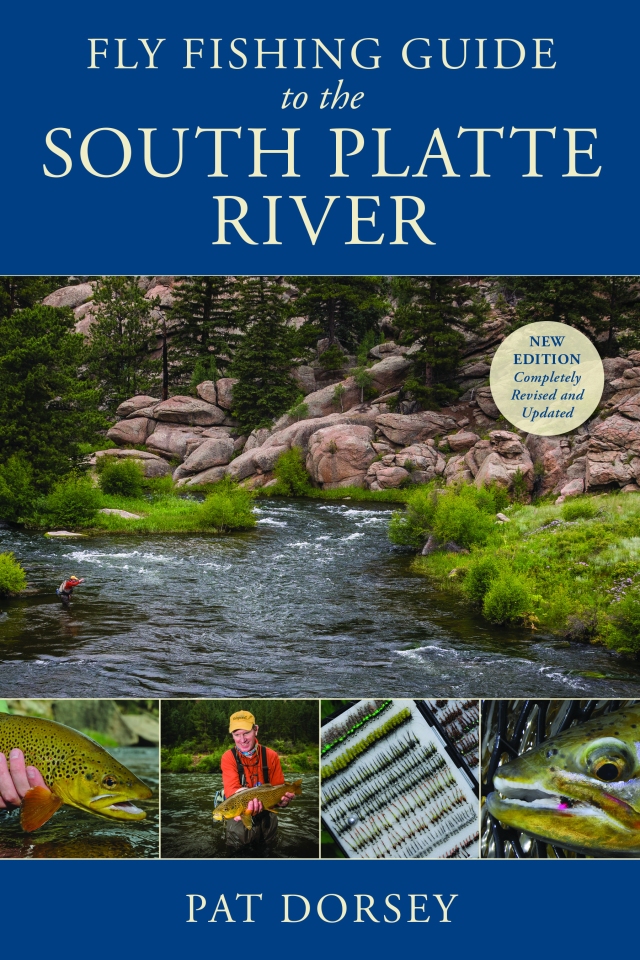
Book Review: Fly Fishing Guide to the South Platte River

I’ve never fished the South Platte. I have no immediate plans to do so. But dammit, now I’ve read this book. And the gears are turning.

Such is the power of the second edition of Fly Fishing Guide to the South Platte River. Although Pat Dorsey is listed as the author, contributors to the book are many, and the list reads like a western U.S. fly angling who’s who: Landon Mayer. Greg Blessing. Just to name a few.

The book is neatly organized into three sections. Part 1 is The South Platte System, which divides the water into geographical sections. You get details like maps, access points, water descriptions, and seasonal strategies. The chapters are sprinkled with sidebars like “High Water Season,” “Etiquette,” and “Year-Round Strategies to Find Trout.” These are  informative and they don’t intrude on the reading experience. I’m impressed by the level of detail, and the intrepid reader receives enough comprehensive information to DIY the South Platte.

Next up is Important Hatches and Fly Patterns. It’s just what you’d expect: hatch charts, monthly descriptors, and — my favorite — fly patterns. As a fly tying geek I am always on the lookout for inspiration and intel, as well as the hot local pattern that will work the same wonders here in the eastern U.S. (Yeah. Pale Olive Midge Larva. I’ve got my eye on you.) It’s no surprise that as a tailwater, much of the focus is on midges. Last, we get Techniques and Strategies on how to attack the river. As with the entire book, this section is richly illustrated with photos of trout and breathtaking scenics.

Quibbles are few. As is the norm for many contemporary fly fishing books, wet flies and wet fly fishing are conspicuously absent. (I’d love to swing a team of three through some of the water illustrated in the book — or give trout rising to PMDs a look at The Magic Fly.) And the only featured mention of wet fly presentation (the Leisenring Lift) pertains to nymphing — and it gets the technique wrong (the angler does not physically raise the flies — the angler checks the rod and lets current and tension do the work.)

Nonetheless, Fly Fishing Guide to the South Platte River is highly recommended. Pat Dorsey should be commended on his skillful blending of situational river specifics and general trout knowledge. If you’re heading west to fish the South Platte, you’ll be glad you invested in a copy.

“…lush valleys, meandering meadow streams, and rose-colored, boulder-filled canyons.” Where do I sign up? Just south of Denver, Colorado, this world-class trout fishery comes to life in Pat Dorsey’s Fly Fishing Guide to the South Platte River. If you’ve never fished the river, this book is a must have, with new maps and updated river, access, and fishing information. Fly Fishing Guide to the South Platte River by Pat Dorsey, Stackpole Books, ISBN 978-0-8117-3818-7.

9780811738187_fc

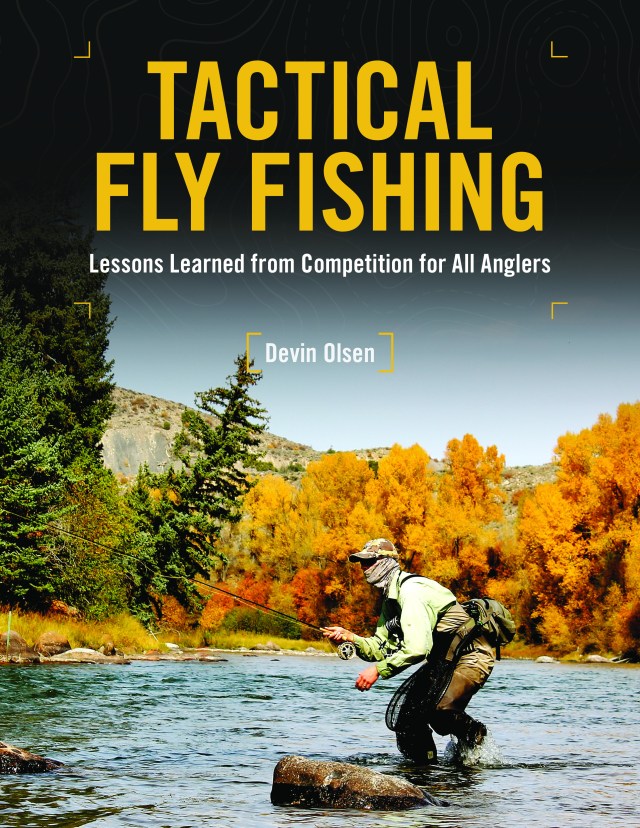
Book Review: “Tactical Fly Fishing” by Devin Olsen

To fully understand the genesis of Devin Olsen’s Tactical Fly Fishing, you need to include its subtitle: Lessons Learned from Competition for All Anglers. If you’re like me — someone who views competitions as a joy-of-fishing buzzkill — letting the C-word put you off would be a mistake. If you’re interested in becoming a better, more well-rounded angler, Tactical Fly Fishing is jam-packed with information you can use to catch more trout on your next outing.

Some of the best teachers I know take an “I’m not right, and I don’t know it all — I’m just showing you how I’d do it” approach to learning. Olsen nails this throughout the book. It’s particularly evident in the chapter, “Gear and Rigging.” He gives you an honest, broad overview, and leaves it to you to make equipment decisions.

Olsen divides river sections into water types: Pocketwater, Riffles, Runs, Pools, Glides, and Bankside Lies. He devotes a chapter to each, and this is where the book shines. He includes a few case studies, complete with photos, detailing how he approaches each water and situation. It’s almost like you’re tagging along for the lesson. With Olsen’s competition experience and success, you get the sense that there’s not a lot of water he hasn’t seen. Fish with confidence!

Regular readers of currentseams know that I don’t Euro-nymph, and given its competition roots, Euro-nymphing methodology plays an extensive role in this book. That doesn’t mean the information is irrelevant to us non-Euro nymphers — you just need to work through it as it applies to how you fish. Reading water is reading water, and since that’s such a huge part of catching, we all would do well to study the water type chapters. There’s also a short chapter on proven fly patterns; as a fly junkie I wish there were more (what, no soft hackles?).

Despite the Euro-nymphing emphasis, a consistent theme emerges throughout Tactical Fly Fishing: there is no one best way — and the best anglers take a fluid approach to the situations they are faced with and the methods they choose. In some stretches the book can get a little technical, but I’d rather have more information than not enough. (I first heard of Devin when I saw a picture of him weighing nymphs on a tiny scale. I remember thinking: this is a detail-oriented angler.) Olsen’s style is nonetheless conversational and easy-to-read. Tactical Fly Fishing is one of those references that I will be going back to on a regular basis.

It may seem like an easy gig — people send you books, you read them, then write about them — but it isn’t. You should know that I take this seriously, and if I didn’t like something, I’d tell you. So I’m telling you. This is a good one. All I ask of a how-to angling book is: teach me stuff I don’t know. Remind me of stuff I’ve forgotten. Don’t write like you’re trying to impress me with your knowledge of the thesaurus. Tactical Fly Fishing delivers. Tactical Fly Fishing — Lessons Learned from Competition for All Anglers by Devin Olsen, Stackpole Books, ISBN 978-0-8117-1982-7.

TacticalFlyFishing

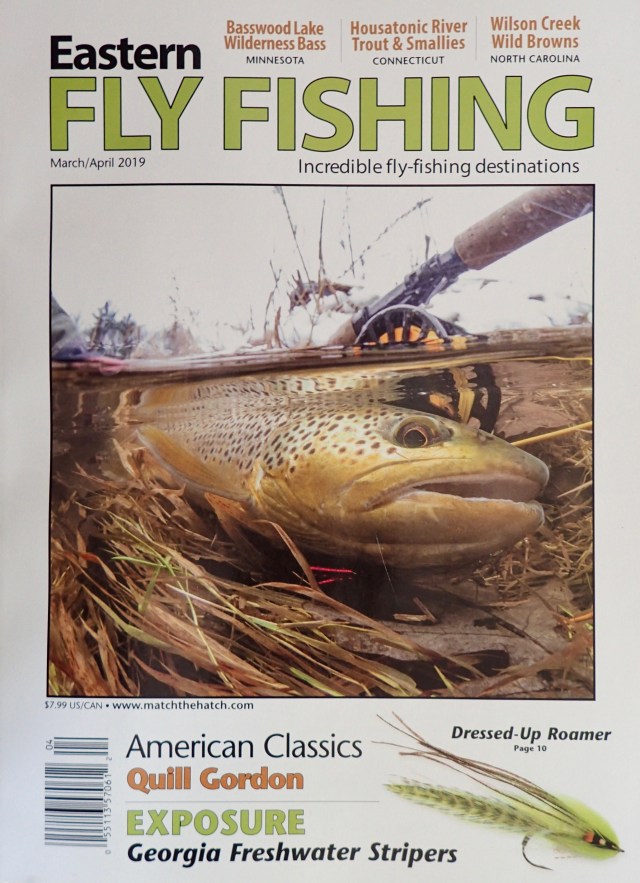
Housy Trout & Smallies in the March/April issue of Eastern Fly Fishing

Hot off the presses: “Upper Housatonic River, CT — The Smallmouth River That Thinks It’s A Trout Stream.” You can read it in the March/April issue of Eastern Fly Fishing. You’ll find a little river history, a little reconnoiter, some trout and smallie basics, and a couple of my favorite Housy fly patterns. Oh. It’s also a pretty good read (said the author modestly). I believe you can get a copy at matchthehatch.com.

Where we set out to prove the O.W. Holmes quote, “There’s no tonic like the Housatonic.”

OLYMPUS DIGITAL CAMERA


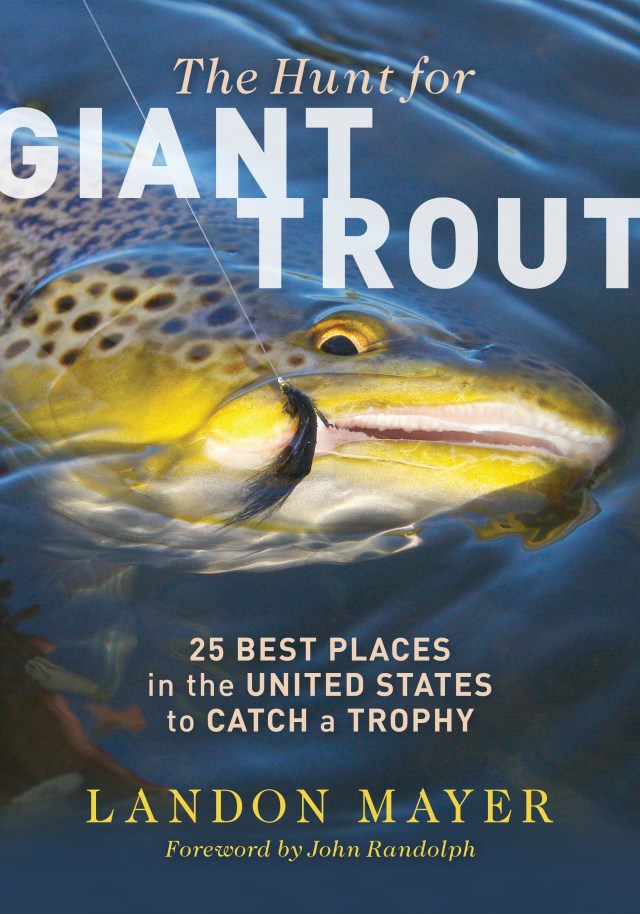
Book Review: “The Hunt for Giant Trout” by Landon Mayer

Well now — who doesn’t want to catch a giant trout? My first encounter with such a creature came in the early 1970s on CT’s Salmon River: twenty-three and one-half inches of malevolent brown beast. Its perfectly formed paddle fins and striking colors indicated that this was a holdover of at least several seasons. I just happened to be the kid who stuck it.

Yes, I’m addicted. Not quite as big as that Salmon River fish, but within trophy range. Farmington River, September 2018.

DCIM100GOPROG0013068.

~

Catching a giant trout changes you, and once you decide to pursue them you realize that big fish really are different — one of the many instructive points author Landon Mayer makes in his new book, The Hunt For Giant Trout — 25 Best Places in the United States to Catch a Trophy.

The Hunt For Giant Trout is divided into two sections: Strategies & Techniques, and The Fisheries. Strategies & Techniques is loaded with information on giant trout behavior and how-to (from reading water to fighting tactics). As a seasoned angler, I often judge fly fishing books from the perspective of: tell me stuff I don’t already know. There’s plenty of that in the first section, and I’m always delighted to discover how much I still have to learn.

The Fisheries takes you on a tour of 25 locations where you can fulfill your quest. I like that Mayer involves locals (some big names in there!) in each writeup; who knows the water better than someone who fishes it a hundred days a year? Included are favorite patterns and recipes, from bulky articulated streamers to midge nymphs. (As a fly tying nerd I’m always curious about what other people are tying and throwing.)

Mayer’s style is conversational and easy to read. Everyone learns differently, and there’s a ton of visual reference, from photos to diagrams. Even if there weren’t pictures of Landon holding giant trout, you’d still come away with the notion that this guy knows what he’s talking about. Minor quibbles? Only three of the twenty-five fisheries are within driving distance of New England; the list skews heavily western U.S. Still, there’s more than enough quality information here for me heartily recommend The Hunt For Giant Trout. Now I’ve got to go back and read it again. Summer’s coming, and that two-footer is lurking under a logjam, waiting for the opportunity to strike.

One of the coolest parts of doing presentations at places like the Fly Fishing Show is that you get to meet people who have caught way more big trout than you. Like Landon. He’s also one of the nice guys in our sport. So get this book and read it. The Hunt for Giant Trout by Landon Mayer, Stackpole Books, ISBN 978-0-8117-3719-7.

GiantTroutCover