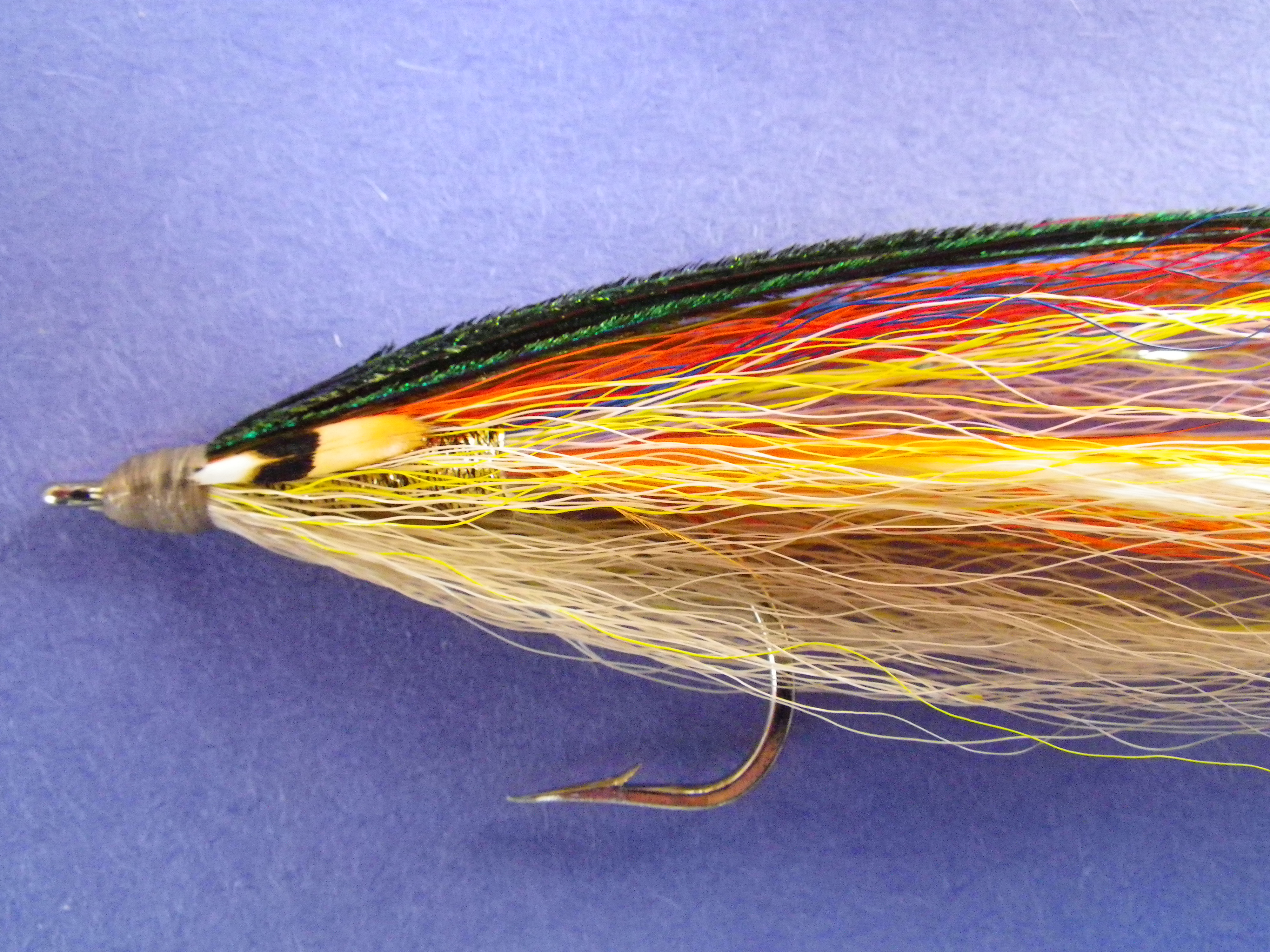
Today’s Blue Plate Special: the Rhody Flatwing

The Rhody Flatwing is an old pattern that was developed by Bill Peabody (of Bill’s Bodi-Braid fame). Being a Rhode Islander, Bill is said to have drawn his inspiration from fellow Ocean Staters Ken Abrames (flatwing design template) and Ray Bondorew (Ray’s Fly colors).

The result is pattern that makes a superb generic baitfish imitation. By altering the size of the fly, the tyer can match all manner of baits. The original pattern calls for a sparse tie. You can see from the picture that what I’ve used is more than enough material. Also note that there are no eyes on this fly – they’re just not necessary. Of course, if you must have eyes, jungle cock would be the appropriate choice.

This dozen was tied for a local fly shop, and the flies are about 5” long. Delicious!

A Dozen Rhody Flatwings

Image

Hook: Eagle Claw 253 1/0-3/0
Thread: White 6/0
Support: 30 hairs white bucktail
Pillow: White
Tail: 2 strands gold Flashabou under yellow or olive saddle hackle
Body: Pearl braid (Bill’s if you’re going for homage and tradition)
Collar: 30 hairs short white bucktail on bottom, 30 hairs long white bucktail on top
Wing: 15 hairs yellow bucktail under 8 hairs light blue bucktail under sparse olive Krystal Flash under 20 hairs olive bucktail
Topping: 5-7 strands peacock herl

Tying notes: The Eagle Claw 253 is a classic hook choice for flatwings. It is light and has a short shank that helps prevent fouling. You can use either an olive or yellow saddle –well, heck, you can use whatever colors you like. Try all black. Try all white with a hint of pink or chartreuse. I like a hollower, springy bucktail fiber for the support on this fly. I made the collars an even length because that’s what looked right to me. Adding flash to a fly is like applying cologne: easy does it. Less is more.

The Crazy Menhaden three-feather flatwing

This flatwing draws its inspiration from Ken Abrames’ classic streamer, the Crazy Menhaden.

The original pattern calls for eleven saddles. But what if you don’t have all the right colors? Or, what if you have precious few saddles? One solution – the one I’ve chosen here – is to use bucktail instead of saddles to complete the proper color blend that makes this such an attractive fly.

Image

For this version of the Crazy Menhaden I’m using one white, one yellow, and one orange saddle to anchor the center of the fly, add length, and provide the swimming action flatwings are renowned for. (The exception is the biggest fly pictured, which has eight saddles.) The bucktail on the top half of the fly is tied like a Blonde, at the tail end of the shank and near the head. These fibers provide the bulk of the color and content, along with some flashabou accents and long peacock herl. The beige and yellow bucktail throat and sides remain true to the original pattern.

Along with the saddles, the rest of the color palette is bronze, pink, ginger, red, blue, chartreuse, olive, light green, and copper. The largest fly here is 12″ long; the smallest, just a bit over 7″.

I’ve had a lot of success with this fly at night on our rivers here in Connecticut. I like to fish it during the bottom of the tide, on a greased line swing.

You can find the original pattern in Ken’s book, A Perfect Fish, on page 93. When it comes to fly fishing and fly tying, I don’t usually speak in imperatives. But if you’re interested in flatwings and you don’t have this book, you need to get it. It’s the flatwing bible.

Image

Hook: Eagle Claw 253 3/0
Thread: Tan
Platform: Orange and yellow bucktail, mixed
Support: White neck hackle
Tail: Natural white saddle, under 2 strands copper flash, under a yellow saddle under an orange saddle, under 2 strands red flash, under 30 total hairs ginger, pink and violet bucktail, mixed, under 20 total hairs pink and chartreuse bucktail, mixed, under 2 strands green flash under 20 total hairs blue and red bucktail, mixed.
Body: Bronze braid
Collar: Beige bucktail on bottom, yellow and beige bucktail, mixed, on sides
Wing: 15 hairs orange bucktail under 30 hairs olive bucktail
Topping: Peacock herl
 Eyes: Jungle cock

 A closer look at the head detail and the color blends:

Image