Another Good Night For The Five-Weight

“What?”

That was my wife’s response, delivered with no small amount of incredulity – or was it sympathy – when I told her I was going fishing tonight. I really couldn’t blame her. After all, I had been traveling home from Florida all day. Now it was evening, and I was on the phone with her, calling on a New Haven-bound Amtrak from Manhattan. I wouldn’t be home for another two hours, and then it’d be another two hours before I could leave.

But, you get to used to the oddball treatment from people who don’t obsess over tide times, heights, moons, and river levels like you do. Even if you’re married to them.

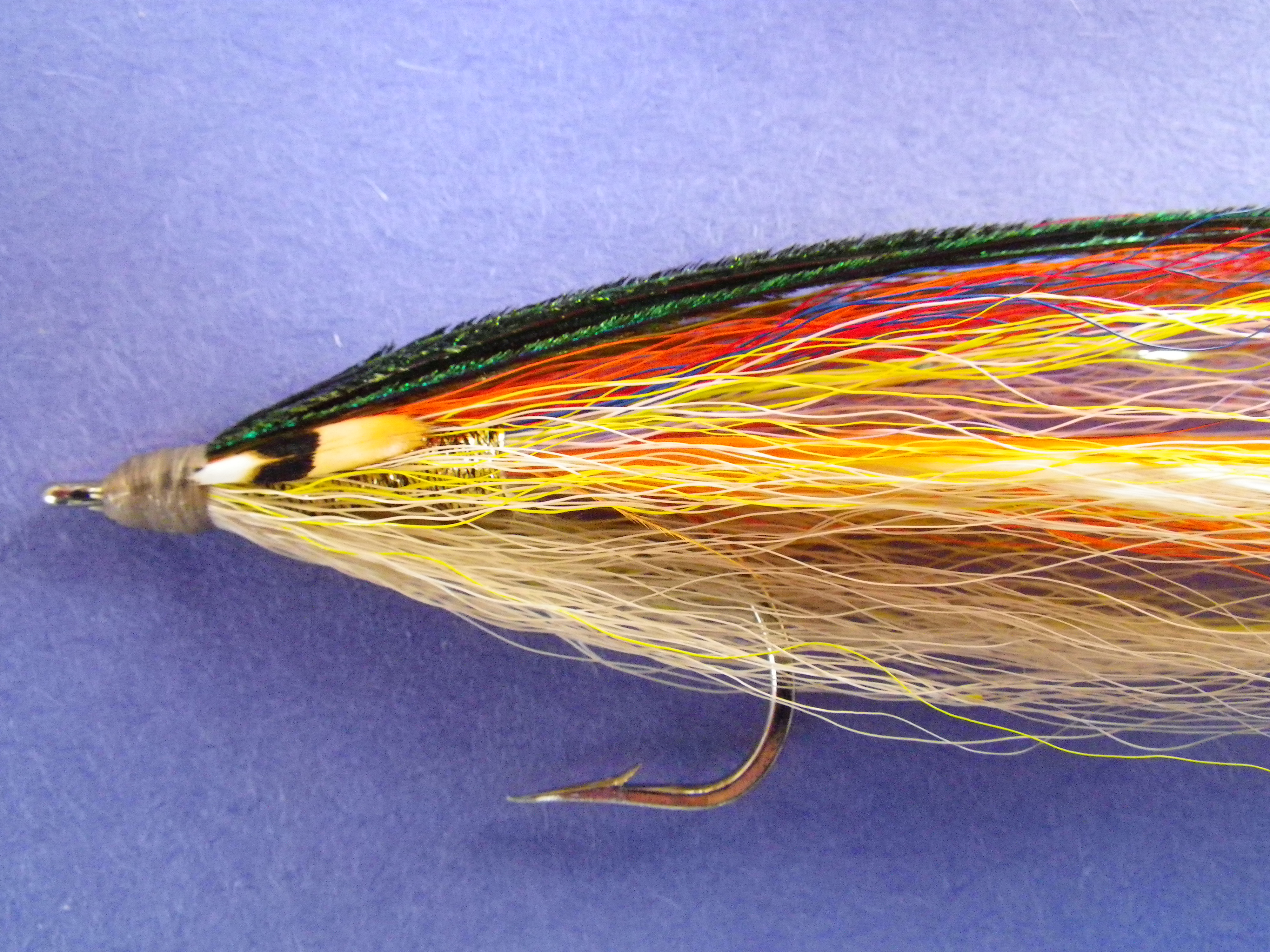
I hadn’t fished in over a week, so I had it bad for some stripers. Tonight would be a perfect night for the five weight rod. Not too windy, and the prospect of a striper in the 15 pound class. I attached a fresh 30-pound test leader about eight feet long to the line, then tied on a Herr Blue flatwing about eleven inches long from nose to flash. Everything looked just right.

Not even a nighttime roadwork traffic jam could slow my spirits. I ended up getting my spot ten minutes late. So what? The fish would still be around.

The current on the outgoing tide was moving at a slow walking pace. In what little ambient light there was, I could see the intricate cake-frosting swirls of the eddies as they passed over the hidden bottom structure. I tried to guess the water temperature with my index finger. 58? 62? The thermometer said 59 degrees. Not a bad couple guesses.

I began by working a deep little run between the rocks. Herring swirled near the surface right in front of me. I tried a few dead drifts, almost like high-stick nymphing, but there were no strikes. So I began to methodically walk down-current, greased line swinging the whole way.

The fish in this section of river tend to hit on or about my second mend, but forty minutes had gone by without a tap. The drill was comforting. Cast. Immediately throw an upstream mend. Then another. Let the fly swing around. Swim, pulse, and dance it in the current. A few short strips, then let it fall back. Even fishless, the presentation was pleasant and meditative. A glance at my watch showed it was well into the wee hours, and I was out here all by myself.

Except for her.

She took the fly as they often do on the greased line, slowly, with full confidence, inhaling the Herr Blue near the head, then turning back toward the bottom. I felt it as a sudden change in pressure on the line. Subtle, nuanced, yet distinctive from the unimpeded drift. No demonstrative WHACK! No explosion on the membrane between water and air. Not yet. I came fully tight to the line with a backward thrusting motion. The hook point found its seat in the corner of her mouth. Right where it was supposed to be.

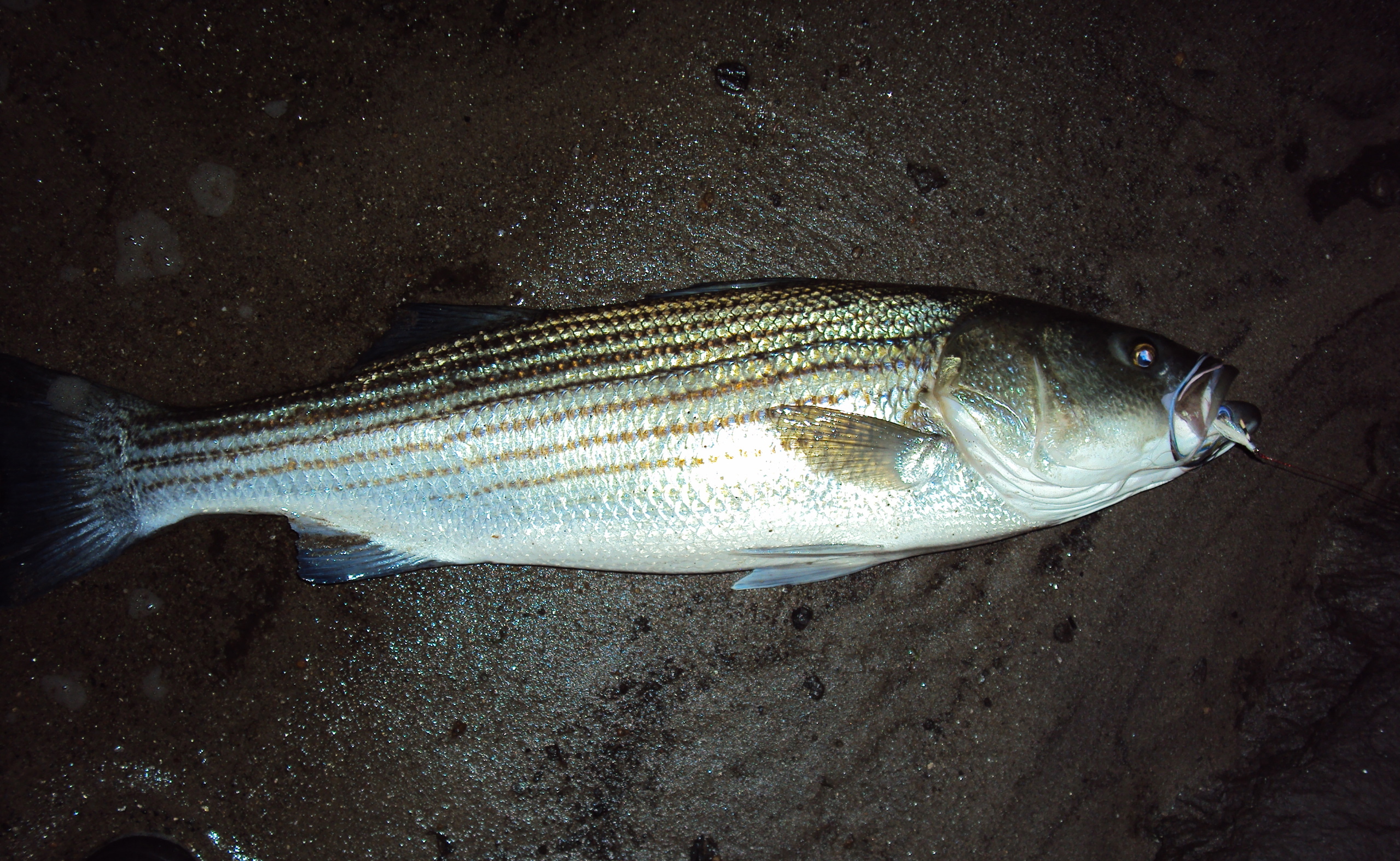
Now she becomes unhinged, tail thrashing at the surface. At first, I’m unsure how large the striper is, and I under-guesstimate her to be in the 24”class. She’s moving toward me, and I’m hand stripping her in. Once she reaches the edge of the sand bar and discovers she no longer has the comfort of depth to rely on, she lets me know that hand stripping will be ill-advised. The fish begins her first run, taking the slack line out of my shooting basket through my thumb and forefinger at a jerky, frantic pace.

The drag protests as more line is peeled off. I ratchet things down a little tighter, and that stops her. Just to be sure, I re-set the hook. Line is regained, lost, and regained. She’s tantalizingly close now, about twenty feet out, but not quite finished.

Her last defense is her undoing. To escape the shallows of the sand bar I’m standing on, she heads for the deepest nearby water, which happens to be upstream. Between the current and the pressure I put on her, she tires quickly.

As I cradle her in the water, I wonder how many herring she’d eaten that night? Our time is all too brief together, not only the fight, but the release as well. I don’t have her in the revival position for more than a few seconds before she thrusts out of my hands and melts away from the beam of my headlamp into the darkness.

I climbed into bed around 4am. The birds were singing. I was, too. All the way home.

Miss Piggy poses for posterity. “Dang,” she’s thinking, “I really thought that was a herring.” For perspective, the fly, a Herr Blue flatwing, is about 11″ long.
Image

A close-up of the Herr Blue flatwing.

Image

This piece was written in May, 2012, and originally appeared in several online fishing forums.

Thanks to the Saltwater Edge for tonight’s flatwing class

I spent a very enjoyable two hours tonight at the Saltwater Edge tying flatwings. We kept it simple with single-feather and two-feather patterns, like the Morning Glory and the September Night. Another great group, very enthusiastic, with lots of good questions. It is a privilege and a pleasure to be able to teach tying these magnificent flies. Thanks to Peter Jenkins and his gracious crew for having me. And thanks to Ken Abrames for leading the way.

Some flatwing-bucktail hybrids. Even at rest, they have a palpable energy.

Image

Today’s Blue Plate Special: the Rhody Flatwing

The Rhody Flatwing is an old pattern that was developed by Bill Peabody (of Bill’s Bodi-Braid fame). Being a Rhode Islander, Bill is said to have drawn his inspiration from fellow Ocean Staters Ken Abrames (flatwing design template) and Ray Bondorew (Ray’s Fly colors).

The result is pattern that makes a superb generic baitfish imitation. By altering the size of the fly, the tyer can match all manner of baits. The original pattern calls for a sparse tie. You can see from the picture that what I’ve used is more than enough material. Also note that there are no eyes on this fly – they’re just not necessary. Of course, if you must have eyes, jungle cock would be the appropriate choice.

This dozen was tied for a local fly shop, and the flies are about 5” long. Delicious!

A Dozen Rhody Flatwings

Image

Hook: Eagle Claw 253 1/0-3/0
Thread: White 6/0
Support: 30 hairs white bucktail
Pillow: White
Tail: 2 strands gold Flashabou under yellow or olive saddle hackle
Body: Pearl braid (Bill’s if you’re going for homage and tradition)
Collar: 30 hairs short white bucktail on bottom, 30 hairs long white bucktail on top
Wing: 15 hairs yellow bucktail under 8 hairs light blue bucktail under sparse olive Krystal Flash under 20 hairs olive bucktail
Topping: 5-7 strands peacock herl

Tying notes: The Eagle Claw 253 is a classic hook choice for flatwings. It is light and has a short shank that helps prevent fouling. You can use either an olive or yellow saddle –well, heck, you can use whatever colors you like. Try all black. Try all white with a hint of pink or chartreuse. I like a hollower, springy bucktail fiber for the support on this fly. I made the collars an even length because that’s what looked right to me. Adding flash to a fly is like applying cologne: easy does it. Less is more.

The Crazy Menhaden three-feather flatwing

This flatwing draws its inspiration from Ken Abrames’ classic streamer, the Crazy Menhaden.

The original pattern calls for eleven saddles. But what if you don’t have all the right colors? Or, what if you have precious few saddles? One solution – the one I’ve chosen here – is to use bucktail instead of saddles to complete the proper color blend that makes this such an attractive fly.

Image

For this version of the Crazy Menhaden I’m using one white, one yellow, and one orange saddle to anchor the center of the fly, add length, and provide the swimming action flatwings are renowned for. (The exception is the biggest fly pictured, which has eight saddles.) The bucktail on the top half of the fly is tied like a Blonde, at the tail end of the shank and near the head. These fibers provide the bulk of the color and content, along with some flashabou accents and long peacock herl. The beige and yellow bucktail throat and sides remain true to the original pattern.

Along with the saddles, the rest of the color palette is bronze, pink, ginger, red, blue, chartreuse, olive, light green, and copper. The largest fly here is 12″ long; the smallest, just a bit over 7″.

I’ve had a lot of success with this fly at night on our rivers here in Connecticut. I like to fish it during the bottom of the tide, on a greased line swing.

You can find the original pattern in Ken’s book, A Perfect Fish, on page 93. When it comes to fly fishing and fly tying, I don’t usually speak in imperatives. But if you’re interested in flatwings and you don’t have this book, you need to get it. It’s the flatwing bible.

Image

Hook: Eagle Claw 253 3/0
Thread: Tan
Platform: Orange and yellow bucktail, mixed
Support: White neck hackle
Tail: Natural white saddle, under 2 strands copper flash, under a yellow saddle under an orange saddle, under 2 strands red flash, under 30 total hairs ginger, pink and violet bucktail, mixed, under 20 total hairs pink and chartreuse bucktail, mixed, under 2 strands green flash under 20 total hairs blue and red bucktail, mixed.
Body: Bronze braid
Collar: Beige bucktail on bottom, yellow and beige bucktail, mixed, on sides
Wing: 15 hairs orange bucktail under 30 hairs olive bucktail
Topping: Peacock herl
 Eyes: Jungle cock

 A closer look at the head detail and the color blends:

Image

A new flatwing from the Culton bench: the Rock Island

Rock Island Flatwings

Depending on your cultural exposure, Rock Island Line is a blues, country, or skiffle song. I won’t go into the details of the story, but there’s a railroad and a train involved. It takes place ‘way down south, miles away from the Metro North line, but that’s the route I take when business calls in the City. That train parallels the shoreline, and it goes over plenty of marshy, salty estuaries — you know, the kind stripers like to hang out in. If you’re a bass angler, you can’t help but notice them, especially that rocky island right next to the channel that’s just got to be holding some decent size fish.

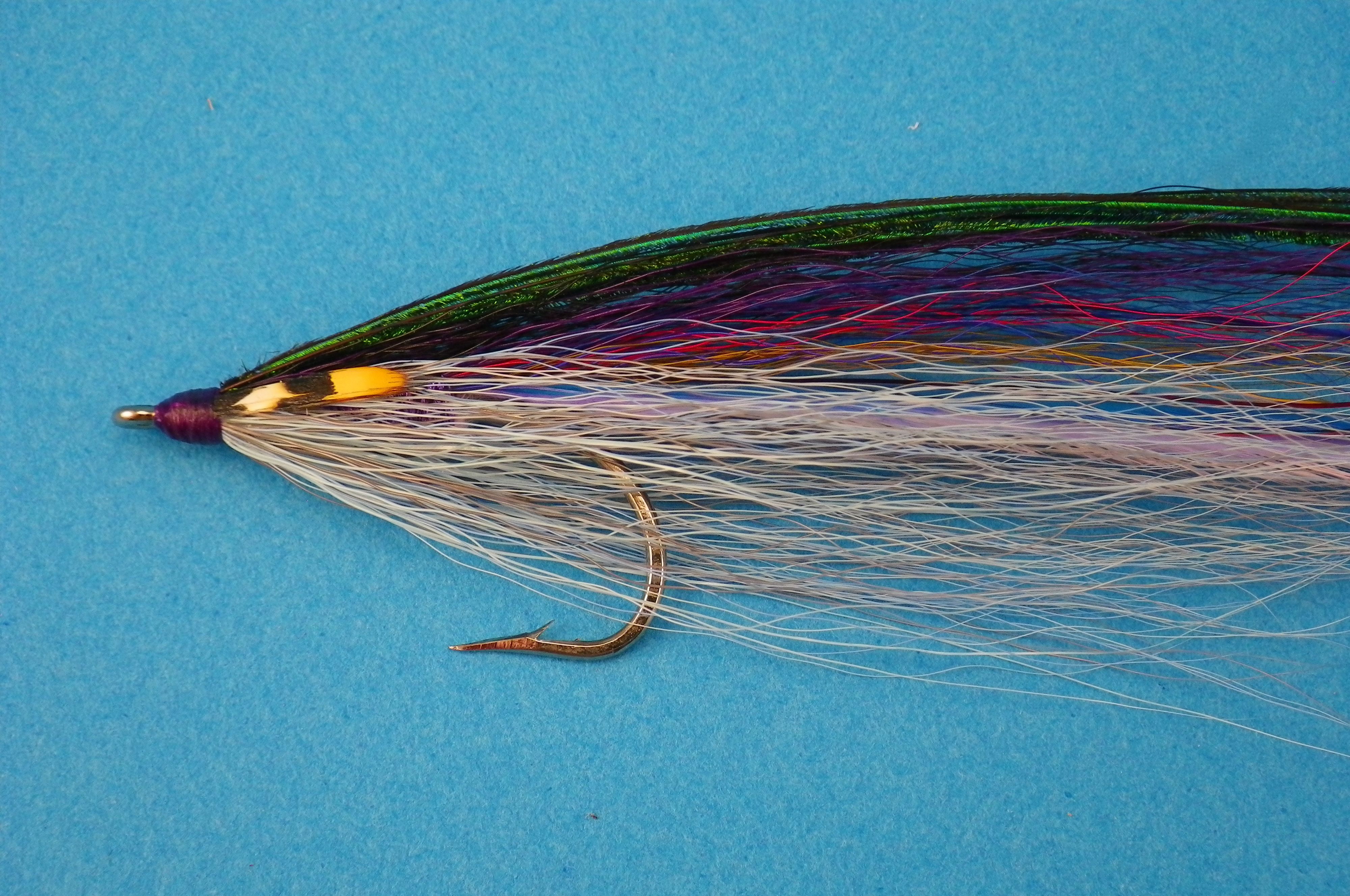
The Rock Island is a flatwing bucktail hybrid about 8″ long. Like a lot of the flies I make up, the tying process wandered around a bit before the pattern discovered where it wanted to be. For example, I started with black thread, then switched to purple. Then changed some of the bucktail color blends. I really like the contrast in this fly from bottom to top.

The Rock Island will get fished on a greased line swing on a cool May night when the herring are in. A’board!

A closer look at the head detail:

Rock Island CU

Thread: Purple
Pillow: Pink
Platform: Gray bucktail
Tail: Pink saddle, under 2 strands blue flash, under lavender saddle, under blue saddle, under 2 strands red flash, under 30 total hairs royal blue, amber, and olive bucktail (mixed), under 20 total hairs dark blue and red bucktail (mixed), under 2 strands purple flash, under 20 strands purple bucktail.
Body: Purple braid
Collar: Pale blue, light blue, and gray bucktail, mixed
Wing: 15 strands purple and 30 strands black bucktail, mixed
Topping: 7-8 strands peacock herl
Eyes: Jungle cock