New article in the current issue of MAFFG: “Salmon Fishing for Striped Bass”

“Salmon Fishing for Striped Bass” is a primer on greased line fishing for stripers. I’ve been wanting to write this article for a long time, since the greased line technique is one of my favorite ways to fish. If you’ve never tried it, you’re in for a treat. It is an elegant, effective, and just plain fun way to catch stripers. The greased line swing is tailor-made for presentation flies like flatwings and soft-hackles. You can read all about it in the Steelhead — Salmon — Saltwater issue (October 2014) of the Mid Atlantic Fly Fishing Guide. MAFFG is available free in fly shops from Connecticut to North Carolina.

GLS MAFFG

In any given year, my largest stripers come on big flatwings presented on a greased line swing — like this thirty-pound beauty taken on a 10-inch long Razzle Dazzle.

IMG_1367

The Greased Line, The Sparse Flatwing, and the Big Three-Oh.

This was a weird spring. It was cold. Rainy. I suffered from a debilitating case of tennis elbow. Without my switch rod, there’s no way I could have even fished for stripers. Things started late – I didn’t get my first bass till well into April. Most of what I was catching was in the sub-twenty-inch class. While that bodes well for the future, April and May of 2014 will go down as a complete vexation for courting the big girls. Two of my traditional big fish spots were depressingly unproductive. It was weeks into May before I even had a legal sized striped bass. But, oh, what a bass. Here’s how it went down.

I was fishing a new location that had big bass written all over it: current, structure, and the presence of herring. Attached to my floating line was a seven-foot length of twenty-five pound test mono. The fly was one I’d tied several years ago: Ken Abrames’ Razzle Dazzle. This particular fly was a veteran many striper campaigns. Its top two saddles were long gone, and over the course of the seasons, some of the bucktail had likewise gone AWOL.

For two-and-a-half hours, I fought the good fight: cast. Upstream mend. Another mend. Another. Swing. Pulsing strip. Let the fly fall back. Retrieve. Repeat. If nothing else, greased line for striped bass is meditative, so absent any hits, the routine was comforting and pleasant.

But, it was time to leave. A walk down-current to a different section, then ten more minutes.

The takes on the greased line presentation are usually either a sensation of building pressure, or a sharp pull. Hers was neither. Suddenly, she was simply there, rolling on the fly, taking line downstream. I had dropped a substantial fish the week before when I couldn’t get a good hook set. With that wound still festering, I drove the point home. Hard. She felt strong. But I didn’t have a idea yet of what I was dealing with.

Every big bass fight presents a unique set of challenges. As expected, her first run was downstream. She peeled line off the drag, but I was surprised by how little it was – probably about thirty feet. I pointed the rod at her and set the hook again.

She turned abruptly, and headed upstream. I was simultaneously delighted and horrified; the former because in this heavy current she’d be burning a tremendous amount of oxygen in her flight, the later because of the memories of all those steelhead who shattered my heart with relentless upstream runs and hook-spitting leaps. The challenge was to re-gather line as fast as possible, staying tight to the fish. She was faster than my hands, though, and I was sure I was going to lose her. I raised the rod tip. Still there. I lowered the tip and re-set the hook.

Now, she sounded. I’ve heard that big bass will try to rub their cheeks against the bottom to rid themselves of a fly. I don’t know if that’s true, but I do know that the bottoms of rivers and oceans and estuaries are vast depositories for nature’s junk. Who knows what multiple opportunities for snag hell awaited below? I pulled on the line. It didn’t move an inch.

Unbelievable. Stuck on the bottom. Another good striper lost.

But wait. Did the bottom budge? Yes. A little. I moved the rod tip back and forth in a 180-degree arc over the water, trying to stir the fish. It worked. Instead of ripping down-current, she ran uptide. Paused. I re-set the hook. Again. I decided it was time to try and get her out of the abyss and onto the gravel bar. She would have none of that. “Down goes Frazier!” Or, as I imagined it in my head, Cosell shouting “Down goes Culton!” She sounded a second time.

Again, I couldn’t budge her with a straight pull. The rod wagging thing worked once before, so I tried it again. Now she came up a little faster. I could sense she was tiring. Once I coaxed her out of the depths, she took advantage of the shallows, ripping off a series of short runs. But all that sprinting was taking its toll. I still didn’t know what I had. I was hoping for twenty-five pounds. I decided to try to land her on the beach.

I put the rod over my shoulder and walked her in close, then pulled her to the water’s edge. Now I could see the fish. My mouth fell open, searching for words. My pulse rate skyrocketed. After lipping twenty-inchers all spring, her mouth felt like that of some alien creature. Its opening dwarfed my hand. The flesh between my thumb and forefinger was substantial. I could easily see a small dog disappearing down that gaping maw.

I held my rod against her length. Her gill plates came about to the first guide on my two-hander, thirty-four inches away from the butt. This was a striper over forty inches. The big three-oh in pounds. A new personal best on the fly from the shore. She certainly had been eating well, with a distended belly that gave her a perch-like shape.

Wouldn’t you know that this was the one night all spring I left my camera at home? Fortunately, I had my phone in my pack. I took a couple hurried shots, and felt guilty about it, because I really wanted this fish to live. I took hold of her – good Lord, what an impressive mass – and guided her into the shallows. I was expecting a lengthy revival. But no. Almost immediately she felt ready to go. Just to be sure, I held on a few more seconds. As I was re-adjusting my grip, she thrust from my hands.

She slipped away into the darkness, leaving a gentle wake.

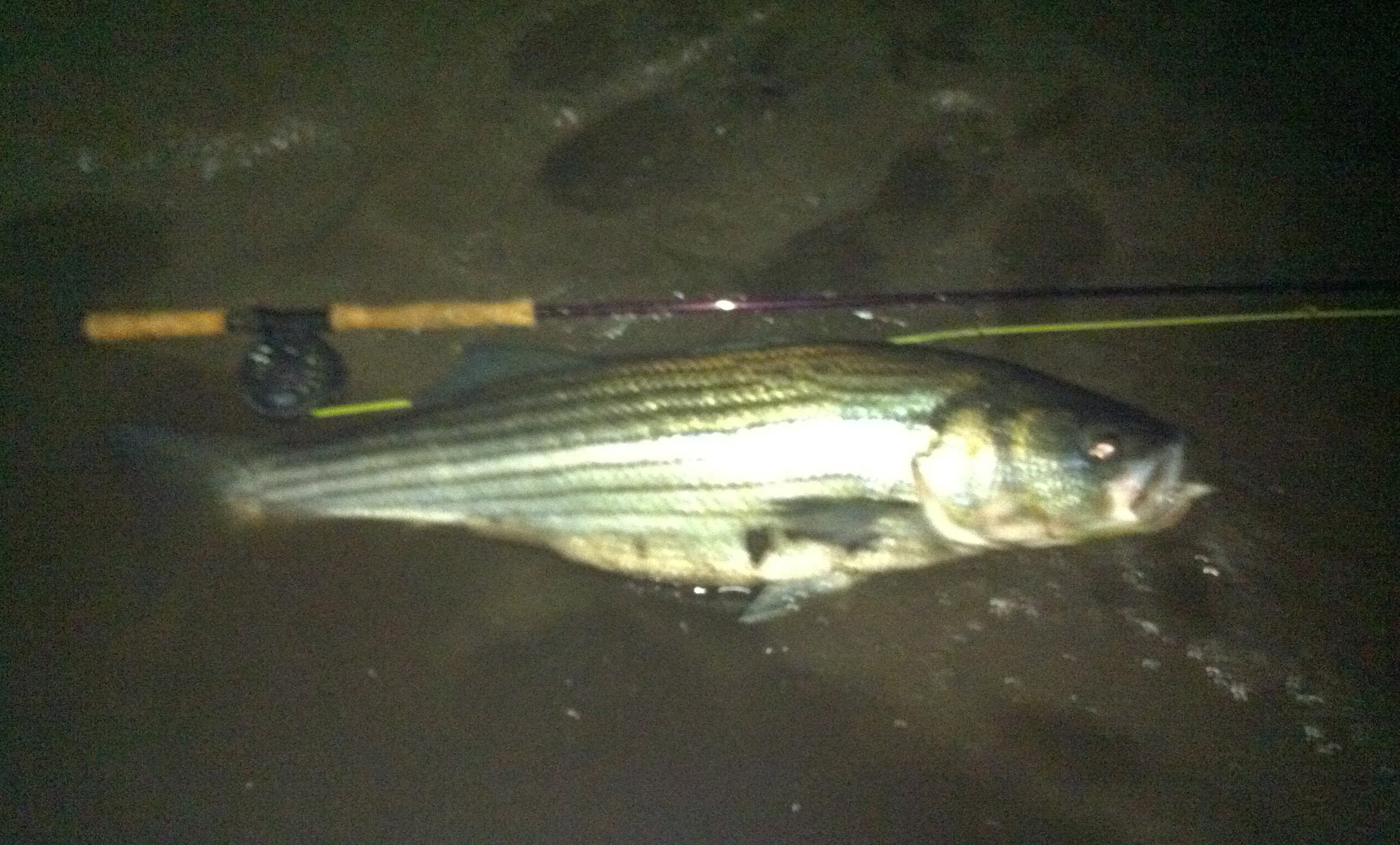
Miss Piggy. A thousand apologies for the sub-par photography. This is what happens when you forget your good camera and are reduced to using an iPhone wrapped in a ziploc baggie. But, you can get a good sense of the sheer mass of the fish. The bottom guide is 34″ from the butt, and her tail extends farther than you can see. Look at that belly full of herring.

Image


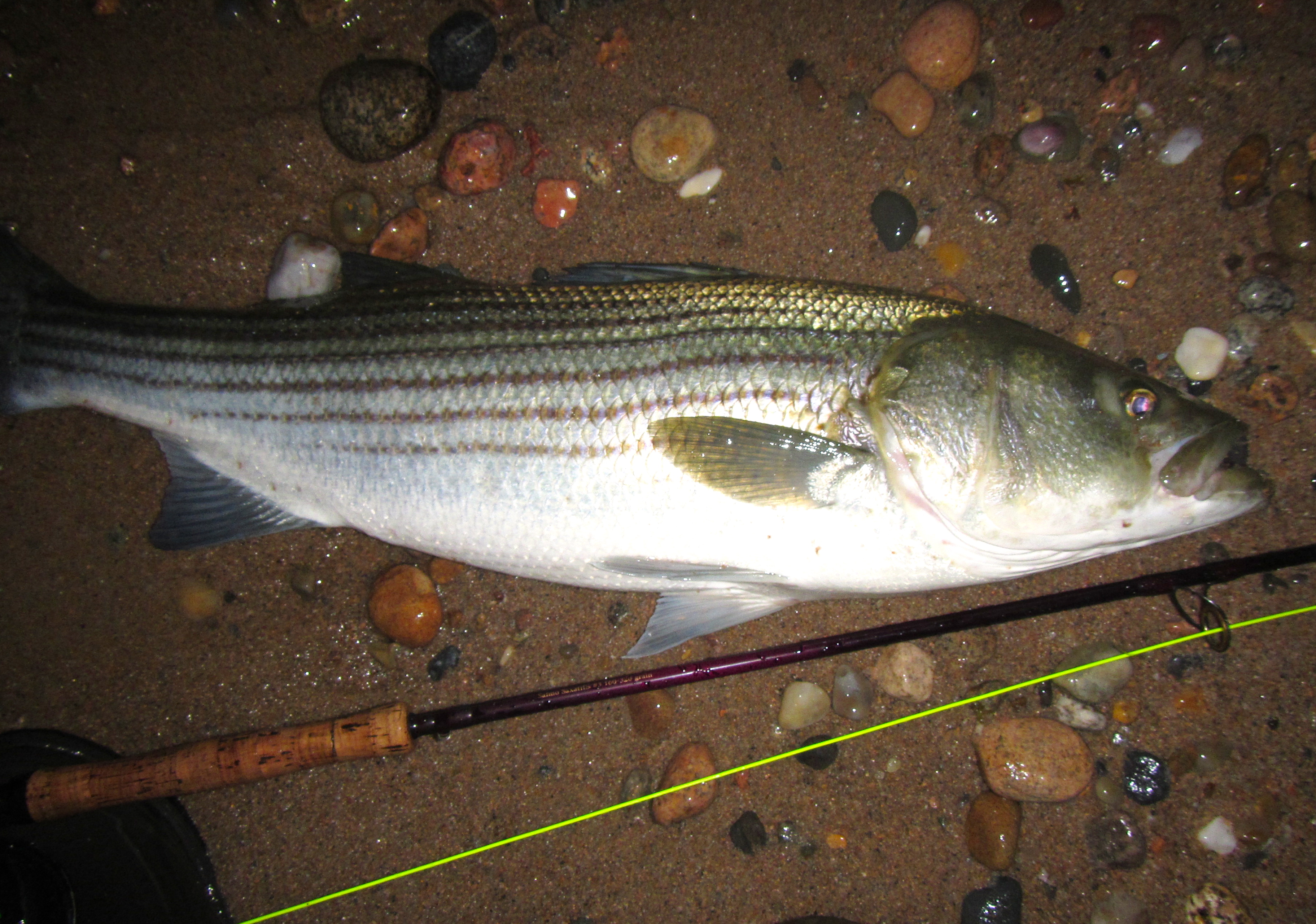
A better shot in terms of detail, but you don’t get the full length effect.

Image


The winning fly. An old Razzle Dazzle, missing two saddles and a fair amount of bucktail. Here we make the case for sparse and impressionistic. This fly is now retired. I may put it out to stud.

Image


A shrimping I did go

It’s hard to improve on Ecclesiastes — let alone the Byrds — so I won’t even make the attempt. To every thing there is a season. And this is time of year I like to fish for stripers who are feeding on grass shrimp.

The grass shrimp swarm to the surface in brackish waters by the tens of thousands. Diminutive (about an inch, inch-and-a-half long) translucent creatures with eyes that reflect ambient light. From a distance, their mating dance looks like so many tiny raindrops. Then the surface boils from below, followed by a resounding pop! I get goose bumps just thinking about it.

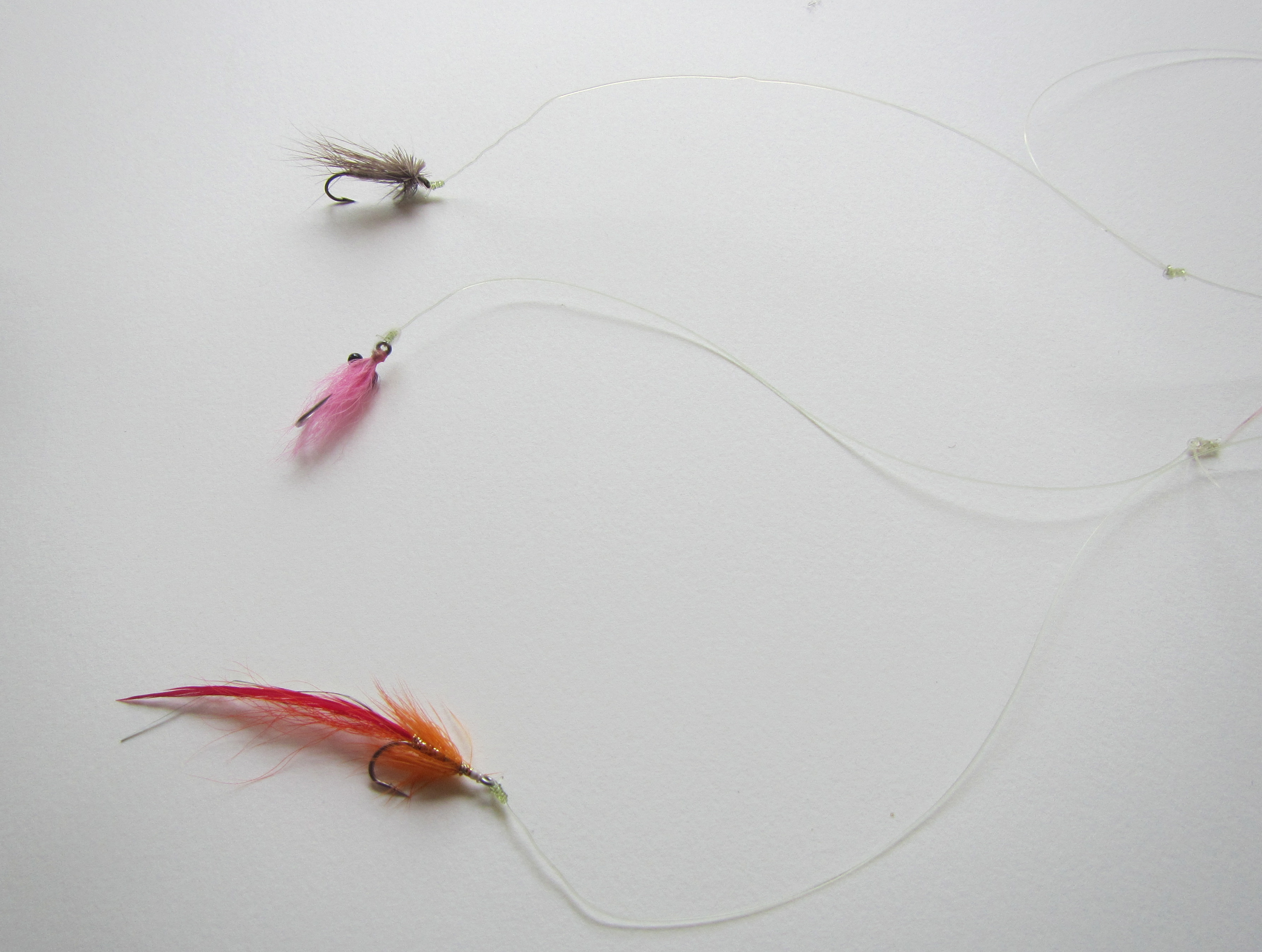
Because there’s so much bait in the water, I like to up my odds by fishing a team of flies. Not only will I be presenting the bass with more targets, I will also be giving them a choice of patterns. Stripers never lie. They always tell you what they do — or don’t like. This weekend, I fished a three fly team consisting of Grease Liner variant on the top dropper, a pink Crazy Charlie on the middle dropper, and an Orange Ruthless clam worm on point. Of course, I am using a floating line should I need to throw a series of mends to fish the flies on a cross-stream dead drift.

Shrimp. It’s what’s for dinner. This fly is a variant of Harry Lemire’s classic steelhead fly, the Grease Liner. A little rabbit fur, a little deer hair, and you’re fooling fish.

Image

I made two trips this weekend under the cover of darkness. The tides were in that weak quarter moon netherworld, but what the place lacked in current, it made up for in splendid isolation. Not another soul in sight, both nights. It amazes me the things you notice when you’re sitting alone on a rock in the dark and the air is completely still. You see the reflections of an airplane’s lights in the water long before you hear the distant drone of its engine. The sound of the building tide seems to increase exponentially. And the reports of feeding bass travel quite well over water.

Friday night was the slower of the two; instead of bass, I hooked and landed several hickory shad. After an hour, I moved upstream to see if creatures were stirring at a bottleneck; they were, but out of casting range. Resigned to trespassing, I did so with the rationale that what goes unseen remains harmless. I can’t tell you exactly where  I was fishing, but let’s just say that between structure and trees, any form of traditional casting was out of the question. I could, however, dangle my flies in the current a rod’s length away. You can get really close to a fish that is holding on station, feeding as the current brings food to his waiting mouth, as long as you exercise caution and keep movement to a minimum. Twice, I hooked the striper that was chowing down ten feet away from me. Twice, I was unable to set the hook.

As I drove home in the wee hours, I was already plotting my return.

Saturday night, the tide hadn’t quite topped out when I reached the spot. I was pleasantly surprised to see the place was empty. The shrimp were already doing their dance, but otherwise it was quiet. Once the tide turned, the game was afoot. I saw a delicate swirl forty feet out. A few casts and a mended swing were ignored. Then, off in the distance, I began to hear the pops of feeding bass. Since the fish were in spinning rod range, I switched tactics and started dumping fly line into the current, all they way to the backing, and then some. Let the flies come tight, plane up, and swing around. Whap! Fish on. I could tell from the way it was fighting that it was another shad, until I brought it into the murky shallows and saw it was a foot-long striper. That made me happy.

I caught a bunch more in the 12 to 16-inch range, most on the dangle and swing, a few while stripping the whole smash back in. It wasn’t easy fishing; far more presentations were refused than taken, which is the way it should be when you’re fishing the grass shrimp hatch. But, now I had to return to the scene of Friday night’s robbery. By the time I got there, the current was just beginning to crawl toward the Sound. I lit a new cigar to keep the mosquitos at bay. I waited. Nothing. No micro swirls or dots painted on the surface by the bait. No earth-shattering pops. I decided to get my flies in the water anyway. You know, just in case.

Finally, a pop, though it was well out of casting range. To combat the boredom — and to create some wakes on the surface — I began manipulating the rod upstream and side-to-side. Still, nothing. And then, with the flies just sitting there, a building pressure on the line, then a series of sharp tugs. Seemingly out of nowhere, I was on. Bass for sure. Yes. Eighteen inches, the king of the weekend’s haul, taken on the clam worm.

By the time I got back to the truck, I still had enough cigar to keep me busy all the way home. But I decided to extinguish it. I kept the windows rolled down, and the air on this warm summer night tasted sweet as it coursed through my mouth and filled my lungs.

Droppers are the fastest way to find out what the fish want. I tied this one using 20 pound test World Wide Sportsman Camo mono.  I learned a few things on this trip. Top to bottom: 1) Harry Lemire’s Grease Liner is a darn good striper fly, even if it was created for steelhead. 2) Charlie Smith’s Crazy Charlie is a darn good northeast grass shrimp imitation, even if it was intended for bonefish in the Bahamas. 3) It is almost never a bad idea to include Ken Abrames’ Orange Ruthless clam worm fly on your team of flies, even if clam worms aren’t the predominant bait.

Image


A few minutes with Ken Abrames (a currentseams exclusive)

The striper grandmaster talks about Tuesday Nights, the rhythms of earth and ocean, and love.

Ken Abrames is one of the most revered names in saltwater fly fishing. He is the creator of the modern flatwing streamer, presentation-style flies that can imitate everything from clamworms to menhaden. His books Striper Moon and A Perfect Fish belong on the shelves of anyone who is an aficionado of traditional New England striped bass fly tying and fishing methods. Besides being a world-class angler, Ken is also a rod designer, author, poet, and artist.

For me, though, the coolest thing about Ken isn’t that he’s supremely talented on so many levels, or his mystical insights into the natural order. It’s that you can go to Rhode Island on Tuesday nights and meet him. Talk to him. And fish. There’s no club, no membership dues, no fee, no appointment. You just check out the forum on his website to see where the group is meeting, show up and have fun. Tuesday Nights in 2014 start next week, April 22, in Matunuck, on the beach to the west of Carpenter’s Bar.

When Ken talks, you tend to listen. Tuesday Night, Quonny Breachway, September 2012.

Image

Currentseams: How long have you been doing Tuesday Nights?

Ken: Since 1984.


Currentseams: What made you decide to start them?

Ken: Around that time, I met a fellow named Armand Courchaine, and we started to fish together. We got the idea of starting Rhody Flyrodders back up again. Bang! The club started to grow – in less than a year we had over 100 members. One Saturday, I put together a fishing gathering in Newport. A bunch of people came, but I wasn’t satisfied. I began to ponder and imagine, what night of the week is most available to most people? I came up with Tuesday, because it’s a good, neutral night.


Currentseams: What was the fishing like in those days?

Ken: From the time I was a boy, to around 1984, shore fishing in Rhode Island had really fallen into a sad state. People didn’t know the places anymore. Very few people were walking the beaches. There were a lot of famous spots in Rhode Island that people didn’t know how to get to. But I knew the places, so Tuesday Night was a way to show people where to fish, and how to fish them, so they would have the wherewithal to go out on their own. Rights-of-ways had fallen into disrepair, and some of them had been encroached upon by landowners. So I had people going around and cleaning up these right-of-ways. And they weren’t just fishermen. All kinds of folks came. Everything we did was like seed to enhance access and fishing. People warmed right up to it.


Currentseams: People who don’t know about Tuesday Nights often ask, “Can anyone come?” And of course, the answer is yes.

Ken: Yeah, there is no membership, and there is no hierarchy.


Currentseams: And people want to know if it costs anything, and the answer is no.

Ken: No, of course not. Fact is, you probably end up going home with more than you came with.


Currentseams: How do you decide where to go?

Ken: I close my eyes…and feel. I don’t use any kind of science. Always go to inner silence when you need an answer. Then you’ll know.


Currentseams: What are your thoughts on the weather we’ve had this winter? It’s been pretty cold…

Ken: When I was a boy I used to always go ice skating on Thanksgiving. So tell me about how cold it is. Things have changed. I see different birds up here now that I never used to see.


Currentseams: Do you think things will be late this year?

Ken: When was the moon in relation to the equinox?


Currentseams: New moon is Sunday, March 30th.

Ken: It’s kind of like the first flower of spring. The first flower of spring comes before the second flower. That’s the order. So the first thing that shows up will tell you what the order of the year will be.


Currentseams: I keep track of things in my garden…

Ken: Yes, that’s right, that’s exactly what you were supposed to say. Is the skunk cabbage out yet?


Currentseams: Not here. I looked at my records, and in 2011 I had crocuses blooming on March 5. I don’t have any flowers yet (March 28).

Ken: So, there’s your answer. Everything happens in order. The ocean is the same as the land. So, you look for the first thing that shows up. And that will tell you what the second thing is going to be. You have to feel. It’s like dancing with a beautiful woman. You can’t do it out of the pages of a book. You have to just hold her, and move with the music. It’s the same thing with this world. It’s alive, and it has a pulse, and a rhythm, and an order. But it doesn’t tell you what those are ahead of time, because reason has no power over the earth. None.


Currentseams: So now, in 2014, what would you say Tuesday Night is all about?

Ken: It’s all about love. It’s that simple.


Currentseams: (laughs)

Ken: I love the earth, I love fishing, I love the people who come fishing. And that’s what they get when they come.

No. Not yet.

Just when Mother Nature gives you permission to believe the stripers might be there (peepers for several days now, first daffodil showing some yellow, temperatures actually in the low 60s) she slams the door with cruel finality. I mean, mean-like. See ya, sucker.

You know it’s bad when the all the spin guys leave before you do.

Here’s what I can tell you: bright, sunny day. Water with good visibility, albeit still well below normal (ten lashes for me for forgetting my thermometer) temperature. Wind honking in my face at 15 mph (with gusts up to 20) that made casting a large diameter floating line difficult. Not a touch for me or any of the other four guys who wisely packed it in before I did.

Everything is late this spring, and the stripers are no exception. April 10 is the farthest I’ve gone into April without a bass. But, there’s good news.  It’s got to start sometime.

It’s like the birds are saying, “Follow the arrows to find the stripers.” If it were only that easy.

Image


Stripers-by-numbers

2: Number of cigars I smoked, a Gispert Churchill on the drive down to Rhode Island, and an H. Upmann 2000 Reserve corona gorda on the way back to Connecticut.

5 and 9: The weight rod and line I used. Perfect for the tight confines of the first spot we fished. I could load the rod with a minimum of line, and shoot the rest with a flick of the wrist.

7 and 9. The weight rod and line Jon used.

1: Number of stripers we caught in the first spot (Jon was the successful angler).

4,957: Number of weeds I hooked in the first spot. At least it seemed like that many. I was fishing a greased line swing, then a dangle, and I could feel the tick the moment the weed hit the fly.

1: Number of stripers we saw in the second spot. Jon noticed a wrinkle on the surface in the moonlight. As we worked our way along the bank, I felt a quick little bap! And then he was gone. Other than seeing a few silversides and a juvenile fluke, the place was as dead as Julius Caesar.

86: My heart rate when we got to our last stop and saw a couple fish feeding out in the current.

10: As we were already well past our cutoff of 11pm, our agreed-upon time limit, in minutes, to catch a striper.

1: Number of bass we caught. (My turn.)

2: Happy anglers who made the drive home to Connecticut.

Block Island Diary 2013: Hey! I Remember You. (Kindof.)

If you’ve followed my previous Block Island Diaries, you know that the last two years of fly fishing from the shore have been – ahem – underwhelming. Used to be, a good night on the Block was a dozen stripers. An off night, two or three, with an odd visit from the skunk tossed in to keep you honest. But in 2011, I took only six bass in seven nights. Last year, a measly four bass. Buoyed by a strong 2012 fall run in Rhode Island and an equally impressive 2013 spring migration here in Connecticut, I ventured once again to the magical land of the Manisses.

Saturday: Red Right Return

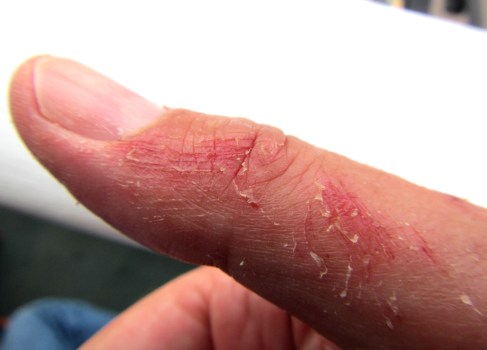
There’s a reason Luke Skywalker doesn’t blow up the Death Star at the beginning of Star Wars. Unfortunately, you don’t have the luxury of manufactured drama in non-fiction. You get what the fates throw at you. And what I got tonight was a good old-fashioned summer blockbuster climax. It was so humid it felt like you could grab handfuls of air. Low clouds and fog banks whipped past, accentuating an already mysterious setting. Five casts in, and I had my first bass of the trip, a porcine twenty-one-incher that went immediately on the reel. Twenty minutes later, I’d already caught more stripers here than I did all last year. Halleluiah! These bass were gathered for one purpose: to eat with extreme prejudice. Sand eels were the entree, and I could hear them plink-ploinking through the water as I waded. There were stripers everywhere, and they attacked my fly, a Big Eelie in a Crazy Menhaden color scheme, with undisciplined fury. Missed strikes were frequently followed by punishing returns. Without a sealed drag, the moisture in the air and an occasional dip in the water reduced my reel to a shadow of its locked-down-tight self. Once hooked, the bass were off to the races, and I did my best to palm the reel. My knuckles took a beating as the handle repeatedly whacked them, but it was a good hurt, and I laughed at my clumsiness. The commotion I created sent several spin and fly anglers scurrying over to join the fray. By some perverse twist they all caught few or no fish. Some muttered as they left, and others departed with a palpably grim silence. Twice I told myself I would give the spot a rest and seek my pleasures elsewhere. Twice a fifteen-pound fish talked me out of it. The action slowed only when Mr. Boating Dipstick 2013 set a course for the wrong side of the channel marker – despite his blazing, brilliant spotlight – and momentarily hit the sandbar. But that was the only wrinkle in an otherwise flawless night. When it was over, my thumb looked like a pound of ground chuck under cellophane. My fly had been surgically reduced to a couple hackles and some forlorn strands of bucktail. Even when I tried to stop fishing, I couldn’t. I caught a legal fish just reeling in my line. One of the stalwart souls still on the beach called out to me. “Are you leaving?” Yep, I’ve had enough. “How many did you get?” I don’t really know. I stopped counting after fifteen. “You had some big fish there.” At least a half dozen in the 15-pound range. “Can I see what fly you were using?” Absolutely. “Wow. That’s it? It doesn’t even have eyes” Nope. Here, take this fly, and this one too. Color doesn’t matter. Good luck to you! Then I began the long walk back to the truck. As I trudged through the sand, I switched on my headlamp, and basked in the warm red glow of an absolutely righteous return.

Any night filled with ten to fifteen pound stripers doesn’t suck. I know, I know, it’s not the most fish-friendly photo. If it makes anyone feel better, I lipped the rest.

Image

That’s gonna leave a mark. The price of admission for a dozens-of-bass outing. 
Image

Sunday: The five most feared words in fly fishing

My friend Bill arrived on the Island today, and I’ve been regaling him with tales of gluttonous bass, buckets of bait and thumb-wrecking action. Word travels fast about a good bite, and the parking lot is mobbed. The weather and the wind are a carbon copy of last night. All we have to do is wait for dark and a little more of that flood tide. Unfortunately, there are more anglers than bait. Or stripers. Plenty of skates, though, in thick and beaching themselves, wings flailing away, frantically slapping against the sand. The wind picks up in intensity, and brings with it brief tropical downpours. I can see a light grey band in the skies over Block Island sound, then a foreboding line of India inkiness over the mainland. In the end, the bite never materialized. I managed a single bass by moving around and fan casting with a black, blue, and purple Big Eelie I call the Bruiser. I couldn’t blame Bill when he bailed after the second squall came through. As he walked off I called out to him, “You shoulda been here yesterday!”

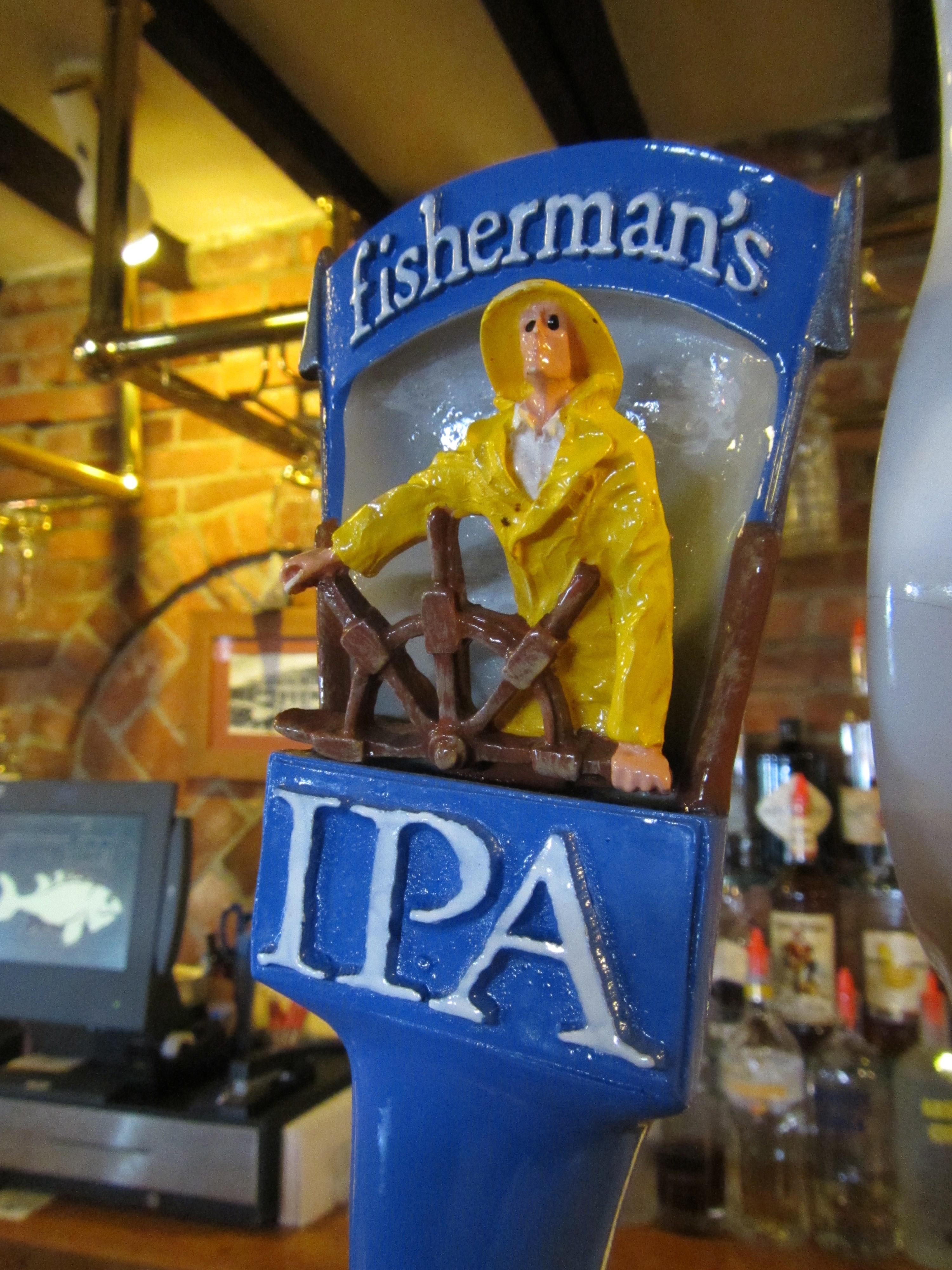
Until someone brews up Silver Stoat Stout, Todd’s Norway Ale, or Flyrodder Lager, I’m still the only dude in my crew with his own label. (“The Fisherman” is my internet forum nom de voyage.)

Image

Monday: Gettin’ jiggy wid it

The wind is banshee bitch, even more so than the previous two outings. The fishing’s about the same as last night, possibly a degree less of suckiness: three fluke in about 90 minutes of fan casting over an expansive flat. Einstein’s definition of insanity being what it is, I decided to go for a wade along some shallows that border rocky structure. I spooked a fluke, then saw some suspicious upheaval on the surface about 50 feet away. I climbed up onto a rock to investigate. Three casts and two bass later, I had my answer. The fish were standard-issue Block Island mid-twenties schoolies, which is to say that they were rotund, powerful swimmers that went on the reel. Not much else going on, and I was in bed by 2am. While I was sleeping, Ravi, who works at the Block Island Fishworks, was jigging for squid in New Harbor. At 3:30am, he hooked a squid, which moments later was swallowed by a 31-pound cow. He said her stomach was full of calamari, from 2” to over a foot long. Now, which box do I keep those Banana Squid flies in?

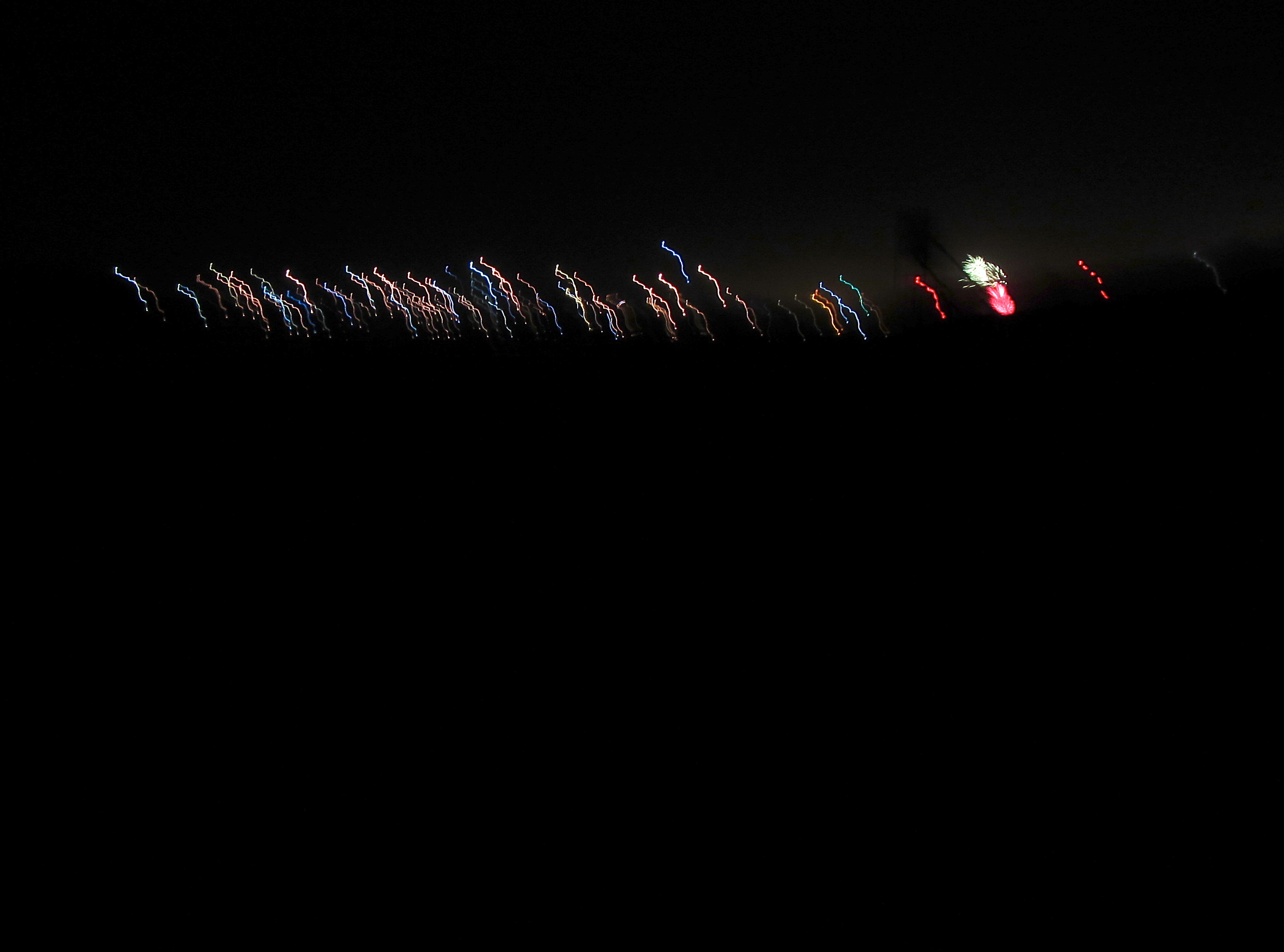
When the fishing’s slow, you look for ways to amuse yourself. Here’s my attempt at an abstract: a long exposure of boat masts swaying in the wind, accentuated by a rogue fireworks shell burst.

Image

Tuesday: A very deep trough

Nothing. I fished the snot out this Island tonight, and nothing. Nothing at the Saturday night heroics spot. Nothing at my favorite jetty. Nothing at Charlestown Beach. (Not that five minutes of beleaguered casting in hellacious 20mph crosswinds counts for much.) Bill came back out tonight, and I talked him into trying a spot on the west side I’d never fished before. We were sheltered from the wind by a kindly bluff, but it’s generally a bad idea to wade out into unknown waters at night, even if you scouted them from the shore in the daylight hours. Bill gave it 15 minutes, but he just wasn’t feeling it, and after he left I got the standing-in-the-ocean-at-night-by-myself-catching-nothing blues. The visibility was so poor that I couldn’t even make out the horizon. All it took was one good gut-high wave to knock me off the rock I was standing on. Off to more clement waters, where, of course, I caught nothing. There was the mystery of the glow-in-the dark shooting basket to keep me entertained, though. I noticed that at odd intervals, the inside of my basket would glow a dull red. It was a puzzlement until I realized it coincided exactly with each draw I took on my cigar.

Yup. That about sums it up.

Image

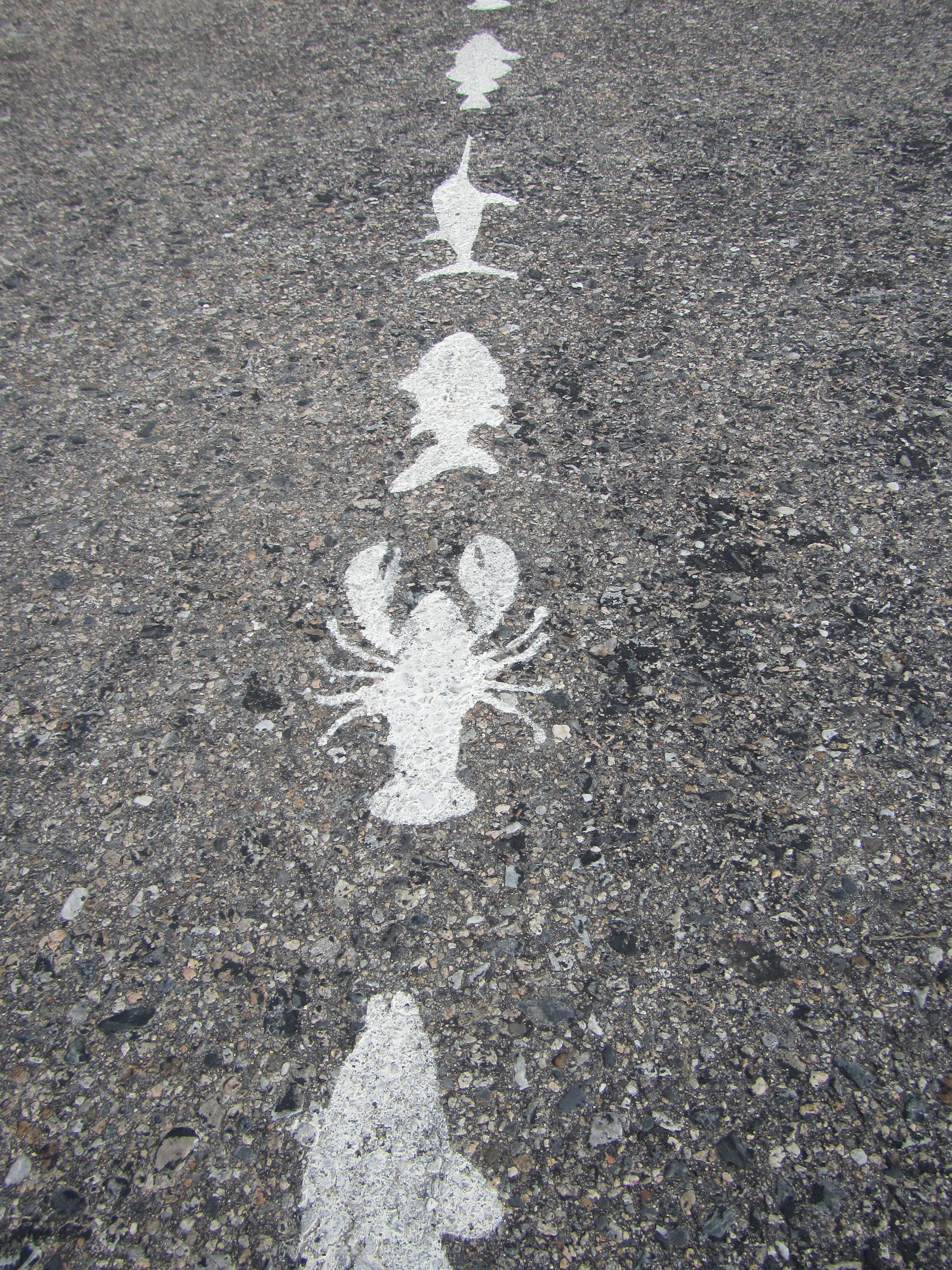
Follow the fish. If only finding stripers was this easy.

Image

Wednesday: The natural

Tonight I’m taking my 10 year-old out with me. Last year was Cam’s first time night fishing for stripers, and although we didn’t catch any bass, he aced the outing. Whether it’s because I’m with my new fishing buddy or I’m attuned to some angling sixth-sense, I feel like we’re going to see some saxitillus tonight. Cam is fishing a 4” jig-head Sluggo, and lands a fluke in short order. We move to a different spot where Dad hooks a bass. It’s a standard-issue schoolie, but Cam is more than happy to land it on the fly rod in the misty twilight. Our last stop is the jetty. We experience our first double, although it is curiously strange that we have both hooked skates, Cam’s from the bottom and mine on the surface. We go out in a blaze of glory when I tie into a keeper bass about 70 feet away. I set the hook, and hand the rod over to Cam, who’s never fought a striper that large before, let alone on a fly rod. I take a quick picture, then clamor down the weed-covered rocks, telling Cam to let the fish run when it wants, reel it in when he doesn’t, and take his time until I can get down into the water. I’m standing at the bottom of the jetty, about to tell Cam to start getting the fish in, when I see a splash at my feet. Cam’s already beaten the striper, and there it is, waiting to be lipped. I got goose bumps when I realized that he’d landed his first keeper bass a lot quicker than his old man did.

A portrait of the artist as a young man, focusing on the job at hand and doing his father proud.

Image

Thursday: Fireworks cancelled due to fog

And the bass followed suit. At least for me they did. We all put our waders on one leg at a time, and tonight I’m living proof. Everything that could go wrong did. Everyone caught a striper but me. It’s not much fun when you’re going through it. At least afterward you have the comfort of humorous remembrance. Things started poorly when I drove a spot on the east side that was on lockdown – and they were catching fish. No room at the inn, so I drove to the west side where my line repeatedly insisted on wrapping itself around my rod. Literally sprinted a hundred yards down the beach after an angler reported blitzing fish on a sand bar – and found nothing. To make matters worse, I was wearing my stubborn hat tonight. I stayed out way too late. At least the birds weren’t singing by the time I drifted off into the fog of sleep.

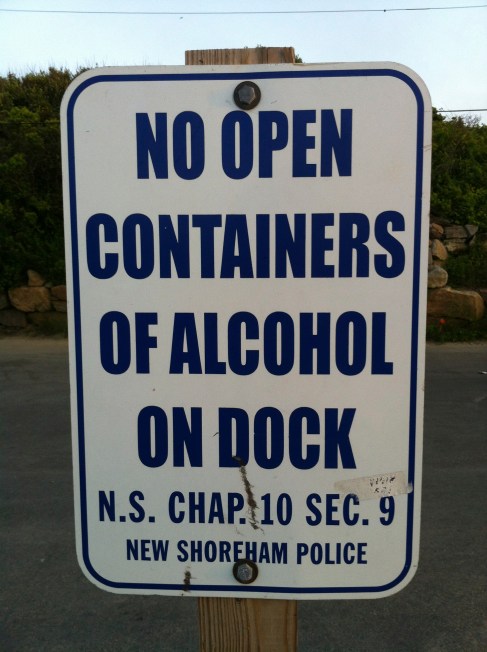
Fortunately, there’s nothing in Chapter 10, Section 9 about carrying a cold one out on a jetty.
Image

Friday: Right where he’s supposed to be

It’s good practice for any serious striper angler to know a spot – and know it cold. I’ve fished the Island long enough now to have a certain level of competency. I have a mental index of where to fish at what tide, wind direction, moon, etc. Tonight I had my heart set on catching a striper at X. There were a few problems with my plan. X is generally a two-hours-either-side-of-the-flood spot. Tonight was fireworks night with the family. That would put me there well into the third hour of the dropping tide. The best I could do would be to have the truck pre-loaded so I could make tracks even as the finale’s last boom! was echoing across the hills. There was enough bait in the water to keep me hopeful, even after a fruitless fifteen minutes of casting. Then, bump! Missed him. Mortal depression. This being such a mercurial week, that might be my only touch of the night. But somewhere out there, in the rapidly fading twilight, I could hear the mischief of a bass feeding. I couldn’t quite place him; there was enough wind chop to make sighting the rise rings impossible. Bump! He hit it again. I let the fly sit there. Gave it a short strip. Bump! What gives? Must be a small fish. Another strip. Whack! Got him now, a silvery ten-pound striper that was the perfect fish in a perfect place at a perfect time. As I’ve gotten older, I’ve tried to embrace the concept of, “I don’t need to be right.” But oh my goodness, sometimes it feels so damn good when I am.

A perfect fish. Just what I needed to close out the week. As tradition dictates, taken on a Big Eelie in the original colors.

Image