Farmington River Report 6/10/20: Verrry interesting…but not funny

Just when you think you’ve got it all figured out, the game changes. Nature’ll do that to you. Yesterday was a perfect example.

We had a warm, humid day with stable flow conditions. The late afternoon/early evening  sulphur hatch was a shell of its Monday self — I’d give this one a 3/10 at best. Very few caddis, thousands of super small midges, and I saw one lonely Iso. Correspondingly, the wet fly action was slower. I landed only a half dozen trout on wets from 5:15pm-7:30pm, although I did have one hot stretch during a micro flurry where I scored trout on three consecutive casts. (Biggest fish, a hefty rainbow, came on the Magic Fly.) And there was the strange trout behavior: I had two incidences where the trout struck at the wet, but failed to grab it. This rarely happens when I fish the subsurface wet during the sulphur hatch. Certainly the feeding activity just wasn’t at the same level as Monday. Yet, that is.

Sidebar: I was also hampered by the fact that I couldn’t move around freely to prospect some prime feeding lanes. Crowding continues to be an issue on the Farmington. (I plan on addressing this problem in a future post.)

One sulphur pattern remained stable: the 7:00pm-7:30pm doldrum. Things picked up as the hour hand moved north, and around 8:00pm the switch was thrown. This hatch was easily a 9/10, with the air and water surface cluttered with size 16 yellow duns. By now I’d switched to dry fly, but I messed up. The hatch was so intense that the trout were gorging on the bugs with the same ferocity as shoppers racing for the hot new toy at Walmart on Black Friday. Usually, the transaction is a more patient process; the Magic Fly or the Usual serve the angler well when the sulphur emerger or cripple is the food. I missed ten minutes of trout dry fly fantasy camp before I realized they wanted the fly high and dry. Once I switched to Catskills Light Cahills, it was a trout on every cast.

Anglers of a certain age will reflect upon the title with a smile. At the time, I didn’t see the humor in the trout ignoring so many perfect presentations. But since I’m willing to learn, the joke ended up on them.

For years, I’ve been using classic Catskills dries like the Light Cahill with great success. I carry them in sizes 10-18. My SOP is fairly consistent: match the hatch size, then move to increasingly larger as the light begins to fade. This makes it easier for me to track the fly, and as the darkness grows the trout become less concerned with size matching. What’s more, if the menu changes to spinners, Catskills dries continue to be effective. Here’s a great tying tutorial from my friend Tim Flagler.

OLYMPUS DIGITAL CAMERA

Farmington River Report 6/8/20: Our Lady of Blessed Magic Fly, or: spectacular sulphur wet and dry fly action

I fished last night from 5:45pm until 9:15pm, well past when I could no longer see my fly. I started out swinging and dead-drifting wets, sometimes prospecting, but mostly casting to active feeders. I had to work for my fish, but that was OK since some of them were larger wild browns. My rig was a size 12 Squirrel and Ginger top dropper, size 14 Partridge and Light Cahill middle dropper, and Light Cahill winged wet on point. All three patterns took fish. Hatch activity was a 7/10: caddis, sulphurs, Light Cahills, mobs of midges, and a few stray Isos. Around 7pm I switched out the winged Light Cahill for a size 14 Magic Fly after I saw a batch of larger sulphurs hatching. The fish opened their mouths in approval.

You can’t tell from the photo, but this is a high teens wild brown, taken on the Squirrel and Ginger. He was feeding in a narrow slot about a foot deep. The presentation was an oblique angle upstream cast, then dead drift. WHACK! (Editorial: I’m proud to say that on this website there are no photos of trout being thrust into camera lenses, angler arms fully extended. I know my readers are far too intelligent and sophisticated to put up with such shenanigans.)

OLYMPUS DIGITAL CAMERA

~

All the while, I was vastly outfishing the anglers around me. I mention this not as a brag point, but rather as a teaching point. Properly presented wet flies have been, and will continue to be, the best way to fool trout during the early stages of a sulphur hatch. Every other angler was fishing dry, which can work, provided you’ve got the right pattern and presentation. But when trout are on sulphur emergers, I’ll go with a team of wets every time.

However, there comes a time during every hatch where the trout begin want the topwater fly rather than the subsurface wet. So at 7:30pm I switched to surface presentations, mostly the Magic Fly (dusted with silica powder), a few drifts with creamy-colored The Usual, and finishing off with Catskills Light Cahills. Classic spectacular dry fly action: I took trout after trout until darkness enveloped me. By then I was gloriously alone. Well, not really. Just me, the trout, and about a million bugs.

Life is good with a cane rod on a sunny June evening on the Farmy. I thought it both poetic and proper that my first surface Magic Fly trout this year was a chunky mid-teens wild brown.

Ladies and Gentlemen, start your engines: Steve Culton is guiding again

Effective June 15, I will be resuming my fly fishing guiding/teaching services. I know many of you have been waiting for this announcement — I thank you for your patience. If you’re interested in a guide trip/lesson, please read the following carefully:

I will be doing half-day (four hours) sessions ONLY. This is to limit exposure for all parties involved.

I know, I know, we’re going to be outside. But you must wear a mask or a buff/gaiter that covers both your mouth and nose. No exceptions. I will be wearing one, too. The goal is to be respectful of one another’s health. And please, if you’re not feeling well, don’t come out. We’ll re-book at no penalty to you.

Take Captain Mark’s lead (but be sure to cover your nose). Hey, if we run into one of those hot, humid days we can pretend we’re somewhere in the Everglades. Minus those horrific mosquitoes.

OLYMPUS DIGITAL CAMERA

My availability will be limited. While there are seven days in a week, I’m not looking to fill all of those days. Weekdays are better than weekends. I have many personal and family commitments this summer — and as you know, I like to fish too.

As always, my focus is on teaching. You can read more about that and find my rate card here. To book a trip, please email me at swculton@yahoo.com or call 860-918-0228. If I don’t answer, leave a message and I’ll get back to you.

I’m looking forward to teaching you and helping you become a better angler.

You too can become a dangerous wet fly machine like Greg.

OLYMPUS DIGITAL CAMERA


Small Stream Report 6/4/20: the natives aren’t restless

I spent a good part of yesterday afternoon knocking on the doors of two favorite brooks. Conditions were similar on both thin blue lines: low water, clear water (thankfully still cold) and bright mid-day sunshine that kept the bite off. Still, a dozen-plus were pricked and a handful landed. All the bite activity came in the deeper plunges, runs, and cutbanks. Given the low water, I decided a downstream approach was best.  (For more on small stream approaches, please read my article “Upstream, Downstream, Small Stream.”)

Bugs were bountiful. One of these streams sees a good number of yellow sallies this time of year, so I fished a size 16 Partridge and Yellow dropped off my bushy dry. It definitely got the attention of the char. Also seen: caddis, midges all sizes, sulphurs, and a few large spinners (March Browns?). 

OLYMPUS DIGITAL CAMERA

~

I love how nature makes something out of nothing. No soil? No problem. We’ll just make a fertile bed on this boulder out of leaf compost and moss and lichens and let the ferns do their thing.

OLYMPUS DIGITAL CAMERA

~

It was no surprise that the best char of the day came from one of the deeper pools, and took a subsurface fly, in this case a black micro-bugger. Given the size of the brook, this buck could be considered a giant.

OLYMPUS DIGITAL CAMERA

A good drowned hopper: The Hopper Hammerdown wet fly

Sometimes grasshoppers forget that they can’t swim. These would-be Weissmullers end up in rivers — and trout readily eat them. While I love fishing high floating foam-bodied hoppers or big bushy Stimulators, not all hoppers get eaten moments after they take a dip. Some get stomped while they struggle in the film, and others become snacks after they drown and sink. That’s the meal ticket I’m punching with the wet fly Hopper Hammerdown, presented here by popular demand.

The Hopper Hammerdown is a soft-hackle. No, wait, it’s a winged wet. Ah, the heck with it — forget labels, and let’s just call it something that looks alive and good to eat. The inspiration for this pattern came from Dave Hall’s Golden Stone Hammerdown steelhead fly. The Hopper Hammerdown first appeared in the May/June 2014 American Angler (RIP) article “Match Game — Matching the  Hatch with Wet Flies.” And here it is.

The Hopper Hammerdown drowned hopper

Culton_Hopper_Hammerdown copy

Hook: 2x or 3x streamer hook, size 6-10
Abdomen/Sub-Thorax: Yellow or bright green fur dubbing
Rib: Small gold oval tinsel
Hackle: long, webby, brown
Wing: Natural deer hair spray
Over-Thorax: Natural deer hair pulled tight
Head: Natural deer hair finished caddis-style


“Block Island, RI: One of the Last Great Places” from Eastern Fly Fishing

You’ve got to go way back into the archives for this one: the May/June 2009 issue of Eastern Fly Fishing. Block Island, RI: One of the Last Great Places was written just as I was beginning to gain some publishing traction. You’ll have to settle for a low-res black and white version of the article, but the work stands on its own. It’s a quick primer on fishing the Block from shore, and it’s about all you’ll get out of me in terms of where-to. Thanks to John Kelsey for tying the Orange and Blue Squidazzle! PDF link is below.

BlockIslandEFF

This used to be an L&L Big Eelie. An epic night of big Block bass on sand eels reduced it to a shell of its former self. They were still eating it when I stopped fishing at dawn.

OLYMPUS DIGITAL CAMERA


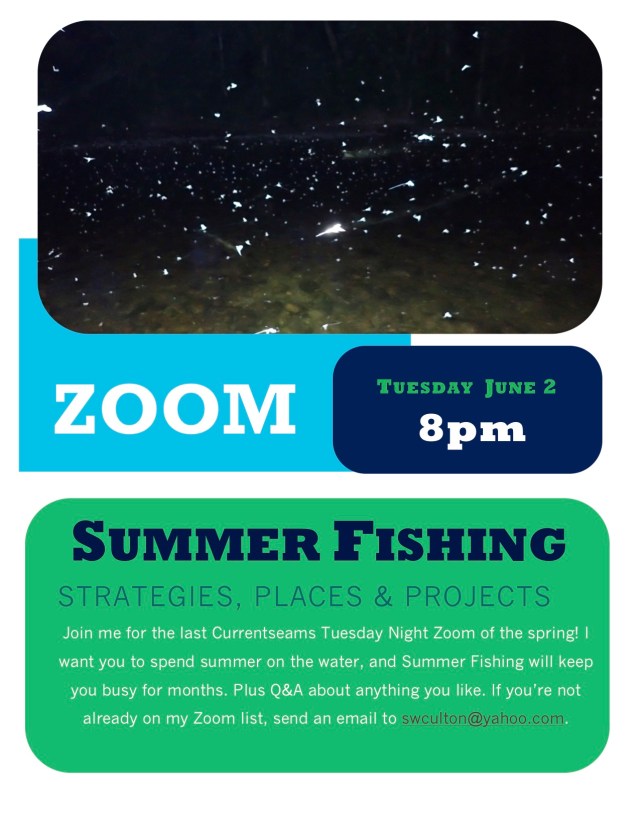
Final Tuesday Night Zoom of the Spring! “Summer Fishing,” June 2, 8pm

Please join me tomorrow night for the final Tuesday Night June of the spring. I’ve got all kinds of good stuff to talk about, so don’t miss it!

Summer_Fishing_Poster