Leisenring’s Favorite Twelve Wets: Gray Hackle

Some questions simply cannot be answered by mortal man: Why do fools fall in love? Should I stay or should I go? But I digress. Consider Leisenring’s Gray Hackle. Why would you specify “yellow or white creamy furnace hackle” and then name the fly…well, you can see where this is going. Maybe Big Jim’s stash of said hackle had a gray cast to it. Maybe it looked a certain way when wet. We may never know. But we do know that there’s a little magic in this design. See for yourself.

Gray Hackle

OLYMPUS DIGITAL CAMERA

~

Hook: Dry or wet fly, 12-14
Silk: Primrose yellow
Hackle: Yellow or white creamy furnace
Rib: Narrow gold tinsel
Body: Bronze peacock herl
~
Tying Notes: This hackle came from a bag of strung feathers I bought a long time ago for probably a couple bucks. I used two strands of herl to wind the body, and I used the technique of pressure from the thread in front of the herl to make a nice, compact wind (you can see that technique in Tim Flagler’s excellent Squirrel and Herl video.)

Leisenring’s Favorite Twelve Wets: Brown or Red Hackle

I can’t make up my mind whether this is a beetle or an attractor. Leisenring must have had some trouble deciding on the pattern as well. Brown hackle? Or red hackle? Ah, what the heck. While we’re pondering these delicious mysteries, let’s go with this: the Brown or Red Hackle looks like something that’s alive and good to eat.

Brown or Red Hackle

OLYMPUS DIGITAL CAMERA

~

Hook: Dry or wet fly, 12-14
Silk: Crimson or claret
Hackle: Red furnace
Rib: Narrow gold tinsel
Body: Bronze peacock herl
~
Tying Notes: I have a nice reddish brown Whiting wet fly hen neck. It’s more badger (feathers with a dark center, lighter toward the tips) than furnace (dark center, lighter middle, dark tips) but it’s close enough. I used two strands of herl to wind the body, and I used the technique of pressure from the thread in front of the herl to make a nice, compact wind (you can see that technique in Tim Flagler’s excellent Squirrel and Herl video.)
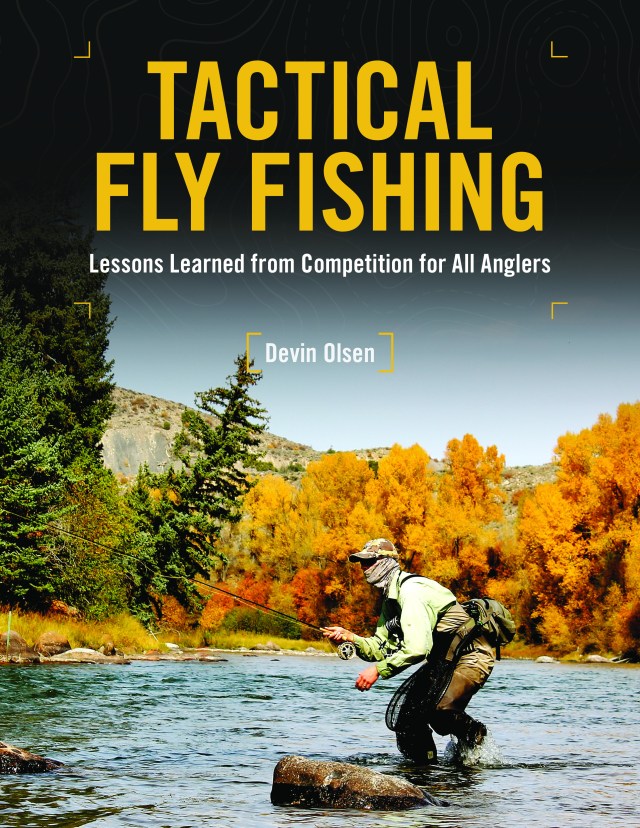
Book Review: “Tactical Fly Fishing” by Devin Olsen

To fully understand the genesis of Devin Olsen’s Tactical Fly Fishing, you need to include its subtitle: Lessons Learned from Competition for All Anglers. If you’re like me — someone who views competitions as a joy-of-fishing buzzkill — letting the C-word put you off would be a mistake. If you’re interested in becoming a better, more well-rounded angler, Tactical Fly Fishing is jam-packed with information you can use to catch more trout on your next outing.

Some of the best teachers I know take an “I’m not right, and I don’t know it all — I’m just showing you how I’d do it” approach to learning. Olsen nails this throughout the book. It’s particularly evident in the chapter, “Gear and Rigging.” He gives you an honest, broad overview, and leaves it to you to make equipment decisions.

Olsen divides river sections into water types: Pocketwater, Riffles, Runs, Pools, Glides, and Bankside Lies. He devotes a chapter to each, and this is where the book shines. He includes a few case studies, complete with photos, detailing how he approaches each water and situation. It’s almost like you’re tagging along for the lesson. With Olsen’s competition experience and success, you get the sense that there’s not a lot of water he hasn’t seen. Fish with confidence!

Regular readers of currentseams know that I don’t Euro-nymph, and given its competition roots, Euro-nymphing methodology plays an extensive role in this book. That doesn’t mean the information is irrelevant to us non-Euro nymphers — you just need to work through it as it applies to how you fish. Reading water is reading water, and since that’s such a huge part of catching, we all would do well to study the water type chapters. There’s also a short chapter on proven fly patterns; as a fly junkie I wish there were more (what, no soft hackles?).

Despite the Euro-nymphing emphasis, a consistent theme emerges throughout Tactical Fly Fishing: there is no one best way — and the best anglers take a fluid approach to the situations they are faced with and the methods they choose. In some stretches the book can get a little technical, but I’d rather have more information than not enough. (I first heard of Devin when I saw a picture of him weighing nymphs on a tiny scale. I remember thinking: this is a detail-oriented angler.) Olsen’s style is nonetheless conversational and easy-to-read. Tactical Fly Fishing is one of those references that I will be going back to on a regular basis.

It may seem like an easy gig — people send you books, you read them, then write about them — but it isn’t. You should know that I take this seriously, and if I didn’t like something, I’d tell you. So I’m telling you. This is a good one. All I ask of a how-to angling book is: teach me stuff I don’t know. Remind me of stuff I’ve forgotten. Don’t write like you’re trying to impress me with your knowledge of the thesaurus. Tactical Fly Fishing delivers. Tactical Fly Fishing — Lessons Learned from Competition for All Anglers by Devin Olsen, Stackpole Books, ISBN 978-0-8117-1982-7.

TacticalFlyFishing

Leisenring’s Favorite Twelve Wets: Light Snipe and Yellow

Inspired by classic North Country flies, James Leisenring developed an arsenal of reliable patterns to match the hatches of his beloved local streams. You can clearly see the Snipe Bloa and Poult Bloa influence in the Light Snipe and Yellow. Farmington River trout love this fly, a lesson that is repeated on cool June nights when Light Cahills or Sulphurs are emerging and the water surface is boiling.

Light Snipe and Yellow

OLYMPUS DIGITAL CAMERA

~

Hook: Dry or wet fly, 14
Silk: Primrose yellow
Hackle: Snipe undercovert
Rib: Fine gold wire
Body: Primrose yellow buttonhole twist
~
Tying Notes: Instead of working silk, Leisenring used buttonhole twist (the thread that’s used on the borders of buttonholes) for the body. You don’t need to do that — your favorite silk or thread will work. But if you’re shooting for authenticity and can’t find buttonhole twist, try DMC embroidery floss. It comes in a bazillion colors (this is #744). It’s multi stranded, so cut a length then separate a single strand for the body. No snipe? Try starling or woodcock undercovert. You can find a general North Country spider video tutorial here.

Bonus fly: Rat a Tat Big Eelie Variant

After tying the original large R.L.S. Rat a Tat flatwing, I couldn’t help but begin to imagine a translation into a Big Eelie. Those of you who are long time readers (and few of you who have stumbled across me on the beaches of Block Island and wondered, “What fly is that guy using?”) know that Ken Abrames’ Big Eelie is a Steve Culton summertime striper staple. (A little alliteration to jump start your post-lunch brain.) You also know I think it’s a profile and action fly, and that while colors may be irrelevant, I nonetheless love to play around with different combinations. I have to admit I’d never think of grouping these colors in a sand eel pattern. But I’ve got a hunch this is one is going to produce a big bass for me. And for you as well!

Rat a Tat Big Eelie

OLYMPUS DIGITAL CAMERA

Hook: Eagle Claw 253 3/0
Thread: Chartreuse 6/0
Platform: 30 hairs black bucktail
Tail: A yellow grizzly saddle, under 2 strands each of gold and red flash, under a chartreuse grizzly saddle, under a turquoise grizzly saddle, under a yellow grizzly saddle.
Body: Gold braid
Collar: 3-4 turns ginger marabou, tied in by the tip.
~

Tying notes: Sand eels are a slender bait, so make your saddles about the width of a pencil. You don’t want a flaring broom shape for the platform, so likewise make it slim, and take the bucktail from near the tip of the tail. All the saddles are tied in flat. The marabou adds the magic here, as it veils the body when wet, creating movement and an almost glowing effect. I like to tie this fly about 4  1/2 inches long.

“The Little Things” at Russell Library, Middletown, CT, May 1, 6pm

I will be presenting “The Little Things” at the Russell Library, 123 Broad St., Middletown, CT, 06457, on Wednesday, May 1, 6pm-8pm. This is my original “The Little Things” program, so if you haven’t seen it here’s your chance. As usual, we’ll have a post-presentation Q&A, and if there’s time I may tie some flies. Hope to see you there!

The original. Then came LT 2.0. And now, I’m building “The Little Things 3.0.” It should be ready to go for the fall of 2019.

Screen Shot 2019-03-05 at 1.08.45 PM

~

My wet flies event at Legends on Saturday, March 23, is sold out. Thanks if you’re one of the attendees!

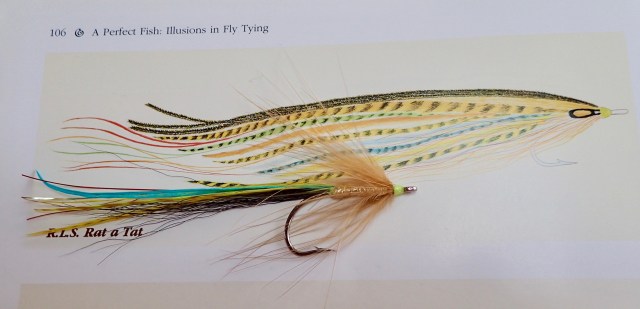
Eight-feather flatwing: Ken Abrames’ R.L.S. Rat a Tat

I’ve been eyeballing the RLS Rat a Tat in the back of A Perfect Fish for about as long as I’ve owned the book. At first I didn’t really know what to make of this pattern. Over the years, its energy grew on me. Finally, this winter, I found the saddles I needed to tie it. Ken described the Rat a Tat’s genesis this way: “That’s a fly I designed just to irritate fish. It’s the kind of a fly that will get a reaction strike.”

I’ll be sure to hold on tight.

Ken once told me that he sometimes includes yellow elements in a fly to indicate the presence of fat, so this should make a fine greasy baitfish pattern (think herring or menhaden). Note how naturally the jungle cock nail integrates with the random black of the grizzly. Lots of magic going on here.

Ken Abrames’ R.L.S. Rat a Tat. This tie is about 11″ long.

OLYMPUS DIGITAL CAMERA

Hook: Eagle Claw 253
Thread: Chartreuse 6/0
Platform: Black
Pillow: Chartreuse dubbing
Support: Chartreuse neck hackle
Tail: First, a yellow grizzly saddle, second, a chartreuse saddle, third, 2 red Flashabou, fourth, a turquoise grizzly saddle, fifth, a light blue saddle, sixth, 2 gold Flashabou, seventh, yellow grizzly saddle, eighth, a ginger saddle, ninth, 2 emerald green Flashabou, tenth, a fluorescent green grizzly saddle, eleventh, 2 red Flashabou, twelfth, a yellow grizzly saddle
Body: Gold braid
Collar: Bucktail, ginger, bottom and both sides.
Wing: Bucktail, yellow
Cheeks: Bucktail, 3 hairs each turquoise, orange, chartreuse, dark blue and emerald green
Topping: Seven strands of peacock here
Eyes: Jungle cock

~

A closer look at the zebra-like tail section reveals great gobs of grizzly goodness.

OLYMPUS DIGITAL CAMERA