I don’t care how good an angler you are: sooner or later, you are going to make a mistake on the water. Sometimes you pay. Others, you still inherit the forune. On this morning, I got a little lucky.
It was another session dedicated to the nymphing cause. I hadn’t been doing any serious nymphing since there was ice along the river’s edge, and it felt good to be returning to my fly fishing roots. The first spot I visited was a blank. I fished it hard for 45 minutes, then decided to head upriver.
Another ten minutes without a take. Then down went the indicator. And this is where I messed up. I had been repeatedly reminding myself, “set downstream.” So what’d I do? I set upstream, as Eric M so eloquently expressed it, “instinctively doing the wrong thing.” Almost immediately, I corrected with a hard downstream set. Thus begineth the battle. I could see I had something good after his first impressive clear-the-water-by-a-few-body-lengths aerial, followed by one desperately ugly surface somersault. All worthy of fresh chrome. Eyeballing aside, I can always tell I have a good fish when I have an “I think I may be snagged on the bottom” moment. Then I feel that dampened head shake sensation as the fish yields to the pressure. This cantankerous creature did not want to come to net. After several runs and a short walk downstream, he was in.
Another fish that clearly has been in the river for some time: wide pink banding, perfectly formed paddle tail, and just look at those fins. Fat, healthy, and powerful — he’s been eating well. A measurement placed it just a bit shy of the 20″ mark. No complaints here.
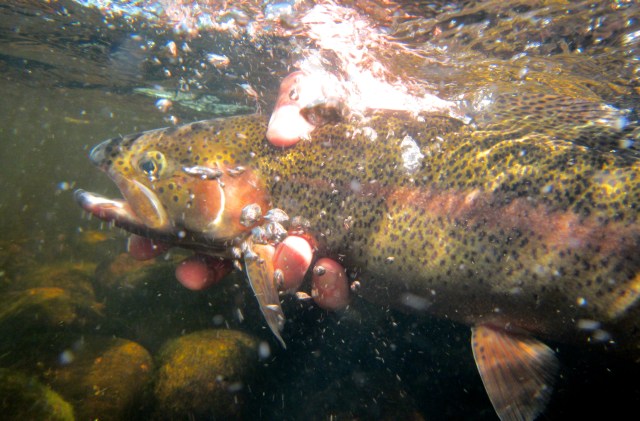
A few minutes later, I landed his younger brother. Then a wild brown. Spot C, another classic nymphing hole, delivered a few more wild browns. As the sun edged past its noon zenith, I fished Spot D, a collection of current seams (oh, that phrase), pockets, plunges and runs. Another brown, and then what I believe to be a brown/Atlantic salmon hybrid*. I am not exaggerating when I tell you this guy made head high aerials. (That is correct. Plural.) I figured rainbow, because of its color and acrobatics, but when I got it to hand it looked — well, different. Damn me, I didn’t think to get a picture.
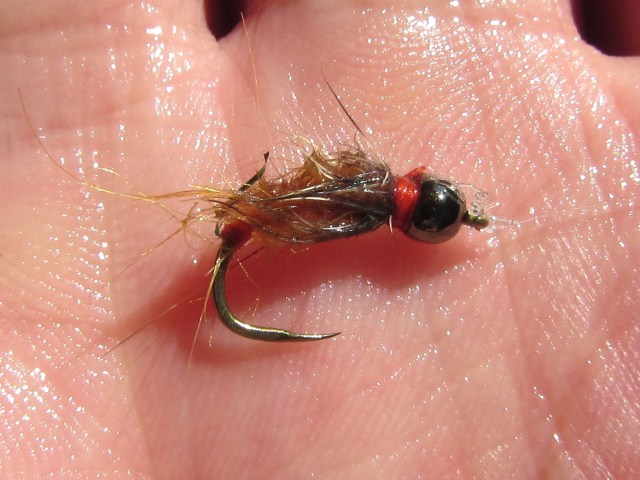
Here’s what was most fascinating to me today: I fished a two fly nymph rig with a size 12 bead head Squirrel and Ginger on point and a size 14 soft-hackle Pheasant Tail top dropper. The fish took both flies — but with one exception, all the wild browns took the soft-hackle. Again, some very subtle takes on the soft-hackle — almost like the indicator stalls for a microsecond. Set, and I was on.
The rainbows found the size 12 bead head Squirrel and Ginger to their liking.
*In conversations with DEEP Fisheries biologists, they’ve revealed that they think some of the more precocious Atlantics canoodle with browns. I believe this is the second such offspring I’ve caught.



 currentseams.com