Farmington River Report 8/6/14: Follow the Heinie Trail

It seemed stupid to spend close to two hours driving to fish for only seventy-five minutes. But I did it anyway.

I turned my attentions to a snotty section of the lower river. At 510 cfs it was a challenging wade. I didn’t bring my thermometer, but it felt about 65 degrees at index finger depth. Not bad for early afternoon on a sunny day in August.

This year, the wet fly fishing has been slower than usual for me. I think some of it has to do with the elevated flows. I probably should be doing more nymphing. At least the trout are happy. I fished size 12 Squirrel and Ginger on top dropper, a sz 12 Drowned Ant in the middle, and a size 12 soft-hackleBHPT (tungsten bead) on point. I had several raps from those pesky JV salmon; I landed one of them. What a tub of fish flesh. Almost perch-shaped. I dropped a brown who was hiding behind a rock with a dopey reaction hook set. The one brown that came to hand was wild and in the foot-long class. He was quite exuberant in his reluctance to come to net.

That one fish was just enough to cover my lack of good judgement.

Classy litterers only leave premium cans behind. This says, “I’m not just a rude, ill-bred person; I’m a rude, ill-bred person with exceptional taste.” 

IMG_2295


Someone enjoying a snack in the cool shade of the tree-lined riverbank.

IMG_2300


Currentseams Q&A: Multi-fly striper rigs

Q: Just wondering how you rig to balance strength on the dropper and still allow movement in the fly?  Blood knot with a long tag?  Or surgeons knot with a long tag towards the tippet end? What do you think your hook-up ratio is for the front fly versus the trailing dropper?

A: I think you’re referring to a tandem rig; when I fish multiple flies for stripers, it’s usually a team of three. I build all my multi-fly teams with 20, 25, or 30# Worldwide Sportsman camo mono. The mono size depends on where I’m fishing and what flies I’m using. For example, crystal clear water or small flies would have me leaning toward 20. If I’m feeling lazy, I’ll use a triple surgeon’s knot to form the droppers. If I suspect larger fish may be in the mix, I’ll use a double uni knot. I had a “bad” experience many years ago with a school of high 30s bass — if I hooked two, the bottom fish would pull the triple surgeon’s knot right out from the top dropper. Now, if I’m targeting larger stripers, I go with a single fly.

If I am fishing multiple baits ( i.e. grass shrimp, peanut bunker, silverside) the fly that gets eaten most is usually the one that most closely matches the naturals the fish are feeding on, regardless of position. One night a small peanut bunker fly saved my bacon. It happened to be the middle dropper. It still worked when I re-rigged with a single fly.

If I know what bait is present, I’ll hedge my bets. This June I fished two small grass shrimp droppers with a small clam worm on point. The water was infested with grass shrimp. 3/4s of the bass I caught came on the shrimp patterns.

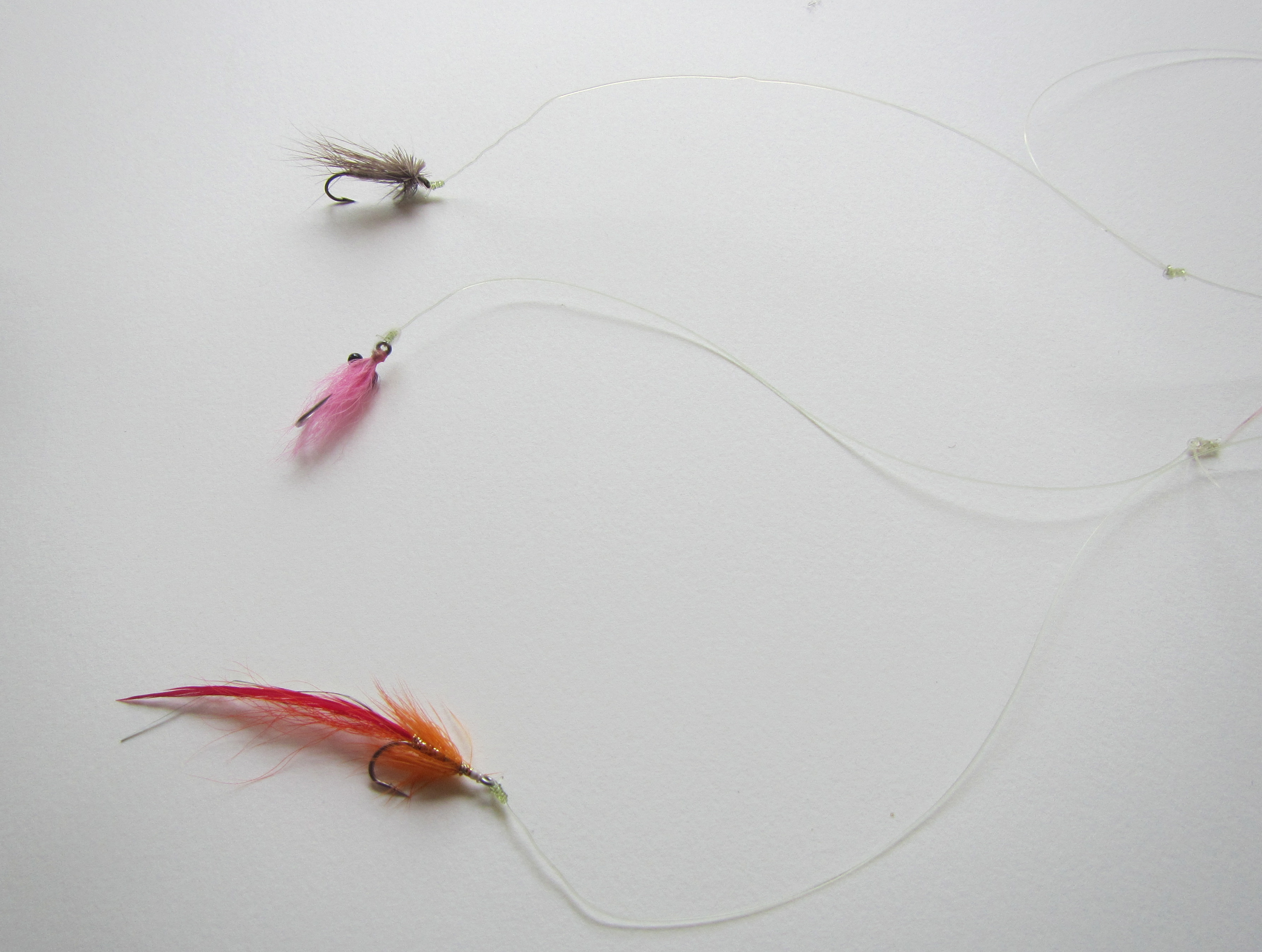
My three-fly team from early June 2014, top to bottom: Grease Liner variant, pink Crazy Charlie, Orange Ruthless. The bass liked all three flies. These tags are about 5-6″ long.

Striper ShrimpDropper Rig

In early July, small sand eels were on the menu. I rigged a dropper system of two sparse sand eels suspended between a corkie and a Gurgler. This setup was fished in barely any current at a dead drift. Even though the bass were keyed on the sand eels, I still took one on the Gurgler (the point fly) while it was just sitting there.

This Golden Knight is tied on a small freshwater hook, but on an Atlantic salmon hook, it’s the kind of fly that I like to have when I’m fishing multiple sand eel patterns.

Sparse Golden Knight

Farmington River Report 7/31/14: Saving the best for last

I have to confess there are times when I am completely flummoxed by this river and its residents. Like last night.

I arrived on the upper TMA at 5:45pm, committed to the dry fly cause, cane rod and 14-foot leader ready. Here’s what I was dealing with over the next couple hours: trout feeding on caddis emergers. Trout rising delicately to something very small. Trout slashing violently on the surface, breaking the film and leaving an air bubble. Trout taking sulphur and March Brown duns off the top. All of it rather haphazard, with no consistency to the rise forms or even with specific fish feeding. In one thirty second period, five fish would rise. Then nothing for the next fifteen minutes. Random would be a good word.

So I took a kitchen sink approach to fly selection. Small Magic Fly. Big Cahills. Small Cahills. Small caddis emergers. Small ants. All I had to show for it was a bunch of refusals and a JV Salmon on the Magic Fly. So I made a plan: as darkness fell, the trout would get sloppy. A size 12 Light Cahill would do the trick.

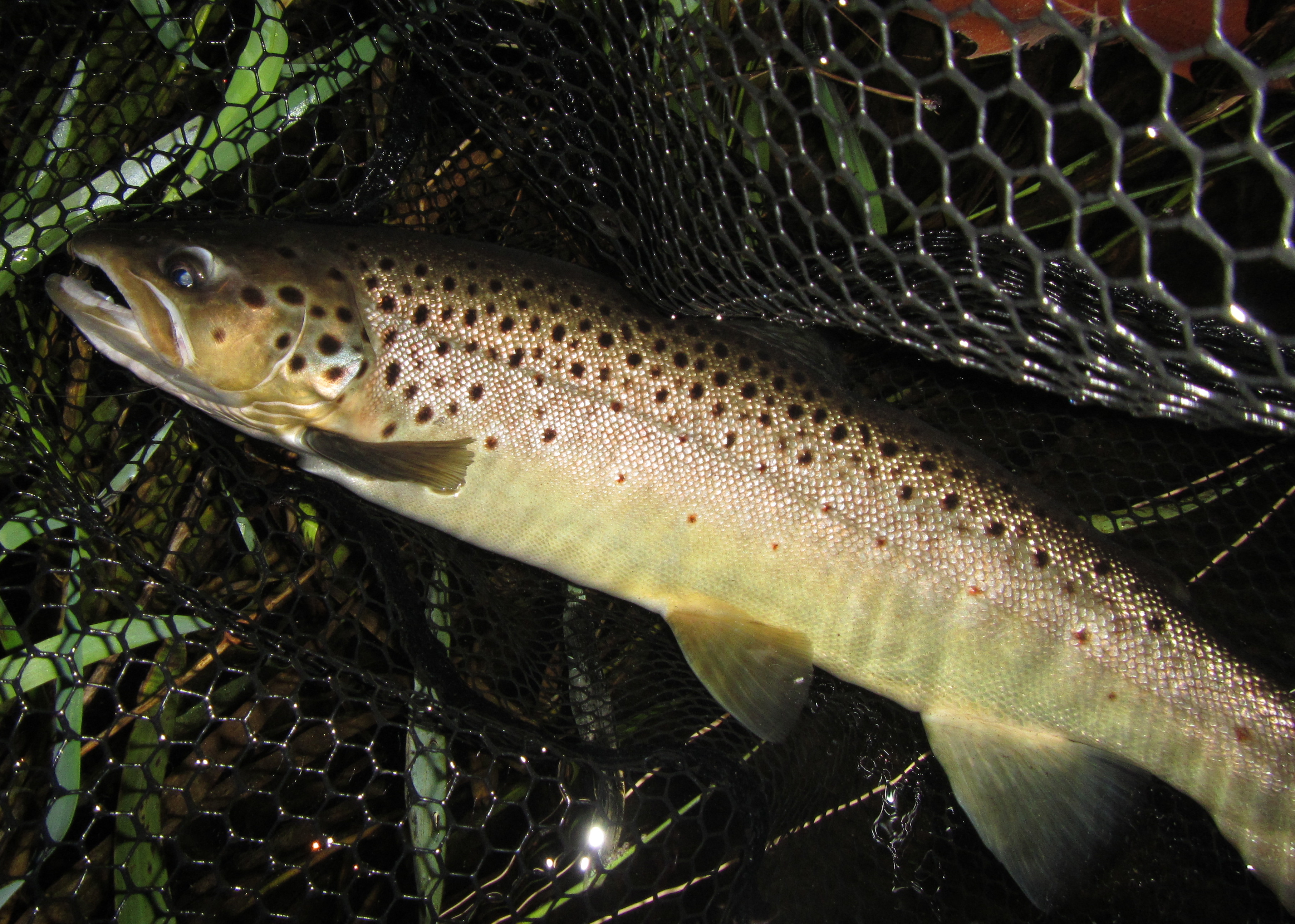
And that’s how I managed to cross paths with this handsome fellow, a wild brown in the high teens  who gave me a thrilling battle on the click-and-pawl South Bend:

Dry Brown 7:14


I stuck a few more of his friends even after it was too dark to see the fly. Then celebrated with a cheeseburger from Five Guys.

River notes: upper TMA 475 cfs. Golden stones (about a size 14) came out at nightfall. Water running cool and clear.