“What?”
That was my wife’s response, delivered with no small amount of incredulity – or was it sympathy – when I told her I was going fishing tonight. I really couldn’t blame her. After all, I had been traveling home from Florida all day. Now it was evening, and I was on the phone with her, calling on a New Haven-bound Amtrak from Manhattan. I wouldn’t be home for another two hours, and then it’d be another two hours before I could leave.
But, you get to used to the oddball treatment from people who don’t obsess over tide times, heights, moons, and river levels like you do. Even if you’re married to them.
I hadn’t fished in over a week, so I had it bad for some stripers. Tonight would be a perfect night for the five weight rod. Not too windy, and the prospect of a striper in the 15 pound class. I attached a fresh 30-pound test leader about eight feet long to the line, then tied on a Herr Blue flatwing about eleven inches long from nose to flash. Everything looked just right.
Not even a nighttime roadwork traffic jam could slow my spirits. I ended up getting my spot ten minutes late. So what? The fish would still be around.
The current on the outgoing tide was moving at a slow walking pace. In what little ambient light there was, I could see the intricate cake-frosting swirls of the eddies as they passed over the hidden bottom structure. I tried to guess the water temperature with my index finger. 58? 62? The thermometer said 59 degrees. Not a bad couple guesses.
I began by working a deep little run between the rocks. Herring swirled near the surface right in front of me. I tried a few dead drifts, almost like high-stick nymphing, but there were no strikes. So I began to methodically walk down-current, greased line swinging the whole way.
The fish in this section of river tend to hit on or about my second mend, but forty minutes had gone by without a tap. The drill was comforting. Cast. Immediately throw an upstream mend. Then another. Let the fly swing around. Swim, pulse, and dance it in the current. A few short strips, then let it fall back. Even fishless, the presentation was pleasant and meditative. A glance at my watch showed it was well into the wee hours, and I was out here all by myself.
Except for her.
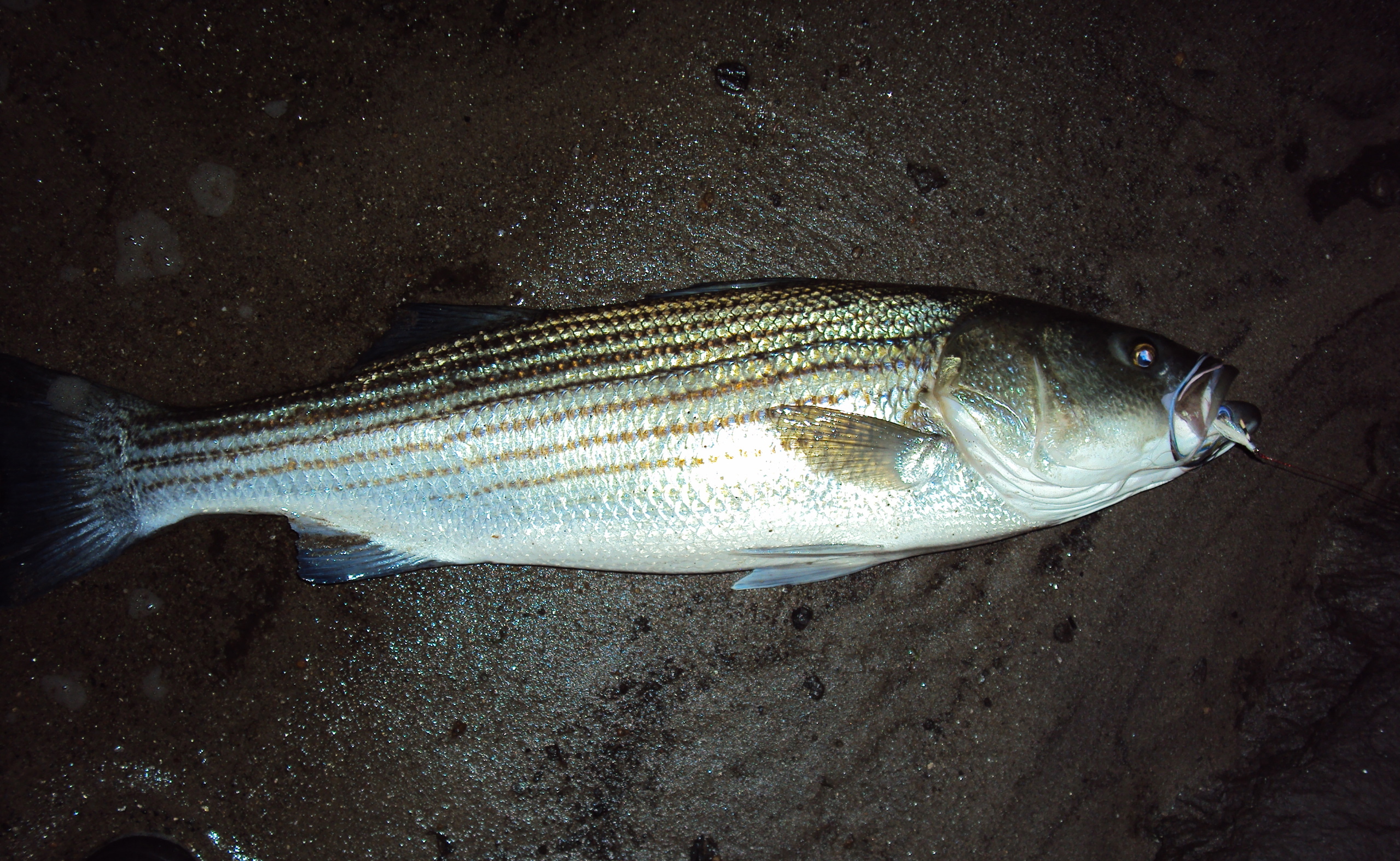
She took the fly as they often do on the greased line, slowly, with full confidence, inhaling the Herr Blue near the head, then turning back toward the bottom. I felt it as a sudden change in pressure on the line. Subtle, nuanced, yet distinctive from the unimpeded drift. No demonstrative WHACK! No explosion on the membrane between water and air. Not yet. I came fully tight to the line with a backward thrusting motion. The hook point found its seat in the corner of her mouth. Right where it was supposed to be.
Now she becomes unhinged, tail thrashing at the surface. At first, I’m unsure how large the striper is, and I under-guesstimate her to be in the 24”class. She’s moving toward me, and I’m hand stripping her in. Once she reaches the edge of the sand bar and discovers she no longer has the comfort of depth to rely on, she lets me know that hand stripping will be ill-advised. The fish begins her first run, taking the slack line out of my shooting basket through my thumb and forefinger at a jerky, frantic pace.
The drag protests as more line is peeled off. I ratchet things down a little tighter, and that stops her. Just to be sure, I re-set the hook. Line is regained, lost, and regained. She’s tantalizingly close now, about twenty feet out, but not quite finished.
Her last defense is her undoing. To escape the shallows of the sand bar I’m standing on, she heads for the deepest nearby water, which happens to be upstream. Between the current and the pressure I put on her, she tires quickly.
As I cradle her in the water, I wonder how many herring she’d eaten that night? Our time is all too brief together, not only the fight, but the release as well. I don’t have her in the revival position for more than a few seconds before she thrusts out of my hands and melts away from the beam of my headlamp into the darkness.
I climbed into bed around 4am. The birds were singing. I was, too. All the way home.
Miss Piggy poses for posterity. “Dang,” she’s thinking, “I really thought that was a herring.” For perspective, the fly, a Herr Blue flatwing, is about 11″ long.
A close-up of the Herr Blue flatwing.

This piece was written in May, 2012, and originally appeared in several online fishing forums.

 currentseams.com