This article originally appeared in the July 2013 issue of the Mid Atlantic Fly Fishing Guide under the title “A Good Night For The Five-Weight.” Many thanks to MAFFG for allowing me to share it here. Those of you who are familiar with how I fly fish for stripers know that I often fish like other people don’t — or won’t. Fewer things get my adrenaline pumping stronger than the thought of using my five-weight to present a ten inch-long herring flatwing to striped bass that might be best measured in pounds.
When I tell people I like to fish for stripers with a five-weight rod, I get a lot of strange looks. Some of their comments are even more pointed.
“Oh, your poor rod!”
“Doesn’t that void your warranty?”
“You’re only stressing the fish and adding to the mortality rate.”
I can’t say I blame them. Ours is the culture of the nine-weight rod for stripers, and deviations from that norm are looked at with jaundiced eyes. Their reactions stem from fear – and the unknown. I know, because when I first thought about using my five-weight for stripers, I was terrified that I would break my rod. And that I wouldn’t have the first clue about how to play and land a big striper on such tackle. As it turns out, our 32nd President was right. The only thing I had to fear was fear itself.
All five-weights are not created equal.
Before you head out, make sure you’re using the right tool for the job. My striper five-weight is a nine-foot, fast-action blank, flexible in the tip and stiff in the butt. It is a beautiful beast of a five-weight. I can upline the rod, and easily cast larger flies up to 12 inches long – as well as dropper rigs of three flies. The stout butt section gives me the power to battle bigger bass (I’ve taken fish up to 33 inches) and turn them, even in swift moon-tide currents. I never feel under-gunned, and my only complaint with the rod is that it doesn’t have a fighting butt. Many rod makers put fighting butts on their six-weight models, so you may want to look into one of those.
You could use a lower weight rod – I know an angler in Rhode Island who loves his three-weight for stripers – or a slower action stick if that’s your preference. Many things are possible with unconventional tackle for the adventurous angler. And it’s not limited to striped bass. Do an internet search for the short film, “Salar, The Leaper” to see Lee Wulff land a 12-pound Atlantic salmon on a 6-foot, 1 ¾-ounce midge rod.
Don’t be afraid to upline.
If you’re going to catch stripers on lighter tackle, you’re going to have to break a few rules. One of them involves uplining, also known as overlining. When you upline, you use a line weight that is greater than the one specified for the rod. This is often the source of great consternation among purists on internet forums, but have no fear: the casting police have no real power over you. Besides, stripers don’t care what line you use with what rod.
Why upline? In two words: Comfort. Necessity. I use a line that allows me to effortlessly load the rod with one false cast, and to overcome the air resistance of a large flatwing or dropper rig of three flies. The line that mates perfectly with my rod and slower casting style is a nine-weight, weight forward integrated shooting taper. The head length is 37.5 feet, and it sports a hefty weight of 375 grains.
As an angler who puts a premium on presentation, my preference is for floating lines. But you should use whatever kind of line works best for you. If you can, it’s a good idea to try different lines with your rod before you buy. When you find the one that makes your rod sing, you’ll know it.
When I upline my five-weight, even long flies like this 11-inch Herr Blue flatwing are easy to cast.
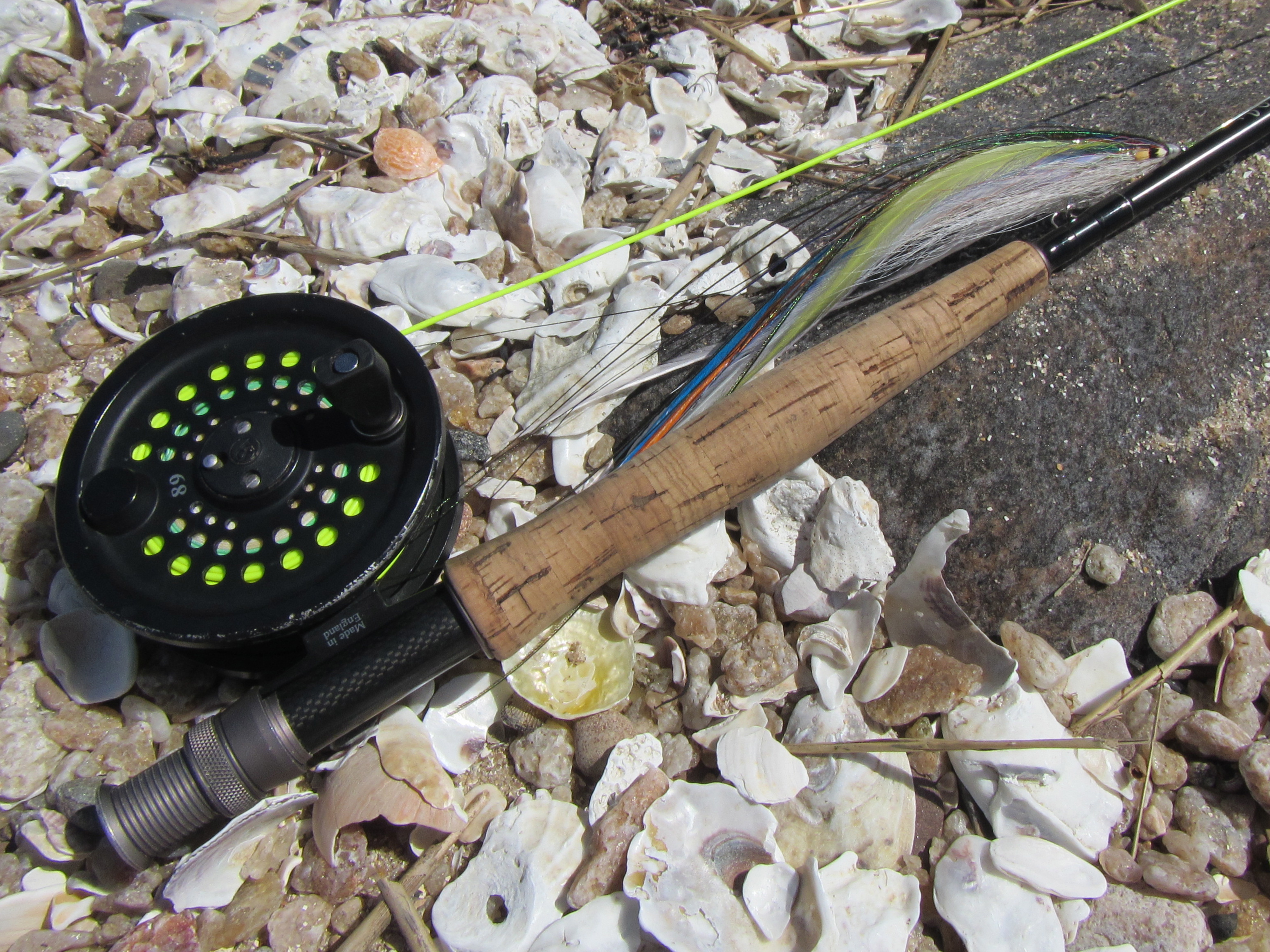
The beauty of a good reel and a stout leader.
School bass in the 12 to 20 inch range are terrific fun on a five-weight rod, especially in current. You can easily hand-strip those fish in. However, once you get into keeper-size territory (28 inches in my home state of Connecticut), you’ll appreciate having a reel with a reliable drag. That’s because you fight those bigger fish with the butt of the rod and the reel – not the tip.
That’s where a strong leader system comes into play. My typical leader is 7 ½ feet of 30-pound monofilament – more than enough to handle any striper I’m likely to hook from the shore. If you consider striped bass to be a precious resource, you want to make sure you don’t overplay the fish. Once you hook a striper, the combination of a 30-pound leader and your reel puts you squarely in charge of the situation.
Fighting bigger bass on lighter tackle.
Many anglers wax poetic about how a powerful striper took them into their backing. It makes for good storytelling, but I’d rather not have the fish take that much line. I like to ratchet the drag down tight, especially when I’m fishing with my five-weight. In fact, I’ve never seen my backing with that rod, even on chubby, well-fed bass up to 15 pounds.
Here’s a typical fight scenario. I’m presenting a big flatwing on the greased line swing. Suddenly, I feel a build of pressure – the bass taking the fly into its mouth – then the water erupts as the fish turns and realizes it is hooked. I can tell it’s a bass over 28 inches from the size of the boil and the power of the initial thrashing. I come tight to the fish by quickly reeling in the slack from my shooting basket, or letting the fish take the line through my fingers.
At that point, the striper may begin its first run. But sometimes there’s a quick grace period where the bass will sulk in the current. I use that time to my advantage by re-setting the hook. I point the rod and line straight at the fish, and, with my arms outstretched, give one or two hard thrusts straight back toward my gut (now you see why I like 30-pound test). That fish is now well hooked. From this point on, she’ll be fighting a losing battle.
There’s another good reason for re-setting the hook. Stripers have tough, rubbery mouths. Many years ago, I lost several substantial fish due to poor hook sets. Since I added this simple arrow to my quiver, I have not lost a single fish over 28 inches.
Once I’ve re-set the hook, I’ll play the fish with my rod held somewhere between a 30 and 45-degree angle. Remember, on lighter tackle your power comes from the bottom one-third of your rod. You want to feel the fight not at the rod tip, but down in your hands. There is absolutely no loss of sport with this technique. A good fish in current will put a tremendous bend in your five-weight. The battles are exhilarating, and will test your tactical know-how as well as your physical abilities.
If the bass is holding in the current, I’ll start to reel. When the fish wants to run, I’ll let her, because she’s not going very far with that tight drag. What’s more, her runs will burn a tremendous amount of oxygen, tiring her out and making her easier to land. Most of the bigger stripers I’ve caught are good for a couple long runs, maybe another shorter one once I bring the fish into the shallows. But by then, the fish is beaten, and my goal is to get the striper to hand, remove the fly, and send her off on her merry way.
This keeper striper fell for the charms of a Rock Island flatwing, fished on a greased line swing.

Those who practice catch-and-release – and I’m one of them – have a responsibility to land the fish as quickly as possible, regardless of tackle. I’ve seen plenty of anglers with traditional striper rods overplay sub-legal bass to the point of near death. If it’s taking you more than a few seconds to revive a striper you’ve just fought on lighter tackle, you need to work on getting that fish to hand quicker. A.H.E. Wood wrote that he expected his rod to earn its keep. Do likewise. Don’t be afraid to push your five-weight. It’s a lot stronger than you think.
When and where to use lighter tackle for stripers.
Of course, you can fish your five-weight any time you like. But there are certain places where lighter tackle shines, like sheltered estuaries and salt marshes; back bays; salt ponds; and harbors. For me, the determining factors are: How far do I need to cast? Do I have limited room behind me? What’s the wind doing? Are waves an issue? It helps to look at these not as independent variables, but rather in conjunction with one another.
For example, if the wind is blowing at 15 knots in my face, I might still take the five-weight if I’m heading to a well-lit dock where the bass will literally be right at my feet. If my destination is a wide river mouth where I will be making casts well over 50 feet, I’ll be taking my big two-hander instead. Same call if my plans include the outside of a breachway or a beachfront with surf over three feet. Fishing is supposed to be fun, and fishing with the wrong tackle for the conditions is a sure path toward a miserable outing.
If you upline your rod with a weight-forward shooting taper, you can still cast a fair distance with just a little line in the air. This makes your five-weight a great choice for fishing in areas loaded with obstructions. One of my favorite spots for the five-weight is dock that is cluttered with overhead wires, light poles, and assorted wooden structures. There’s no room to get off a big back cast – but it’s not an issue because I can load my rod with less than thirty feet of line. Similarly, I fish a breachway between two salt ponds where a standard back cast would hit the rock seawall directly behind me. My setup allows me to easily get my fly out where it needs to be.
Consider bringing a landing net if you’ll be fishing off a dock. School bass under 18 inches are easy to heft out of the water. A twelve pounder, not so much. Some docks are several feet above the waterline, especially on an ebb tide. A landing net will make life easier for you – and your fish.
Sheltered estuaries like this one coursing through a marsh are ideal places for lighter tackle.

Tripping the light fantastic.
The best way to learn the nuances of any fly fishing setup is to go out and fish with it. Nothing beats time on the water. Start with smaller school bass until you get your sea legs. In time, you’ll have the confidence to take on stripers you never dreamed were possible on lighter tackle. And the time will come when you’ll land a bass that will be measured in pounds, not inches.
That’s when a good night for the five-weight becomes a great one.


 currentseams.com